Archive for September, 2009

Why is bubble wrap so good?

30 September 2009

2601498908_bd8aba83e7_b

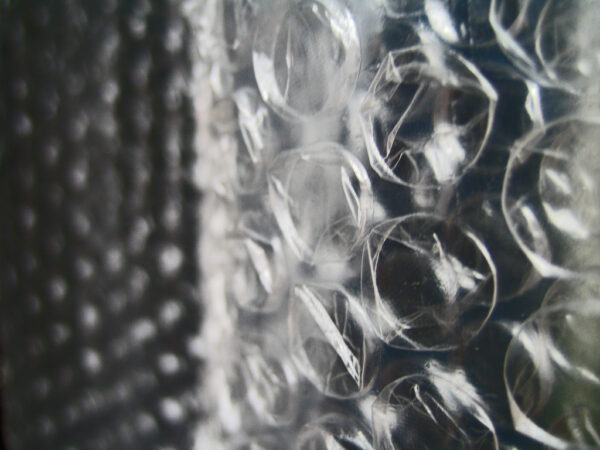
Every now and then I have a look to see what search terms are bringing new visitors to the site. It’s always interesting to see how people find the site and what topics readers are most curious about. My favorite among the search queries of the past month is “Why is bubble wrap so good?” bringing people to this earlier post I wrote exploring the subject.

It delights me that there are others out there who wonder why bubble wrap (or rainbows or cupcakes or fireworks) bring us joy. These questions may seem unimportant in the face of all we are confronting at the moment, but they speak to profound curiosities about our human nature and our world, curiosities that are no less important for being about what creates pleasure than about what helps avoid pain.

Re-reading the earlier post, I think my answer is still the same, but I’d add two things. First, bubble wrap has a certain amount of magic to it because it contains air in a permanent way, in contrast to all the bubbles of natural world. Bubble in water float to the surface, bubbles in air pop, bubbles trapped in ice eventually melt. So bubble wrap makes the elusive air bubble tangible in a way that seems mundane but is actually quite magical.

The other thing I would say is that it also has something to do with sensory immersion. Bubble wrap has a unique tactile sensation, and it’s also an aural experience. This richness contrasts with many materials which have expected textures and that don’t “speak” to us. Bubble wrap could be an even richer sensory experience, and in fact there’s at least one person out there who intends to make it so. Check out this genius patent I found for scented bubble wrap. It’s like the love child of bubble wrap and the scratch ‘n sniff sticker.

And finally, here’s a fun bubble wrap fact: did you know that it was an accidental innovation? The inventors were actually trying to create a new kind of easy-to-clean wallpaper! Thankfully, the experiment went awry and the world’s most joyful packing material was born.

Image: Feeline
Original post

Aromatic graffiti

30 September 2009

scent_graffiti

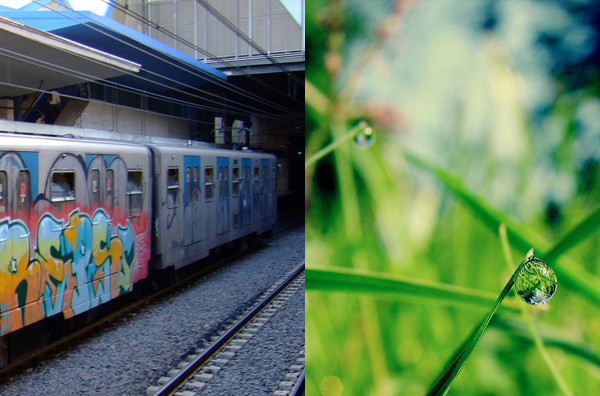
I love non-traditional street art. Yarnbombing, seedbombing, mossbombing, LED throwies — anything that brightens and transforms the urban environment really brings me a sense of joy.

So this scent graffiti by Mitchell Heinrich really charms me. Scent is a particularly interesting medium for several reasons. Heinrich says:

Scent is interpreted by the limbic system which is very closely tied to emotion and memory. This leads me to believe that interacting with people using scent can potentially be a much more powerful medium than paint since people experiencing it can’t help but react to it. The goal of this project is to realize the potential of smell as art and to explore different ways of using it to interact with people.

True, but this is only part of the story. Scent requires proximity in a way that vision does not. Visual understanding is nearly immediate once something enters our eyeline. But scent is based on the diffusion of volatile chemicals through the environment, so it reaches us in a more gradual way. It’s like vision is a sudden downpour and scent is a slowly increasing drizzle. So the quality of the surprise achieved is fundamentally different.

Also, in a chat I had a few weeks ago with Dr. Pamela Dalton at the Monell Chemical Senses Center, I learned one of the most important factors in scent processing is context. Many scents occur in multiple contexts. One example is butyric acid, a molecule that in some situations we recognize as aged cheese, and in others we recoil from as the odor of sweaty feet. Without realizing it, we constantly use contextual information to interpret scents and determine how to react emotionally to them. This fact creates some interesting possibilities for scent art. By taking scents strongly identified with a particular context — say cut grass or baking cookies — and pairing them with urban contexts that have a strong associated odor, the effect could be quite dazzling and dislocating. It could also work the other way, creating a powerful negative emotional response. But either way, it likely would cause to reflect on the environment more mundane sensory stimuli as well, and develop a clearer picture of how those make us feel.

Scent graffiti is also fleeting, and that transience is appealing. So often graffiti is not about destruction but about reclamation: the desire to form some kind of personal relationship with the anonymously-designed city that contains and constrains us. To shape this looming environment in some small way. The evanescence of aroma allows for continually shifting scent-images to alter the city, allowing a constant redesign and rediscovery of public space.

Here’s a link to an instructable on how to create your own scent spray cans. Images: attack the darkness and circulating.

{via PSFK}

Joyful craft: Quilts of Gee’s Bend

29 September 2009

geesbend

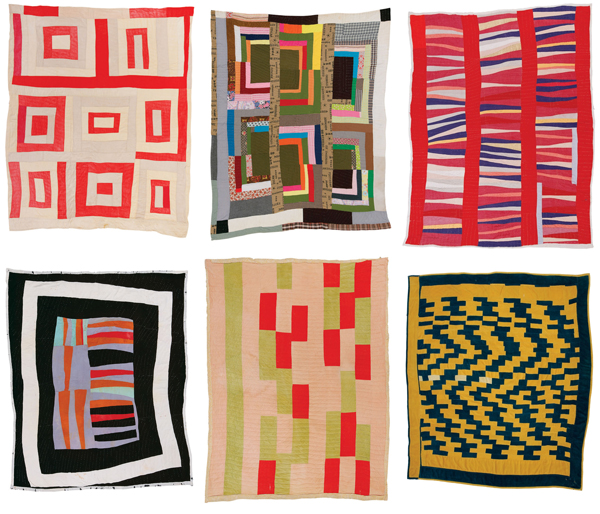
Today I’m in the studio working on models for the product component of my thesis. I’m surrounded by color and fabric and it reminded me of the distinctive color blocks in the quilts of Gee’s Bend, which I’ve loved since I discovered them on a set of U.S. stamps a few years back.

Gee’s Bend has a great history. You can read about the quiltmakers here and see a catalog of some of the most famous quilts here. There are also a number of books available as well. It’s very inspiring to see a historically modest women’s craft elevated to the level of art by a community of talented craftspeople.

Quilting is a joyful art form. Not just the color and the softness of the textiles, but also the integration of memory in tangible form. Quilts often use fabric from special occasions or the clothing of children after they’ve grown up. They’re traditionally made by hand and often given as gifts. The quilters of Gee’s Bend take this rich history and unselfconsciously interpret it in a very bold and modern way.

q057-03b_jpg

q140-03b_jpg

q030-06_jpg

Magic plants

29 September 2009

boskke2

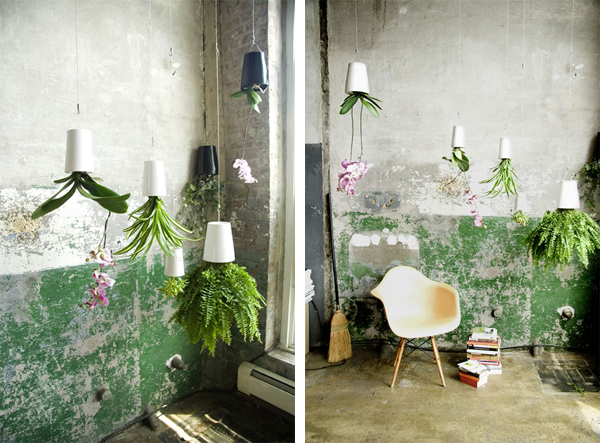
Defying the laws of gravity, the Boskke sky planter makes ordinary houseplants into magical specimens. Oddly joyful!

{via Oh Joy!}

boskke1

I must say I like bright colours

28 September 2009

jenkins_1-1

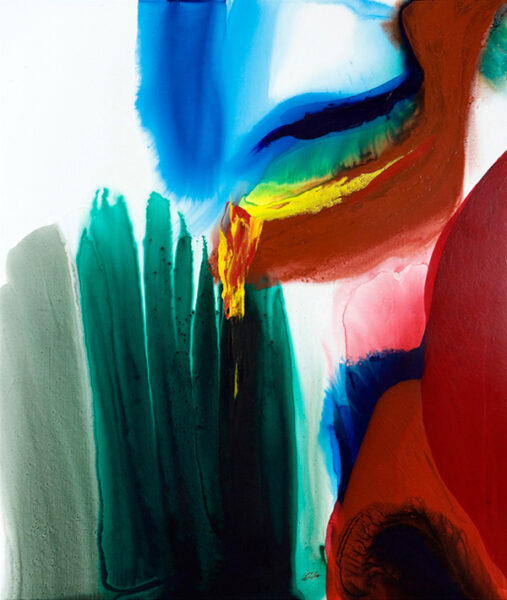
I must say I like bright colours. I cannot pretend to feel impartial about the colours. I rejoice with the brilliant ones, and am genuinely sorry for the poor browns. When I get to heaven, I mean to spend a considerable portion of my first million years in painting, and so get to the bottom of the subject. But then I shall require a still gayer palette than I get here below. I expect orange and vermillion will be the darkest, dullest colours upon it, and beyond them will be a whole range of wonderful new colours which will delight the celestial eye.

Winston Churchill

Art by Paul Jenkins, via But does it float. Quote via Kay Redfield Jamison’s Exuberance.

Invisible dogs

28 September 2009

invisible_dogs3

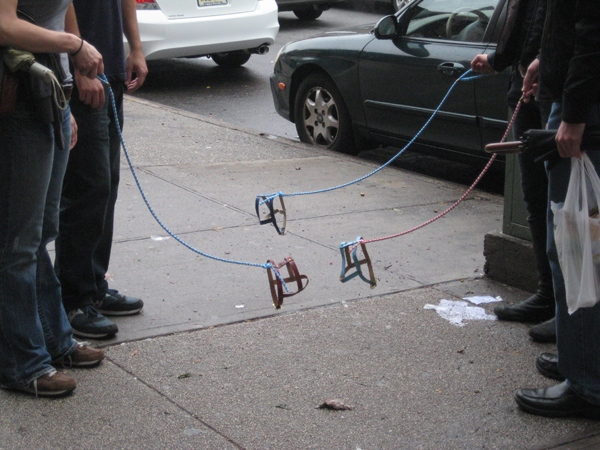
If you were out and about in Carroll Gardens yesterday, you could have been forgiven for thinking there was something mysterious afflicting the canine population of the neighborhood. But it wasn’t exactly clear who were the ones affected: the dogs or their owners.

Everywhere you went on Smith and Court Sts. you could find dozens of people carrying invisible dog leashes, pretending with great self-conviction to be walking their dogs. Dog walkers would stop and chat with each other about their dogs’ names and breeds, ages and habits. Walking past, you might overhear, as I did:

Dogwalker 1: Ugh, Buster, don’t sniff his butt!

Dogwalker 2: Oh, it’s ok. It’s what dogs do.

Just a normal dog owners’ conversation. Except there were obviously no dogs. As I passed a group, one woman wielded her leash in my direction, as if her invisible dog had come over to sniff my groceries, then grappled with the air as if trying to rein him in. I saw others break their gaits down the street as their invisible charges paused to water a tree, and one particularly zealous owner bent down with an invisible plastic bag (one hopes) to pick up an invisible poop.

It was all very ridiculous, and I couldn’t help but smile, though others seemed to be vexed by the odd behavior. I think when odd things happen, people like to know why, and the dog walkers stubbornly refused to acknowledge anything strange about their behavior even after much questioning. Rumors started to fly. One man at the farmer’s market told me it was some sort of protest against a new dog law. Another said it was to encourage adoption from shelters. But it turns out it was a good old flash mob, put on by well-known pranksters Improv Everywhere. Apparently the leashes came from Invisible Dog on Bergen, a gallery that occupies a former invisible dog leash factory.

Even being a spectator who wasn’t in on the joke, I have to say I thought it was fun. Times are tough, and we all need a little silliness in our lives. Improv Everywhere says their mission is to cause “scenes of chaos and joy in public places.” It’s interesting to think of chaos and joy together. Chaos is often associated with lack of control and unhappiness, but that lack of control can also go the other direction and bring delight. More photos and first hand accounts from dog walkers here.

invisible_dogs2

invisible_dogs1

Aesthetics of joy or eyesore? happy roses

28 September 2009

happy_roses

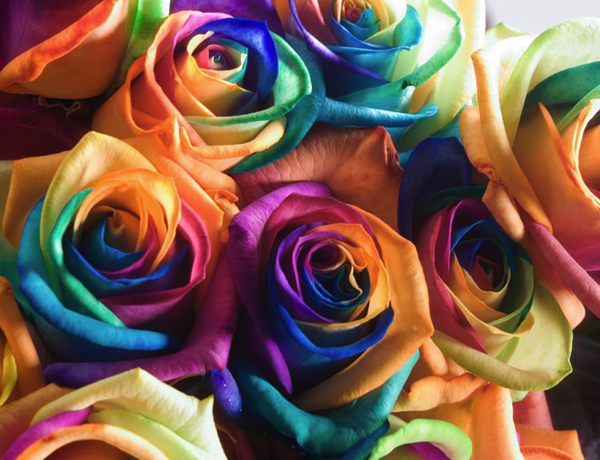
A friend sent me this link to a company selling these strange, multicolored “happy roses.” They’re presumably made by dye absorption, which you may have tried in a lower school science experiment with a couple of carnations and a few drops of blue food dye. (If you’re so inclined, directions are here.) The company says,

The Happy Rose is unique due to its rich and exuberant colour combination and the special colouring technique that lies hidden behind this. One look at this cheerful rose and you will feel happy.

Is it happy? Or just tacky?

On the one hand, bright color is associated with joy, so perhaps it’s as simple as: more color = more joy. And the “coloring process” is certainly magical, illuminating a normally hidden aspect of plant construction. But at the same time there’s something unappealing about the artifice of it.

Aesthetics of joy has an odd tension here. The brightest colors are rare in nature, so when we find them, they’re often in synthetic materials like paints and plastics. But joy also embraces the aesthetics of unfettered nature: the exuberant wildness and wonderful mystery of nature’s accidental creative process. Sometimes our interventions in nature produce great joy. I’m thinking of Samuel Francois’s charming tree art or Carol Hummel’s whimsical knits. You could also look at earthwork, like Jim Denevan’s sand paintings or Maya Lin’s Wave Field, as this type of joyful intervention.

I wonder if it has something to do with proportion. All of the artists I just mentioned seem to work with a great reverence for nature. Nature is their canvas and regardless of the scale of their efforts, it is the dominant element in their compositions. If anything, their work serves to call our attention to nature’s beauty, not to mask it. These “happy roses” walk the line for me. Some of those colors are deliciously intense, but I think their frenetic application obscures the natural form of the flower too much. I lose the beauty of the circular gesture and the bouquet becomes a collection of random ruffles.

All of this is an attempt to parse rationally what is a reflexive, visceral response for me. I vote eyesore. What do you think?

Thank you @_MattMorris for the link and inspiration for this post

Aesthetics of play: simplicity

26 September 2009

3246577594_44e386acb7_o

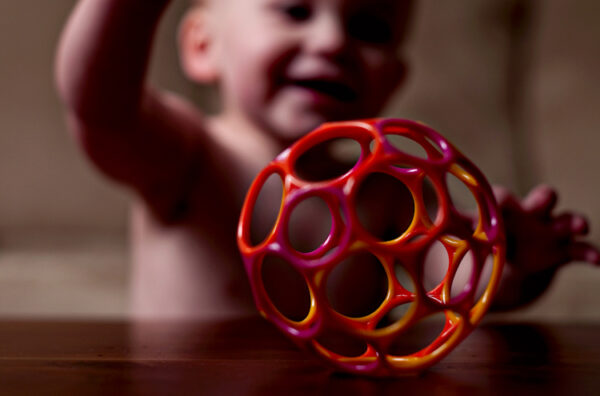
Toys suck. Well, not all toys, but many of the new ones. You play with them once and then you’ve figured it out, and there’s no more pleasure to be had from the experience. Designer Dror Benshetrit says of experiences like this, “Toys with quick and linear paths to gratification have less longevity,” and I think he’s spot on. Ironically, the simpler a toy is, the less simple the experience. If you watch a child play with a stick or a ball or a cardboard box, you see the hours of enjoyment that come from manipulating these very basic forms in a variety of ways. Because of their simplicity, they don’t indicate an outcome. Instead, they provide points of departure for many different kinds of play. In imaginative play, they become props for an array of fantasies. In physical play, they become obstacles or building blocks. In social play, they are transformed by the interplay of ideas and decisions made by a group.

It occurs to me that this idea of non-linear play experiences connects back to my earlier post on circles and roundness as an aesthetic of play. If you think about it, the ability to come back to a toy repeatedly and continue to get value out of the experience is a cyclical process, and cycles are just a temporal version of a circle. So good play involves not just circles in form, space, and movement, but also time.

Simplicity gets sabotaged by the greedy designer. Says Harry Allen,

I worry that in our desire to sell toys to children, we do too much of the work for them. Toy designers have all the fun and leave little to the child’s imagination. One quickly tires of overly designed toys, but one never tires of one’s own ideas.

It’s an interesting notion: that toy designers are naturally those who like to play, and sometimes get overzealous in that process, keeping too much of the fun for themselves and overdefining the experience. To me, Puzzibits are a perfect example of that excessive design. I was excited when I first saw them because I love all kinds of building toys — Legos, blocks, and my absolute favorite, Tinkertoys. I loved the idea of Puzzibits because their rubbery material means that they’re flexible, an exciting twist that opens up the possibility of creating organic forms. But the reality just doesn’t meet the promise.

The flatness of the pieces means that they lend themselves most readily to 2D creations, which is fine, but not as exciting as the 3D forms. This is a problem of affordances. Affordance is a design-y word for the possibilities that are designed into an object or space; they are the ways in which form dictates function. Doorknobs and handles present a really good example of affordances that Donald Norman uses in his book The Design of Everyday Things. A round doorknob affords turning. A vertical handle affords pulling. A long horizontal bar affords pushing. You know if you’ve ever tried to pull a “push” door how frustrating it can be when the affordances of the design don’t match the intended action. In designing utilitarian objects, the goal is usually to constrain the affordances so that it’s clear how the object is to be used. A door that needs a sign that says “Pull” means that the form is not doing the work it should to make it clear how it’s supposed to be opened. “Pull” is effectively a one-word instruction manual for a door, an object so simple it should never need one.

With toys, the goal is the opposite: affordances should be as broad as possible. The more ways a toy can be manipulated, the more possibilities it engenders. Too few affordances, and the usage becomes linear and finite, which is what happens with Puzzibits. The rigidity of the attachment points means the pieces have to be connected in a coplanar way. That simple choice of connector design makes it very easy to achieve 2D compositions and very difficult to create 3D ones. The designers solve that problem with a manual. If a manual is undesirable in a functional item, it’s positively deadly in a toy. Manuals are not fun. Using them consists of following directions, and directions are nearly always linear in nature, prescribing an outcome. In this case, the manual shows constructions like animals or vehicles that can be built (prescribed outcomes). But even when the suggested outcomes are inspiring, the creation of those things requires such a dull, one foot in front of the other process that it’s like putting together IKEA furniture. On the other hand, free play with the toy is so constricted by the narrow affordances that it’s impossible to make any satisfying new discoveries.

This idea of new discoveries is so essential to what play’s all about. It’s about opening ourselves up to the unexpected, and that can only happen when the ending isn’t written into the form of the toy. Simpler forms lend themselves better to complex possibilities because less of their story is already written, leaving more for the players to create themselves. We know classic toys have a deep resonance that continues into adulthood. It also continues for generation after generation of children who discover the same pleasure that their parents and grandparents felt at interacting with these simple objects. It’s not nostalgia that embeds these toys into our psyches, but rather this aesthetic of simplicity that allows us to infuse them with personal meaning.

It’s a good principle, not just for toy design, but for emotional design of all kinds. Leaving room for the customization, interaction, and play by designing in an open-ended way allows users to write their own stories around their objects and relate in deeper, more personal ways. When it comes to aesthetics of joy, in some cases, less is definitely more.

Image: Ivan M

Paul Smith + Evian, redux

25 September 2009

Today I have guest post up on Brandchannel about the Paul Smith + Evian collaboration. I did a short post here about this earlier in the week but hadn’t really formulated an opinion about it yet. I’ve been turning it over in my mind all week and trying to figure out exactly why I find this to be such a striking and significant partnership, despite the blasé reception it’s had from the blogs.

You can read my take over on Brandchannel, but the gist of it is that I think it represents a remarkable shift in aesthetic values for bottled water, and an interesting example of an emergent tendency towards aesthetics of joy being used in a premium context.

I also think water’s blankness makes its packaging a particularly interesting cultural barometer. Water is the ultimate commodity. Product differentiation is nearly nonexistent, so the packaging become the prominent driver of the story. Because of this, water packaging trends tell us a lot about the underlying cultural mood. That mood right now is hungry for some relief from the strictures of responsibility that come from our down economy and damaged environment. It’s not a desire to shrug off that responsibility entirely, but for moments of joy that give us a bit of release, lightheartedness, and hope.

I find the video has a twang of insincerity when Smith talks about his long history of drinking Evian. Designers do things for the money every day; I’d rather that tacit understanding than a disingenuous justification. Nonetheless, it has some beautiful words from him on the design and his inspirations. I particularly like the way he says, “My whole life is about being childlike. Not childish. Childlike.” It’s an approach that obviously really resonates with me.

Happy Friday, and have a great weekend!

Xx Ingrid

Designers on classic toys

25 September 2009

toys

I’m working on another aesthetics of play post to cap off the week (the one about interaction and affordances that I promised earlier) but it’s taking a little long to get fully baked, so in the meantime, check out this amazing set of interviews with prominent designers about their favorite childhood toys.

The snippets are short and feature Michael Bierut talking about matchbox cars, Rob Walker waxing poetic about balloons, Harry Allen reminiscing about Play-Doh, Chris Hacker musing about Lincoln Logs, and many others. It’s hard not to be moved or just inspired to play when reading these evocative stories about the relationships kids have with their playthings, and how these relationships have helped them evolve into the adults they have become.

via ID magazine