Archive for November, 2009

Laundry gnome

30 November 2009

laundry_gnome

Weirdest thing.

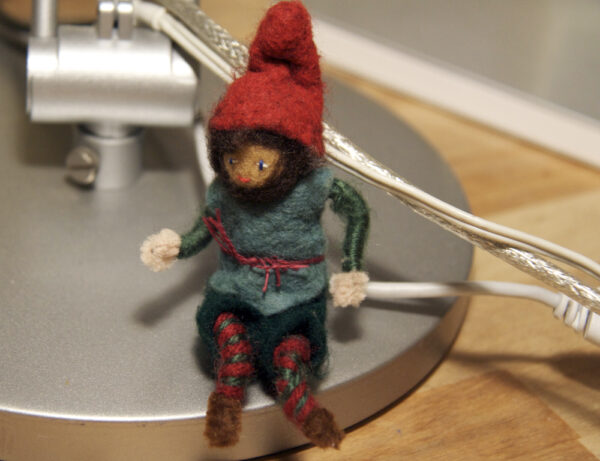
The other day when my laundry came back, I opened the bag and started to put away my clothes, and there in amongst the hand towels I discovered this little guy. A hitchhiker! He was just sitting there, hanging out, as if it made all the sense in the world that he should be there. To be honest, it was kind of creepy at first. An unexplained intrusion into my mundane evening, with vaguely magical undertones.

I had to figure out how he got there. I wondered if maybe he was a gift from the laundromat, a holiday thank you for my business. But when I called to ask, the woman had no idea what I was talking about. (Not a normal query, granted: “An elf. In my laundry. Did you put it there?”) As far as I could tell, she thought I had received someone else’s garment by accident and she asked me to return it next time.

So he must have arrived by accident. I looked it him more closely. Cute gnome. He’s made out of beautiful felt and pipecleaners and wool yarn. He doesn’t look like he’s been through the laundry — so it’s not one of those situations where he got stuck in the lint filter like a sock and emerged in the next load. It’s a mystery.

What’s wonderful — and for me, joyful — about this kind of mystery is that while I know there’s a rational explanation for the gnome’s appearance, it’s hidden from me. The gnome is felt and yarn and wire — it’s made of matter and must obey the laws of physics. Wherever it came from, it had to take a tangible path to get here. Perhaps it fell out of a crafter’s purse or pocket while she was shifting her sheets from washer to dryer, adhered to the laundress’s sleeve by static cling, and made its way into my bag. But I don’t know that story — no one does — and for me the gnome’s past is a giant ellipsis. This would be a nonstarter if the item were a sock or a teddy bear. But it’s an object that takes a form with a built-in magical narrative. Gnomes, elves, fairies are the stuff of myth and lore. If anything has a plausible reason for mysterious behavior, the gnome is it. The gnome roams, as we learn in Amelie and those Travelocity commercials — it appears in places, without taking a journey to get there. Just like my gnome. In a way, it’s a silly and trivial happening. But I wanted to share it because I think it provides an interesting example of the alignment between magical narratives and magical aesthetics.

For the meantime, I’ve decided to keep him. When I was working at Landor in Sydney, my coworkers and I used to joke when we were overwhelmed that we needed a magic gnome to handle the extra work. Well, right now I have ten days until I present my research on Aesthetics of Joy for the first time, and there are lots of loose ends to tie up. I could use a magic gnome. As my mom says, sometimes things find us. And right now, my gnome just makes me feel like the mysteries of the universe are working in my favor!

*** Please bear with me if posts are sparse over the next two weeks as I complete this last leg of my masters. I will be back in force come December 14th, with lots of photos of my latest joy-inspired furniture pieces and many thoughts I’ve been saving up to post. Thanks for reading!

xx Ingrid

100 colors, 100 writings, 100 days

25 November 2009

100days

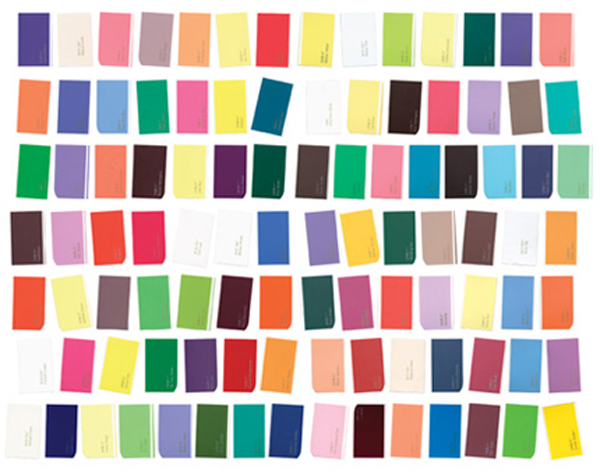
Wonderful project by Rachel Berger. Every day for 100 days she chose a color swatch at random from a bag, and wrote a short piece (like a prose haiku) inspired by it. I love how it exposes all the random connections that color and language form in our tangled brains. There are the aesthetics of joy in the world, but then there are also the aesthetics of joy inside us — embedded in the network in our neurons, the experiences of our cells, the sensations still living on our fingertips, and the pattern of thrills that has shaken our bones. Sometimes it can be hard to access them, but then a chance encounter with a color, aroma, or evocative sound can bring them right back to the surface of the now.

{via DesignObserver}

I’m taking a holiday from the blog this long weekend to focus on last-minute details for the thesis. Happy Thanksgiving, and see you Monday!

xx Ingrid

Fela!

24 November 2009

queen8

Yesterday “Stripes!” and today “Fela!”  This might be the week of exclamation point titles. They’re the most joyful punctuation, and with all the work and so little sleep, I’m getting a little punchy. Perhaps tomorrow I’ll write about those bushmen whose name has the ! at the beginning, the !Kung, and then finish the week out with some Lichtenstein paintings!

Please, don’t mind me. Sleep deprivation makes me giddy. (!)

But back to the order of the day, which is a short note about Fela! the musical, a biopic about the legendary founder of the Afrobeat genre of music Fela Kuti, which has just moved to the Eugene O’Neill from Off-Broadway. My friend Maggie scored free tickets to the Saturday night preview show and I just could not stay at home with the laptop with that on offer. It would not have been the joyful thing to do.

I arrived flustered and let’s just be honest, more than a little cranky. I left light as a feather. What happened in between? Music, of course — Fela’s soul-stirring, body-shaking sounds, brought to life by Antibalas, a Brooklyn Afrobeat band, charismatic lead Sahr Ngaujah and the sensational Lillias White. Dancing — not just by men who seem born in motion and women whose bodies seem to be all hips and no spine, but by you too, every last gangly uncoordinated one of you. And the color and energy of costumes that are positively kinetic in their vibrancy.

I couldn’t help but dig up a little history. This video shows Fela in concert — his songs were known to run 20 minutes or longer — so you can get a feel for the music and the joyous performance style if you aren’t familiar with it.

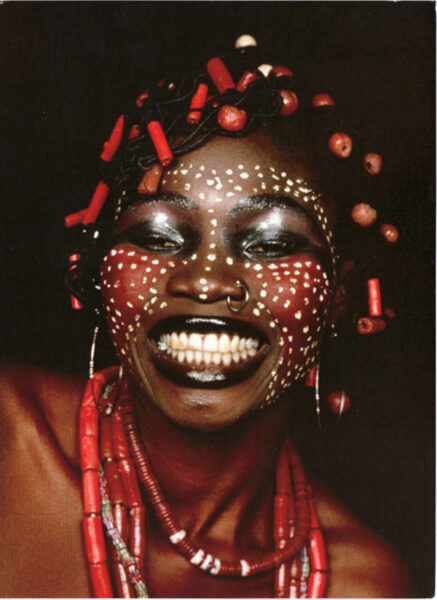
On the revolutionary music blog Revolucion, No you can find lots more about Kuti’s music, as well as these great images of his “queens,” the women who were his dancers and also his wives. These really give you a sense of the gorgeous energy that inspired Marina Draghici’s wonderful costumes and sets.

queen3

queen1

queen18

The translation from history to real life is so vivid, so immersive, that you can’t help but feel that you’re in a completely different world for a few hours. You’re certainly a long way from Broadway!

Read the NYT review: Making Music Mightier Than the Sword
See images of the sets and costumes from the show
Get tickets here

Stripes!

20 November 2009

rebecca_ward

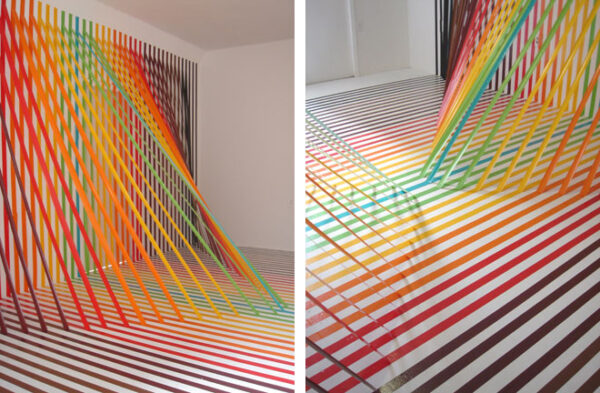
I love how the stripes feel like they’re coming to life in these colorful tape installations by artist Rebecca Ward.

{via @design_sponge}

Optimism, redux

20 November 2009

IMG_5713.JPG

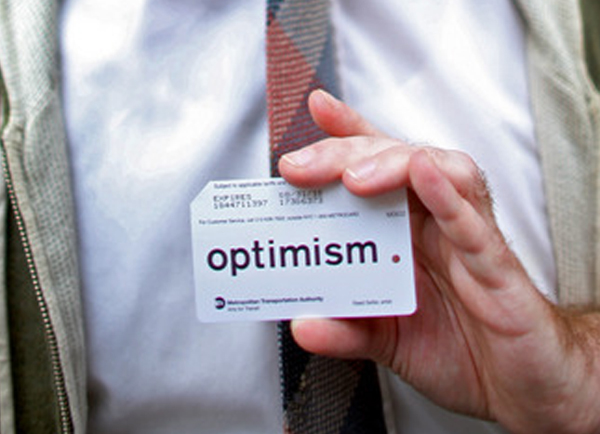
Remember these? I found one lying (improperly) discarded on a subway platform back in September and labeled it “joyful litter.” Now, the NYT explains: it’s a public art project by artist Reed Seifer.

Read more, here.

{via @swissmiss}

Color wheel pick-me-up

19 November 2009

498848417_1889e12fb4_o

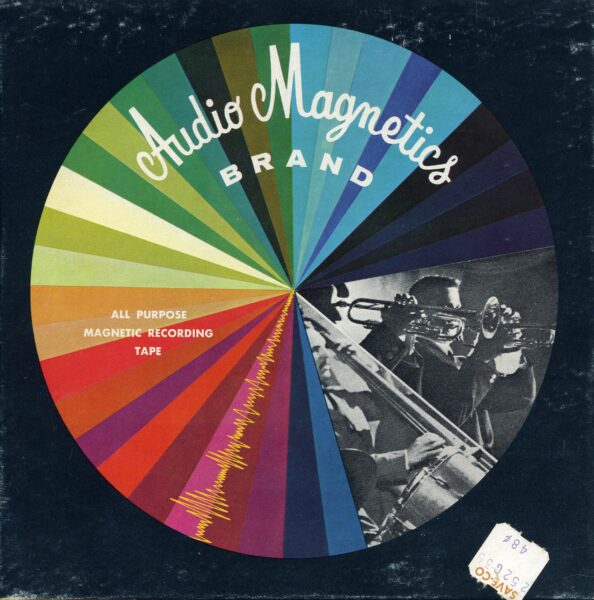
I’ve been saving up these color wheels for just such a gray fall day as this one. I present my thesis just 3 weeks from tomorrow, and while daylight is short the workdays are definitely getting long. Of course, it does help that the work I’m doing is so upbeat and colorful. Just looking at happy images has powerful unconscious effects on mood, creativity, and energy. These color wheels are like a shot of caffeine to the arm — the perfect late-mid-week boost!

Above, {via}

480809831_26725b747f

1347817742_07ef94c6ab

These thread and quilt color wheels are by my favorite fabric-and-yarn store combo, Purl. They sell fabric bundles to help you recreate the quilt above.

3102520887_0c9ece24cc

Above, lilfishstudios

2880509223_2f8f40ed97

Above, Andy Gilmore, who I first wrote about here.

graffiti_wheel

umbrella-wheel

Don’t have a source on the two above — apologies. If this is you, let me know.

And finally, the toy I’d most like to see under the tree if I were four years old (and if Pottery Barn hadn’t discontinued it):

pb_kids_wheel

Ball is the universal toy!

18 November 2009
The Daily Show With Jon Stewart Mon – Thurs 11p / 10c
Windowless News Van for Kids – The Ball
www.thedailyshow.com
Daily Show
Full Episodes
Political Humor Health Care Crisis

Monday night on the Daily Show, Jon Stewart took the National Toy Hall of Fame to task for waiting so long to induct the ball into its hallowed ranks. In this segment, he rails against the institution for selecting “stick” and “cardboard box” years before the ancient and essential “ball.”

I like that the National Toy Hall of Fame is celebrating simple playthings, not just the latest craze coming out of Mattel and Hasbro’s factories. The truth is that the most stimulating toys are the most open-ended, a point I raised a few months ago in a post on aesthetics of play, and the ball is the most infinitely malleable toy out there. Having a ball means having a game, whether you’re bouncing it against a wall or playing with dozens of others on teams. Surely everyone has a childhood memory of a game they played with a ball where the rules were some imaginative variation on an existing game. My best friend Annie and I invented “pancake-turner ball,” which was a cross between keep-up and tennis played with two spatulas and an over-sized tennis ball.

Like Stewart, it strikes me as ridiculous that it could take so long (11 years!) to get ball into the Toy Hall of Fame. So, congrats Ball, on your long-overdue honor!

Sushi every night

17 November 2009

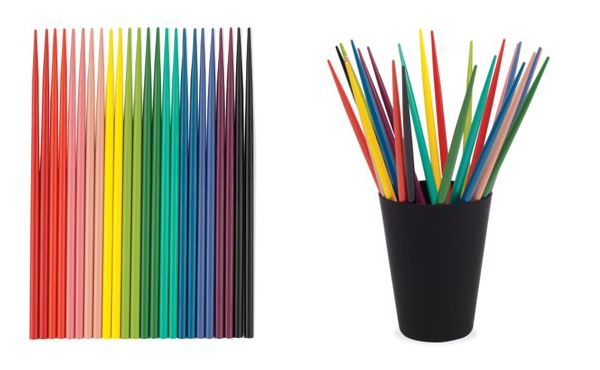
chopsticksIf I had a set of these cheerful chopsticks from DWR Tools For Living, my takeout bill would be steep! Though I guess I could offset the cost with noodle dinners, as these would make even dollar-store ramen into a joyful experience.

This emotional life

16 November 2009

home_v3_101909_bkm

Mark your calendar or set your DVR for January 4th, which is the premiere of an interesting new series from PBS called This Emotional Life. Happiness will be a significant focus of the series, and the interviewees are a fascinating and diverse group: Katie Couric, Richard Gere, Larry David, Chevy Chase, and a slew of scientists and everyday people. The series is hosted by Dan Gilbert, a Harvard psychology professor and author of the excellent book Stumbling on Happiness.

I’m not sure there will be much perspective on the relevance of design to our emotional lives, but there rarely is in these sorts of discussions. They usually focus on a person’s relationship with the self or with others, and almost never focus on the relationships between people, spaces, and things, unless those relationships are negative: materialism, shopaholism, hoarding…. (Of course, I don’t think the focus on people is wrong — things are no substitute for people in the joy equation, and money can’t buy happiness. I only point out that the connection between objects and emotions in a positive way is rarely a focus in the pop science arena.)

But I’ll be watching because I think the topics covered will provide copious opportunities for thinking about emotion and design. Jessica Zucker’s info-packed post on skin and the sense of touch on the series’s website is  a great example of the kind of thinking that gets my mind buzzing with ideas for how to design in a more emotionally positive way.

Watch the trailer here.

Jokes vs. joy

13 November 2009

4033648646_a7a96a6df9_b

I can’t believe I missed these at Halloween. Street artist Diabetik was placing these traffic cones on streets around the DC area.

Here is a great example of something that walks the line between joy and joke, and I think comes out on the side of joy. This is something design wrestles with a lot. A joke is something whose pleasure declines over time, usually sharply. I’m thinking of all those cutensils, the little kitchen cartoons that hang from your faucet or the side of your teacup and were amusing the first time you saw them and now are just kind of annoying. They’re one-liners, and once you’ve gotten the punchline, they become ponderous.

Joy, on the other hand, is something you feel over and over again. It doesn’t get old — often it gets better with time. Joy is carried by aesthetics; it stimulates the senses, not just the funny bone. So even if there is a punchline, as in this case when you make the connection between cone and candy, or the wordplay on cone and corn, there’s a deeper level of sensory pleasure that comes from the aesthetics. If these cones were painted red, orange and turquoise, the joke wouldn’t be there, but you’d still feel a sense of delight at the unexpected hit of color and stripes.

Jokes and joy often come together, and because of this many designers confuse the two. Many designers see humor as a route to joy, but they don’t realize that to embody a joke in material without a reinforcing aesthetic experience is irresponsible. A joke that falls flat on stage harms no one. But a joke injection-molded in plastic, manufactured by underpaid workers in poor conditions, shipped to people all over the world, and discarded the next week or month or year is flat-out criminal. If you want to design jokes, go ahead — but don’t mass-produce them. Make a prototype or a computer model and send it around the web. Show it on YouTube and share it via Twitter. But if you want to design things for people, then make them joyful, or contenting, or stimulating, or awe-inspiring. Make things whose aesthetic properties support the emotional quality you want to evoke, through color, texture, form, density, sound, smell, movement. Before you expend precious matter and energy in the expression of an idea, ask yourself, will it still tickle you ten years from now?

If not, spare a thought about the costs of making it. And think about ways you might design it to be more emotionally durable. Aesthetics of joy is often just about the simple pleasure of these wonderful, renewable experiences. On the blog I like to highlight beautiful, joyful things and talk about why they are so. But at the heart of it all is the idea that through more conscious attention to aesthetics we can move away from one-liners towards these more lasting experiences, away from emotional disposability towards emotional sustainability.

4033651080_2b01ec7663_b

Hello out there

12 November 2009

21_knockmoy_fold

These mystery letters remind me of the ones my best friend Annie and I used to send to each other when we were kids during summers while we were away at camp and visiting relatives. I still keep them in a box and take them out every now and then. The envelopes are covered with stickers and PPPPPPPSs and all sorts of made-up acronyms.

The letters were sent by artists Lenka Clayton and Michael Crowe to all 467 households in the town of Cushendall, Ireland to inspire reaction and discussion. It’s an odd but joyful project, to try to reach out individually to everyone in a community, forging connections between strangers. And the letters themselves are delightful and quirky, each one layered with texture and meaning and no two exactly the same.

{via Neither Snow}

18_dalriada_avenue1

05_cairns_road

07_cairns_road

20_coast_road

Pop!

11 November 2009

4084205504_975572ae38_b

2501680028_71335ea4e8_b

3192920085_70ba332442_b

If you’ve ever wondered what a water balloon looks like right at the instant it pops (don’t you lie awake contemplating this?) — here you go. These photographers clearly have vibrant inner children!

{images: CameraShyMom, A.Connah, herbe_nelson}

Saarinen and the curve

10 November 2009

saarinen_ny600

In this week’s New York magazine, Justin Davidson has a review of the new Eero Saarinen show at the Museum of the City of New York (a wonderful place, so if you’ve never had the opportunity to visit, this might be a good chance). The title of Davidson’s review is “Joy Constructed,” so of course this caught my eye and started me thinking that perhaps Saarinen might represent a counterpoint to the hard-edged, rationalist, emotionally-muted modernism represented by the Bauhaus and the International Style — a truly joyful modernist.

Looking at the swooping railings, ceilings, staircases, and arches in the spread above (from New York magazine), I can’t help but feel uplifted. But why? I’ve previously suggested that curves and round forms have a primal appeal because they are connected with safety. As children we are naturally drawn to objects with non-threatening surfaces, and the more broad and neutral the curve, the more safe and approachable an object is. (No one’s going to cut themselves on a beach ball.)

As it turns out, there’s science to support this idea. In a 2007 study published in the journal Neuropsychologia, researchers demonstrated that angular objects and shapes are perceived as significantly more threatening by the emotional brain. Showing curved and angular variants of the same object (a watch, a pitcher, a candle) and abstract patterns to a group of volunteers resulted in markedly different activity in a part of the brain called the amygdala, which is involved in threat and fear reactions and responds far more quickly than the conscious brain. Angular objects create much more activity in this part of the brain than curved objects. This makes sense in the context of survival within a primitive world — sharp angles are rare in nature, and usually do signal danger, or at least something we should be alert to: teeth, claws, cliff edges, and so on.

Human nature is a funny thing. You can build upon it, channel it, develop it to its greatest potential, but you can’t fight it. I look at the rigid rectilinear solids of modernist construction and I think of them as an attempt to put human nature in a box. To suppress these innate responses. But the unconscious elements within us react whether or not we want them to — they are uncontainable. In thinking of Saarinen, along with Zeisel and Aalto and other modernists who embraced the curve, I see a modernism that runs along the contours of our natural inclinations, an aesthetic that is conducive to joy.

Joy isn’t rational, and it seems fitting that Saarinen would say of his water tower design for GM (below) that it “is a departure from the completely rational.” It’s an unexpected admission for a modernist, and yet a fitting one for a designer who, in Davidson’s words, was spurred on by,  “the dogged pursuit of joy.”

gm-water-tower

Toyota’s flowers

10 November 2009

482268781_49dc6032cf_b

Nice mention of AoJ in this post on Brandchannel about Toyota’s creation of two new flower species that absorb nitrogen oxides and take heat out of the atmosphere. The two flowers, variants of the cherry sage and the gardenia, are planted at Toyota’s headquarters in Japan. Designed to highlight green improvements to Toyota’s manufacturing facilities, the flowers are an interesting marketing move and a great example of a joyful gesture. It may be “joywashing meets greenwashing,” but it’s hard to be skeptical when it just makes you want to smile.

{image: crossmage}

Living wall

9 November 2009

living-wall

There’s little joy in the design of light switches, thermostats, and other utilitarian control devices for the home. The best designs of the genre attempt to make them as minimal and unobtrusive as possible.

This “living wall” takes a different tack, incorporating sensors and switches into a wallpaper that you merely need to run your hand across to control. As the wall’s creators say:

Run your hand across this wallpaper to turn on a lamp, play music, or control your toaster. This interactive wallpaper can be programmed to monitor its environment and control other electronic devices, serving as a beautiful and unobtrusive way to enrich environments with computation. The wallpaper is flat, constructed entirely from paper and paint and can be paired with our paper computing kit whose pieces serve as sensors, lamps, network interfaces, and interactive decorations.

As technology like this becomes increasingly available, some exciting possibilities could open up for designers. Unlike a thermostat that only senses temperature in one part of the house, leaving rooms unevenly heated, a wallpaper with diffused thermosensing could ensure more even (and efficient) heating and cooling. Light sensors could also help to adjust light, so that artificial lights automatically increase as sunlight wanes. Running your hands across the wall to turn on the light just feels more magical, the resultant actions wondrously inexplicable.

The best part is that the living wall is made using simple and inexpensive technologies like conductive and magnetic paint applied to regular paper. So there’s a chance that even the non-millionaires among us could be seeing these in our homes in several years’ time.

More from the high-low tech project at MIT’s Media Lab.

{via PSFK}

Ebullient ethnic

6 November 2009

tina-kalivas-polyrhythms-spring-2009-1

So it’s finally Friday. For real this time. (You’ll have to forgive me — one month out from finishing a masters thesis tends to make all the days look the same!)

These ebullient ethnic print looks from Tina Kalivas’s latest collection really fit my Friday mood, though. All the cutting, folding, and layering transforms the vibrant prints with an effervescent new energy. It’s as if all the tiers and pleats create a third dimension to the patterns, translating their graphics into form, animating them with texture and life. The whole effect is festive, but in a very “celebrate everyday” sort of way.

I hope you’re celebrating something this weekend, aesthetically or otherwise. Happy Friday!

{via Refinery 29}

tina-kalivas-polyrhythms-spring-2009-2

tina-kalivas-polyrhythms-spring-2009-3

tina-kalivas-polyrhythms-spring-2009-4

tina-kalivas-polyrhythms-spring-2009-5

Delicious books

5 November 2009

coralie-bickford-smith-book-designs1

Well, I was going to leave you for the next few days* but then I saw these and I couldn’t wait to put them up. For these Penguin Classics, designed by Coralie Bickford-Smith, I might actually think about violating my multivariate color-coding system.

What is it about gorgeous objects that makes me all synesthetic? I literally want to eat these. I guess, in the end, all aesthetics comes back to survival, food being a big part of that. Whatever the reason, I think these are just delicious.

Also, one the more joyful interviews I’ve read in awhile features Bickford-Smith on the Penguin blog. The image-text format really made me smile.

{via Daily Candy, available on amazon}

*Wow, it’s evidence of the long week I’ve had that I spent this whole morning convinced it was Friday. But, no, it’s still a day away. So there will be at least one new post here tomorrow. Apologies if I confused anybody! xx Ingrid

Kaleidoscope I’s (and A’s and B’s and C’s)

5 November 2009

inpopwetrust

Just a little Friday eye candy. Have a great weekend, and see you next week!

Color Me In by Héctor Sos.

Fun facts

4 November 2009

aug15_640

There’s something joyful about an odd little piece of trivia, especially when endearingly illustrated in such child-like fashion. Learn Something Every Day presents a new fact daily, and you can submit your own facts for Young to sketch up.

aug14_640

september27

aug9_640

Katrin Möller

3 November 2009

km_gemaltes_501

In her own words:

km_in-die-zeit-lebend

What I am trying to express in my work are moments of everything.

km_gemaltes-54

Landscapes, Formations, Light, Smell, Taste…

km_gemaltes_45

But they are not just a reflection of a current feeling or a sudden urge.

km_flussig_3

My paintings are about particles, about the whole or arrangements, they are related, disrupted or intractable, they are left and right, above and below –

km_there_is_no_time

they are everything —

km_flussig_2

For me, Möller’s paintings conflate macro and micro beautifully, reminding us how similar everything looks at extremes of scale. It’s akin to the Eames’s classic film Powers of 10, which transports us through scale shifts of extraordinary proportions. I love how the forms in these paintings could be sea creatures or land masses or sub-cellular structures, but whatever they are they feel vibrant and alive. A wonderful example of how a piece does not need to be riotously colored to invoke joy.

{via but does it float}
quote from here