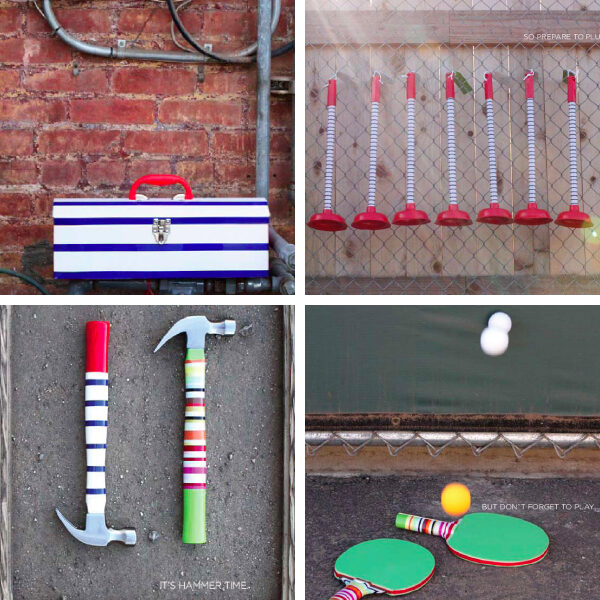
I’m loving these new offerings from the brilliant duo behind quirky housewares company Alice Supply Co. The new nautical color scheme gives the plungers a kind of Dr. Seussian vibe — like the long tail of the Cat in the Hat. The ping-pong paddles are particularly inspired to me. While they don’t fall under the core mandate of housewares, they’re a natural opportunity to add joy to the mundane through color and pattern. Somehow, dressed in stripes, these paddles seem like they should always have looked that way.
Personally, though, the items I’m most coveting are the hammers. If I had a hammer like these, everything would be a nail!
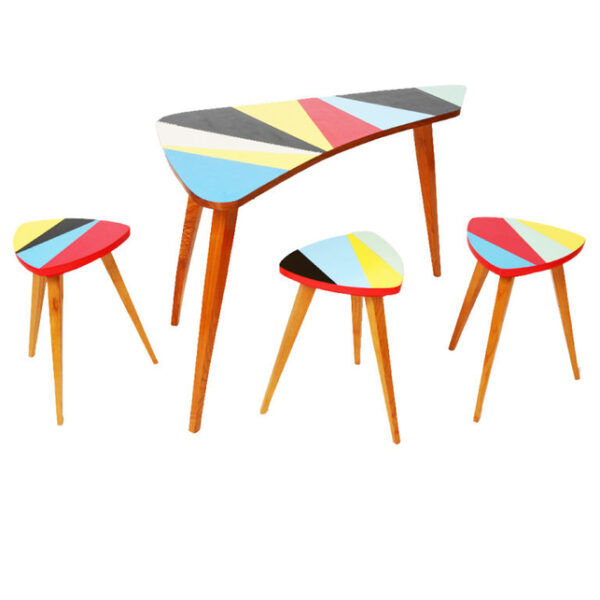
There’s something so delightful to me about this midcentury child’s table and stools set with its colorful wedge-patterned laminate surfaces. I think the splayed tripod legs look kind of anthropomorphic, like an unsteady toddler, which adds a sense of a cuteness to the appeal.
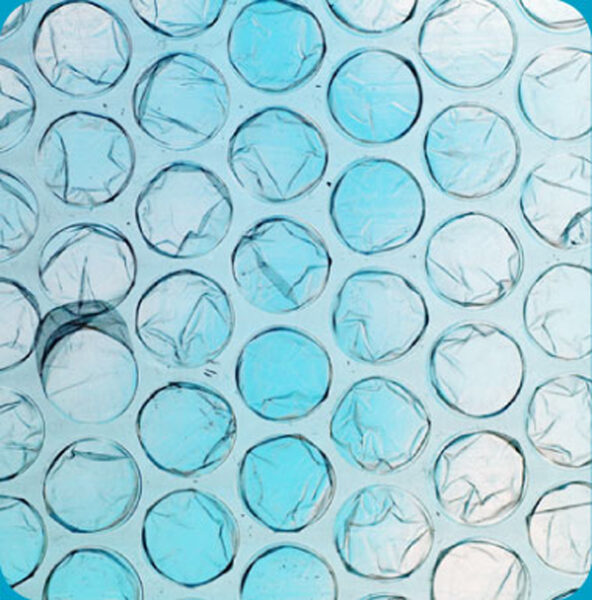
Or live vicariously and feel the delight emanating off the screen from the bubble wrap scene in Wall-E. What does it say about our culture that we we envision such an oddly iconic pleasure as a connection point between two futuristic robots? What timeless part of our psyche does bubble wrap speak to?
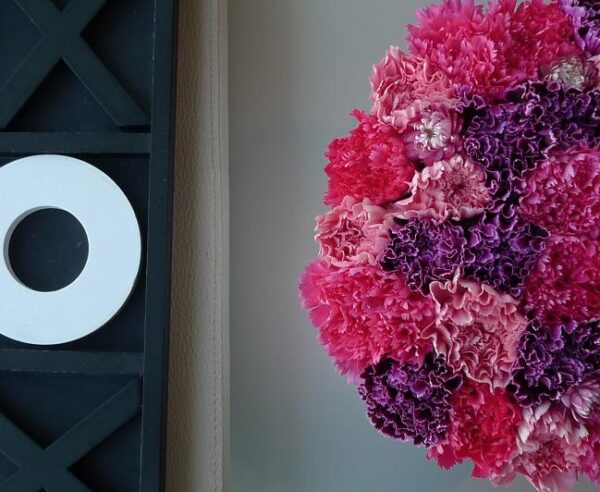
These variegated poufs of carnations are like a gorgeous brand of cheerleaders’ pom-poms. I love how this arrangement makes a prosaic blossom seem so luxurious. They’re so tactile too — you can just imagine how the cool, feathery petals would feel on your hands.
It’s not really lemonade season at the moment, but Seth Godin has a nice little parable on his blog about business and joy as told through the classic child’s first business. One is a garden variety lemonade stand, with the usual reconstituted beverage served for just a dollar in a Dixie cup. The other is run by a little girl making lemonade from scratch for the love of it, offering it for free but leaving a jar for tips. As he describes this second stand,
The whole time that’s she’s squeezing, she’s also talking to you, sharing her insights (and yes, her joy) about the power of lemonade to change your day. It’s a beautiful day and she’s in no real hurry. Lemonade doesn’t hurry, she says. It gets made the right way or not at all. Then she urges you to take a bit less sugar, because it tastes better that way.
….
Finally, once she’s done, you put $5 in the jar, because your free lemonade was worth at least twice that. Well, maybe the lemonade itself was worth $3, but you’d happily pay again for the transaction. It touched you. In fact, it changed you.
I’ve been thinking a lot lately about the transformative power of joy — the way a single moment of delight can shift the course of your mood and your day. A joyful moment can have ripple effects, in the way you treat other people, the things you notice in your environment, the paths you choose to take, the interactions you have with objects and people. Joy can transform space — making it feel more open or more intimate — and it can transform time, shrinking so that your delight spills over its boundaries.
The idea that lemonade could change you sounds silly at first. But in this case lemonade is a conduit for the sharing of joy. It is a craftsperson’s joy distilled into an aesthetic experience for a consumer — to experience, and to pass on.
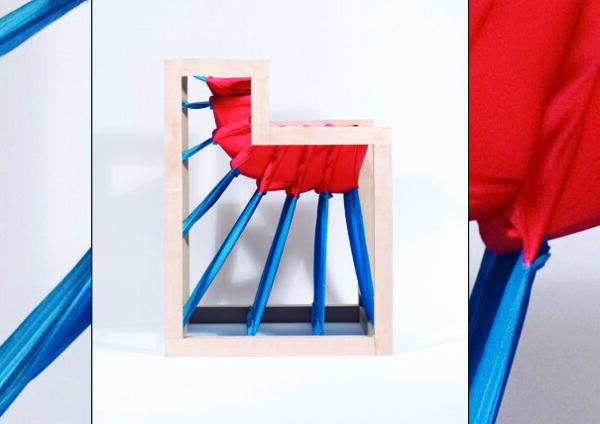
A small note of shameless self-promotion: my Animo kid’s chair is being exhibited at imm Cologne, which runs today through the 24th. The exhibit is part of a collaboration between Pratt and Germany’s Folkwang academy called “Take a Seat.” You can see some of my co-exhibitors here. I’m very excited to have my work showing at this amazing international venue and with such talented designers!
The chair was inspired by watching the way children move: joyfully, experimentally, and totally unselfconsciously. Intended for experimental learning environments such as museums, it supports these healthy movements through a unique system of energy absorption. Based on the tensile balance of a highly elastic material (bungee cords) and an inelastic one (nylon panels), it translates a child’s energy into a dynamic visual display. More info about the chair, including models that show how the mechanism was developed, is here.
Also, I just want to give a public “thank you!” to the amazing John Medley, who fixed the prototype after the tension from the bungee cords bent it out of shape — John definitely saved the day.
On Sunday night I finally saw Avatar. I think I was one of the last people in New York City to do so. I saw it on the Imax at Lincoln Square. I can’t imagine what it would be like on a regular screen or without the 3D, but I’m sure it pales in comparison — just the sheer scale and immersiveness of the experience were dazzling.
There’s so much to say about the joy of this experience, (and also where it fell short), but the most compelling aspect for me is the world James Cameron has created in Pandora. I’m sure I’m not the only one who felt a little bummed to be back in the real world after the film was over, and found the transition from sacred trees to streets a little jarring. It’s a transition from a joyful world to a mundane one, from a place filled with magic and wonder to a city that feels dull and sublunary by comparison. And the difference is all in the aesthetics.
Cameron takes a seemingly ordinary rainforest (already a lush, joyful environment) and imbues it with light, movement, and magic. Everything native to Pandora glows: the trees, the seeds, the mosses, the waters — even the animals. The peculiar luminosity is celestial; the lichens become like a carpet of stars, the tree of life like a cluster of comets. (It kills me, by the way, that I can’t get still images to illustrate these things — evidently the Avatar PR machine is more interested in gunships and battles than the beauty of the setting. Did I miss something? Or wasn’t that just the whole point of the movie?)
Anyway, bioluminescence has long been a source of wonder here on Earth, whether in fireflies or glowworm caves or tropical bays of phosphorescent plankton. But in our world, it’s a rare pleasure, one that many people never experience firsthand. Cameron has taken this joy and scaled it up, creating a world ablaze with ethereal light. Pandora’s light is magical because of its inexplicable beauty — like the earthly bioluminescence it emulates, it operates through chemical light-making processes that seem mystical in contrast to the logical workings of electricity — like a hidden flow of energy.
“A hidden flow of energy” is Cameron’s actual explanation for the bioluminescence in the film. The scientists in the film state that the organisms function like a neural network, all connected to each other symbiotically. This connectedness is another joyful theme, since joy is very much about unity, coming together, and inclusiveness. The aesthetic illustration of this is the bond formed when the Na’vi encounter certain other organisms — the animals they ride to hunt, their mates, or the tree of life. The fusion of the illuminated tendrils calls to mind a kind of neural embrace, where disparate elements craving contact find each other and communicate wordlessly.
These energy flows are magical, and they manifest in other ways besides communication and light. The mountains of Pandora float in midair, like karst formations reflected in still water, and are described to be constantly moving. Creatures float as well. The seeds of the tree of life drift like glowing white-violet jellyfish, giving the impression that Pandora’s atmosphere is rich with this energy, changing its density at will from the thinness of air to the thickness of water. And of course, in the end, (spoiler alert) it’s a mysterious energy flow from the tree of life that saves our hero and Pandora itself.
It’s not just the behavior of organisms, but also their forms that display joyful aesthetics. Cameron uses the lushness of the rainforest, amplified in scale and density, to create a sense of vitality and renewal. He uses lots of spiral and circular forms, such as the small creature that spins on its fan-like wing (a living whirlygig), or the giant spiral-shaped plant that retreats into itself when exposed to touch (no doubt inspired in behavior by the real-world touch-sensitive mimosa). Swooping curves rule in Pandora, whether it’s chalice-like flowers, dangling curls of vines, or the delicate tendrils of the Eywa seeds. Cameron’s artists also play with scale, making some things giant, like the beautiful broad leaves the break the Na’vi’s fall as the leap from the sky, and other things tiny, like the seeds or the spinning creature. All of these are recurring aesthetic motifs in joyful things, both natural and manmade.
Ultimately, it’s these aesthetics of joy that make the Na’vi’s world so mesmerizing, and make us feel that this place is valuable and desperately worth saving. The aesthetics of magic and renewal give an impression that there is salvation for us in this place, not in the (clumsily-named) mineral unobtainium, but in the mystical goodness that underpins such manifest joy. For me, these aesthetics of delight in Pandora’s design do far more than the clunky dialogue and heavy-handed plot to suggest the moral. All of these wonders were inspired by things in our own world. Cameron has said he was inspired to create a bioluminscent Pandora by his experiences night-diving. The rainforest, though perhaps not as fantastical, is still a lush world rich with undiscovered species. Many of the animals on Pandora are hybrids of familiar organisms, like fearsome land-mammal with the rhino body and the hammerhead shark face, which call out these remarkable features — no less remarkable for the fact they occur separately in our world. And science lately is filled with new discoveries about the ways that flora and fauna communicate with each other chemically, much like Pandora’s hidden energy flow.
The more I think about Pandora, the more I think about the beauty of the world that inspired it, which is really the point here. Yes, the technology is a great leap forward, and yes, the 3D experience is revolutionary. But in 5 years this will be common, in 15 it will be primitive. I think the artistic achievement is much greater than the technical one, and more lasting, in the way it abstracts our world away from us, and filters it through a joyful lens, allowing us to discover its rare pleasures anew. Though at first it seems our world is at a disconnect from the magic of Pandora, actually, our world is filled with Pandoran moments, (or Pandora is just an amplification of earthly moments). What is joyful in Pandora is what makes it worth saving, and a good illustration of what makes our own world worth saving too.
I wish I had a fail whale that for AoJ that I could put up right now, but this short missive will have to do. I’ve been working on upgrades to the site for the past week or so (which is why I’ve been so scarce lately) but not all has gone as planned. Please forgive the bugs for the next few days as I get everything worked out!
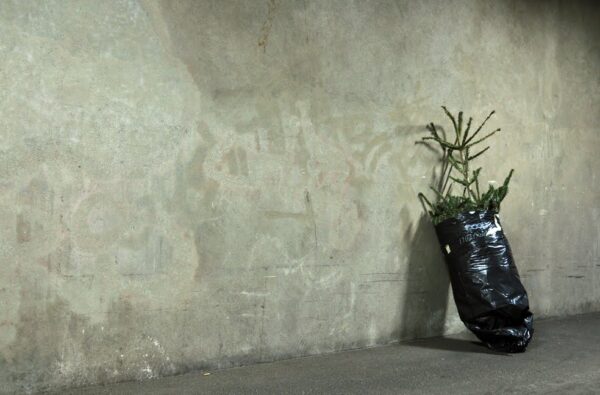
Over the past few days, I’ve been watching as the Christmas trees are put out to pasture on the city streets. For these first few weeks of the new year, it’s like an urban forest has sprung up from the sidewalks, already half-dead and dejected. And it occurs to me that it’s a good example of an object whose emotionality is transformed by context. A Christmas tree in the living room is a festive delight, a beacon in the room, a centerpiece to gather around. A Christmas tree in the street is waste wood, a symbol of extravagance and indulgence. Before December 25th, a Christmas tree is an aesthetic of joy and anticipation. After Jan 2nd, it’s trash to be dealt with, with connotations of loss and sadness. Time and place radically redefine the emotional meaning of this object.
Countless other objects experience similar emotional redefinition in our lives. The security blanket we thought we could never live without becomes embarrassing in our tween years. A precious gift from a lover becomes anathema after a breakup. A knickknack that always seemed ugly in a childhood home can suddenly seem joyful in our own. As I thought about these examples, and the Christmas tree, it reminded me of an early idea I had in my work on joy — the idea of emotional sustainability.
One of my goals with Aesthetics of Joy was to explore the emotional relationships between people and things, to try to understand how we could design things in more emotionally satisfying ways. Emotionally sustainable objects are the things that manage to stay relevant to our feelings over long periods of time, bringing joy repeatedly as we interact with them and use them. By contrast, emotional obsolescence is the quality of things that wear out their welcome, providing an initial burst of satisfaction that is not replicable. I realized early on in this project that emotional obsolescence and functional obsolescence are often out of sync, so that we have things that are broken but still emotionally valuable, and equally problematic, we have things that are emotionally obsolete but that work perfectly. Our landfills are dense with both these types of items — items with residual, unexploited value. And when we look at the problems of designing for sustainability, I think we can’t ignore that just dealing with biodegradability or disassembly or planned obsolescence is not enough. Truly sustainable design takes emotional value into account too.
It occurred to me as I looked at the Christmas tree that objects trigger positive emotion and fit into our emotional lives in different ways. Some are intense and euphoric, like a new gadget; these occupy significant but transitory spaces in our hearts. Others are joyful: they elicit strong feeling, though less intense, that comes and goes in waves. These things are repeatedly joyful throughout long periods, or even our entire lives. And then there are contentment objects — things that give us a low-level glow, a soft, pleasurably feeling of security. These objects are not the ones we desperately covet, but our emotional bond with them is durable. A antique chair or soft rug might be an example of this kind of object.
No kind of object is inherently better than any other, but just like a balanced emotional life, we need to keep things in healthy proportion. A sane emotional life has lots of contentment, some joy, and occasional encounters with ecstatic novelty. Our object lives should probably be similarly balanced. Lots of things that are soothing and make us feel good, a bunch of wonderful things that are truly joyful, that make us smile whenever we encounter them, and the occasional transitory novelty. The thing is that each of these categories of objects has different design imperatives from an aesthetic and a material standpoint. Gadgets, whose emotional character is intense but emotional life cycle is short, have the aesthetics right (sleek, sharp, and über-shiny), but the material wrong. These objects should be totally transient in their design, able to fit seamlessly back into the biological and technical cycles McDonough and Braungart propose in Cradle to Cradle. Other objects that have more lasting emotional relevance need not worry as much about end-of-life issues, but should be designed for durability, so that they can be maintained and passed on.
Misalignment between physical design and emotional character is rampant. The Christmas tree, which started me down this whole line of thinking, is a perfect example. 33-36 million Christmas trees are “produced” (um, cut down?) in the US each year, and another 50-60 million in Europe. The tree’s emotional character is joyful, its appeal recurring at the same level and at precisely the same time each year. But, its design is out of step with that character, because (practically speaking) it must be killed to be transported, and it cannot be preserved or stored. This creates huge waste. What’s needed (if we were going to design one from scratch) is a Christmas tree that lasts forever and yet shrinks down very small for storage. It also needs to have all the multisensory appeal of a real tree, and perhaps a kind of quirkiness that makes it look different every year. And best of all it would be size-adjustable, so that it could grow with a family as they move between homes over the years. Or, another way to design it might be to create a system of local tree farms that minimize transportation cost and waste, paired with a system for using the discarded trees that somehow extracts value from them.
These might be silly approaches, but the point I’m trying to make is serious — namely that emotional life cycles can serve as a guide to product life cycles, telling us what is appropriate aesthetically and materially in design. My ideas on this are still evolving, and I’d love to hear your thoughts.
This week New York magazine offers some very random happiness tips from a cross-section of New Yorkers — everyone from a personal trainer to an interior decorator to a physician specializing in biorhythms. It’s interesting to see how many different lenses there are on what makes us feel good. The advice runs the gamut from pedestrian (“Exercise more!” — Yawn…) to altruistic (help people with strollers up subway stairs) to just plain odd (eat Greek yogurt). My favorite is the advice to paint your walls yellow. Mine happen to be a pale buttery shade — something I never would have picked, but can’t bring myself to repaint because it’s just so bright and cheery.
Fine print
Aesthetics of Joy practices free love — no money is accepted for any recommendation on this site. All original work here is under copyright, so please get in touch if you'd like to republish.
Also, please note that the ramblings on this blog are my own opinions and do not in any way signify the views of my employer or any organization with which I am affiliated.