Archive for March, 2010

Gaga for bubbles

31 March 2010

New York magazine’s Lady Gaga cover story this week again had me thinking about joy. She’s so playful with fashion and identity that I can’t help but feel a sense of delight at her style choices. In December I considered some of Gaga’s outfits and concluded that the bubble dress was the most joyful. So it gave me a little burst of joy to read that Lady Gaga seems to feel the same way:

Gaga was very taken with her new “bubble dress” at this point, and we talked about its unreality, the beauty of the imaginary. Everyone wanted that dress, but it wasn’t a dress at all—it was a bunch of plastic balls. “On my tour,” she declared, “I’m going to be in my bubble dress on a piano made of bubbles, singing about love and art and the future. I should like to make one person believe in that moment, and it would be worth every salt of a No. 1 record.” She dropped the accent for a moment now—the real girl, unartificed, was right underneath—and leaned in. “I can have hit records all day, but who fucking cares?” she explained. “A year from now, I could go away, and people might say, ‘Gosh, what ever happened to that girl who never wore pants?’ But how wonderfully memorable 30 years from now, when they say, ‘Do you remember Gaga and her bubbles?’ Because, for a minute, everybody in that room will forget every sad, painful thing in their lives, and they’ll just live in my bubble world.”

That’s joy, right? Something evanescent but memorable, something that stays with us in a way that is compelling, repeatable, and a little bit timeless. A little bit of the imaginary where it doesn’t quite belong.

Joyful underdogs

28 March 2010

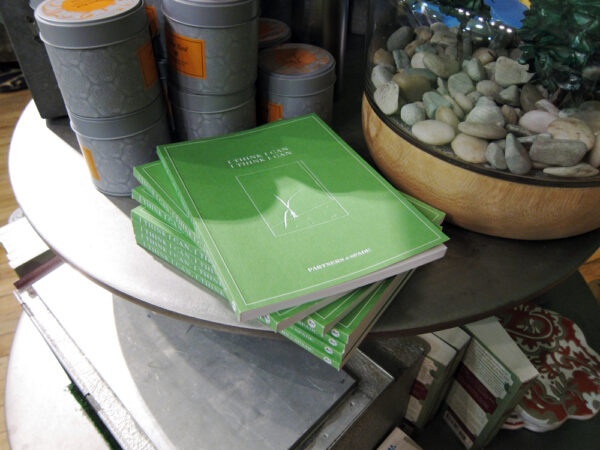
This unassuming little book caught my eye the other day. Inside is a series of simple photos highlighting a phenomenon I’ve long considered joyful: plants that have managed to break through hard urban surfaces and green up the cracks in the city environment.

It’s hard not to feel a sense of delight at the pictures of these little sprouts, and their triumph of living matter over inert concrete, vegetable over mineral, soft over hard. As one reviewer put it, these scrappy, weedy things are “the underdogs of the plant world.” They’re like pioneers pitching a colorful tent in a harsh landscape, brave things that are cheerful in the face of long odds.

I Think I Can looks to be part of a six-book series by Partners & Spade. Another title in the series is The Benefits of Looking Up, which also seems to have joyful potential.

Smile. You’ll live longer.

24 March 2010

This seemed appropriate for today, given it’s my birthday. A new study finds a correlation between smiling in photos and longevity. The study, published in the journal Psychological Science, looked at photos of Major League Baseball players taken prior to 1950, and correlated smile type (none, partial, and full or Duchenne) with years of life. A player with a Duchenne smile was half as likely to die in a given year as a non-smiler, suggesting a clear potential longevity advantage.

In their interpretation, the study’s authors suggest that smile size is indicative of an underlying emotional condition, which in turn reflects general health and well-being. They write:

A growing body of research has shown that basic emotional conditions, such as happiness and sadness, generate differentially patterned autonomic responses (Ekman et al., 1983; Levenson et al.,1990), which influence physical and mental well-being and longevity (Danner, Snowdon, & Friesen, 2001; Maruta, Colligan, Malinchoc, & Offord, 2000; Peterson, Seligman, & Valliant, 1988). To the extent that smile intensity reflects an underlying emotional disposition (Ekman & Friesen, 1978), the results of this study are congruent with those of other studies demonstrating that emotions have a positive relationship with mental health, physical health, and longevity.

I also think there’s a counter-loop here, where joyful moments make us smile more, and the autonomic responses triggered by those moments create physical conditions that are favorable to well-being. People who naturally smile more may find an easy road to a long, happy life, but is it possible that consciously bringing more smile-worthy moments into your life can impact longevity? I don’t know, but there’s a wonderful thing about this question — it certainly can’t hurt to try.

As a side note, I’d be curious to see how a study like this would work in a country where smiles are notably muted or repressed due to social convention — such as Japan, a place well-known for longevity.

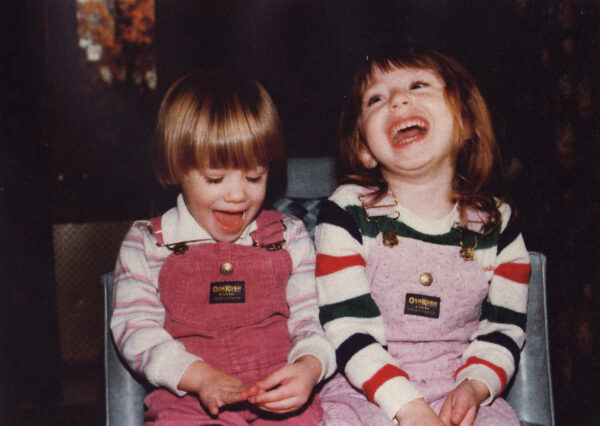
Image: me + my best friend Annie as kids, Duchenne smiles in full display
{via: @swissmiss}

Joyful repair

16 March 2010

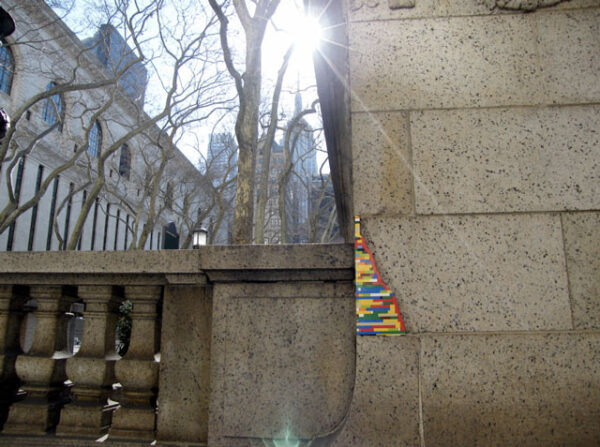
Matt sent me these whimsical images of public structures “fixed” with legos. The pieces are done by artist Jan Vormann, in an attempt to “support Mayor Bloomberg in his everyday-struggle to make this city even more amazing!”

Between these and the precious potholes I featured a couple of weeks ago, I’m starting to see a theme around the idea of “joyful repair.” Add to these some of the initiatives at Droog’s takeover of Governor’s island last fall, such as Heleen Klopper’s Woolfiller, and there really seems to be a pattern. I see this as an emerging desire to salvage damaged things, to fill in gaps and holes with something beautiful, whimsical, and colorful. Of course, these are not serious attempts at repair (Woolfiller excepted), but they get us to pay more attention to our environment, and the condition of the world around us, in a joyful way. There’s something compelling about the motivation behind the work — the need to make something whole, and not just whole, but somehow better and brighter than it was. These pieces suggest that a repaired thing can be not just as good as, but better than a new thing, and for me, this is what makes these provocations go beyond humor and novelty to be truly, deeply joyful.

Algebra in Wonderland?

10 March 2010

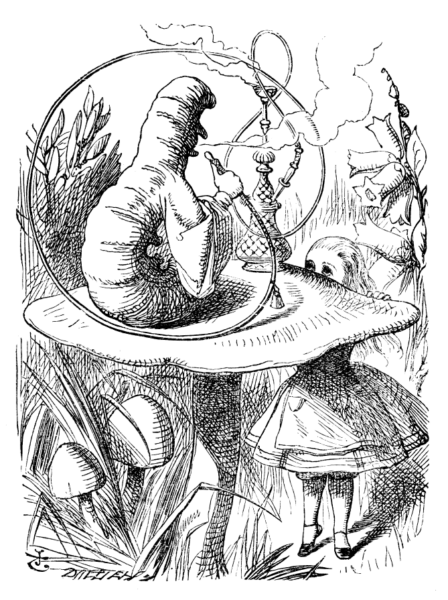
Were the fantastical plots by Lewis Carroll (a.k.a. Charles Dodgson) in Alice’s Adventures in Wonderland a playful way of attacking new ideas in mathematics? This piece by Melanie Bayley in the New York Times gave me a sense of amazement and delight. She suggests that Alice’s rapid changes in size and proportion are a satire of mathematician Augustus De Morgan’s purely symbolic system of algebra, while the Mad Hatter’s tea party is stuck in time because the characters are obeying the principles of William Rowan Hamilton’s principles of “pure time.”

If this is true, it puts a wonderful new lens on one of my favorite joyful books. To visualize mathematical concepts and properties through the behavior of characters is such a clever way to make these ideas accessible, and to expose both their appeal and their absurdity. It’s an ingenious way of adding a layer of emotion to rational concepts, infusing a dry academic debate with charm and relevance.

NYT: Algebra in Wonderland

Design for worship

9 March 2010

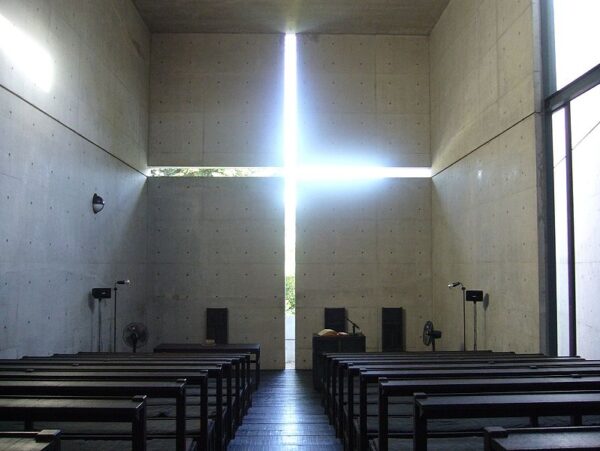
Recently, the website Science and Religion Today invited me to answer an intriguing question: what architecture or design works best for places of worship? I shared a few thoughts with them on aesthetic elements that tend to put people in a spiritual frame of mood, regardless of religion. Read my answer here.

What is your favorite place for spiritual communion? Why? I would love to hear your thoughts.

Image: Osaka’s Church of Light, designed by Tadao Ando. Photo via Wikimedia Commons.

Precious potholes

2 March 2010

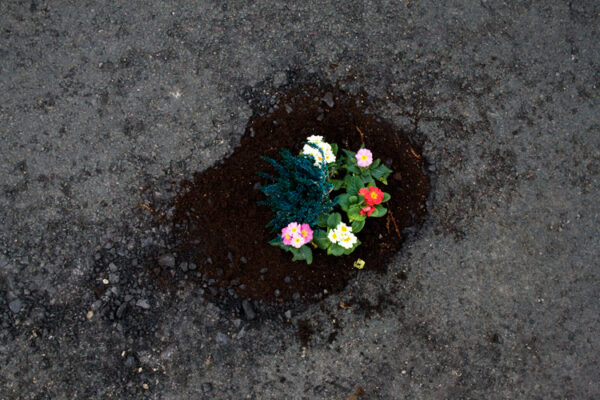
Artist Pete Dungey says of his Pothole Gardens, “If we planted one of those in every hole, it would be like a forest in the road.” Indeed. And a gorgeous, surprising example of urban renewal and joyful activism.

{via for the love of bikes}

Dreams of flying

2 March 2010

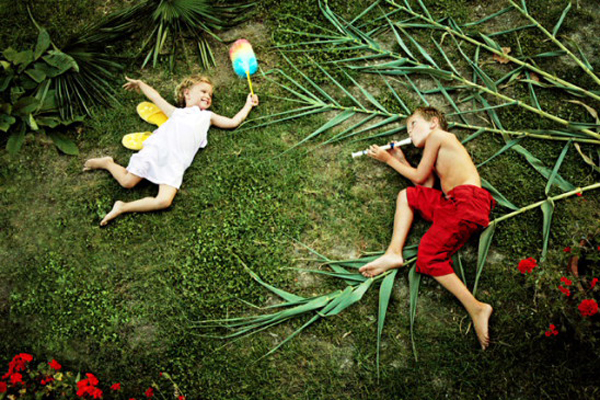
This whimsical series of photos by Jan von Holleben has me totally charmed. There’s something so sweet about the landlocked restaging of childhood fantasies of flight: Peter Pan, Superman, The Red Balloon, etc. It looks like it would be such fun to be one of the kids in the photos. It also highlights a connection I hadn’t noticed before — the link between childhood and a fascination with flight.

So many characters in children’s stories fly: superheroes, fairies, wizards. Many toys fly as well, from balloons to paper airplanes, kites to whirlygigs. There’s something enchanting, liberating about flight and I wonder if children are more fixated on flight or just less inhibited about imagining it. As we get older, the characters in our stories tend to keep their feet more firmly on the ground, and even our dreams seem to have less flying in them, or at least that is the case for me. As a child I used to spend many nights leaping through the air in REM sleep; now, I covet a dream where I even get a few feet off the ground.

It’s also interesting to me how these photos illustrate the joyful gestures of flying. If we take away the props and the settings, what’s left are splayed-out, arms-up gestures that stretch the body wide and open. With no context, you could still understand the form as those of bodies in flight. There is an exultant quality to these bodily shapes; they are delight in contour, revelry in sinew. Joy thrives in this unthreatened openness, this delicious expansion of a physical being into its space. It makes me wonder how we might incorporate more of these kinds of gestures, in stills or in movements, into everyday life.