Archive for June, 2010

AoJ on Core77

30 June 2010

For those who may not have seen via twitter, I’m very excited to announce a new collaboration with Core77 — I’ll be writing a monthly column on the site, starting right now! My first piece is actually more about design and psychology more broadly, but it relates to the unconscious effects of aesthetics that I often write about here on the site. Here’s an excerpt:

If you want to convince someone about something, you’d better give them a soft seat.

This is one design implication coming out of a surprising new set of studies that examines the relationship between our sense of touch and our attitudes and decisions. The studies looked at the unconscious associations between aesthetic elements such as texture, hardness, and weight, and found that by exposing subjects to these elements, researchers could elicit different responses to the same social questions and tests.

For example, study participants who sat in a soft seat and were asked to negotiate with a car dealer made far more generous second offers than those who sat in hard seats. The hard seats literally made them more rigid. Similarly, when volunteers were asked to read and evaluate a story about an interaction between a supervisor and an employee, the ones in the hard wooden chairs viewed the boss as stricter and more rigid than the ones who sat in soft, cushioned chairs. In another experiment, participants who had just put together a puzzle with pieces coated in rough sandpaper were more likely to find a story of an ambiguous social interaction to be difficult and adversarial than those who had put together a puzzle made of smooth, varnished pieces. Harsh textures evidently prime us to think harshly. Other related studies have shown correlations between temperature and social attitudes (proving the intrinsic truth behind the phrases “warm fuzzies” and “cold pricklies”), between weight and perceived seriousness, and between “clean smells” and moral behavior.

Click here to head over to Core77 to keep reading. I’d love to hear your thoughts, and know about other topics you might like to see covered in this new forum. Thanks for reading!

Abundant pattern, transcendent joy

26 June 2010

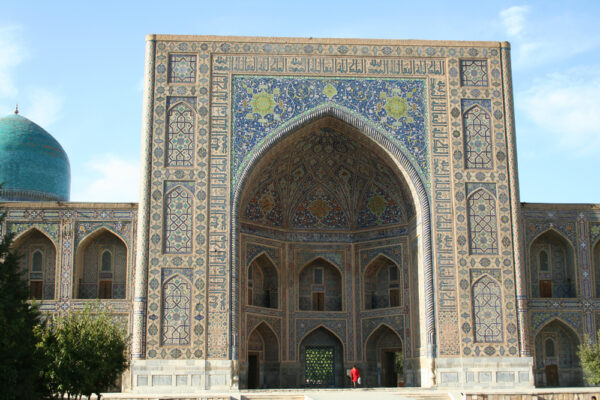
A few months ago I wrote about the architecture of worship — about how elements like elevation, light, and scale create a sense of awe that supports transcendent, spiritual joy. These elements are common to holy places: churches, temples, and mosques, as well as many spiritually significant natural spaces.

This morning, as I was reading The Architecture of Happiness (this is inspiring a lot of thinking at the moment), I came across a discussion of another aesthetic element that might stimulate that wonderful perspective shift we associate with religious joy: pattern at scale. Alain de Botton writes:

Muslim artisans covered the walls of houses and mosques with repeating sequences of delicate and complicated geometries, through which the infinite wisdom of God might be intimated. This ornamentation, so pleasingly intricate on a rug or a cup, was nothing less than hallucinatory when applied to an entire hall. Eyes accustomed to seeing only the practical and humdrum objects of daily life could, inside such a room, survey a world shorn of all associations with the everyday. They would sense a symmetry, without quite being able to grasp its underlying logic. Such works were like the products of a mind with none of our human limitations, of a higher power untainted by human coarseness and therefore worthy of unconditional reverence.

In prior posts, I’ve talked about pattern’s ability to create a sense of abundance, through a visual illusion that uses surface to mimic volume and quantity. This matters because we are innately drawn to abundance, and the aesthetic abundance of patterns such as dots and stripes seems to satisfy a vestigial hunger in our primal mind. Trained to the cycles of glut and privation, we crave quantity as a bulwark against an uncertain future.

But what about the type of pattern that de Botton is talking about — pattern so vast and so staggering, it creates an abundance almost incomprehensible to the human mind? At these orders of magnitude, dazzled by a supernatural abundance, our minds struggle to reconcile the scale of what we’re witnessing with the boundaries of our experience. We measure this new experience against the possible, the normal, and the likely; in each case, our existing mental models are challenged and stretched, causing us to wonder about how this experience came to be. We also face this conflict, between a new experience and our mental models, at encounters with great scale (Grand Canyon), great force (a thunderstorm), great talent (a passionate aria), or great good fortune (“miracles”). For the spiritually inclined, religious belief becomes a way to accommodate an amazing new experience, to explain it and the feeling it triggers within us. For non-believers, though the explanation may be different, the aesthetic awe and resulting joy is there too. It is joy at its mysterious best.

There is also, as de Botton observes, a transporting effect played by pattern at scale. The patterns that line the insides of mosques, like the colored light from stained glass windows, create a world apart. They are immersive and enveloping, jolting the mind away from mundane concerns and holding them at attention. In this way, they function not just as context for worship but a tool of it. Like a zen Buddhist koan, the endlessness of pattern dazzles and contains our restless minds, leaving them primed and open for transcendence.

Joyful commuting

20 June 2010

Yesterday while riding the Q train into Manhattan, my friend Maggie and I made a joyful discovery! She noticed it first — flashes of graffiti that looked cute, almost childlike. Then as we watched, the recurring images resolved themselves into an animation, a kind of underground zoetrope.

I was too slow with the video camera to catch it, but courtesy of YouTube, you can see it above. A little googling revealed that the work is called Masstransiscope, and was installed on a disused subway platform by independent filmmaker Bill Brand in 1980. Evidently it fell into disrepair, but was restored in 2008.

The piece is pure joy. It has no other purpose than to be a surprising bright spot in a morning commute, an interjection of whimsy into the dark underground. Does that make it frivolous? It reminds me of a post I wrote last summer about public art, which speculated on the purpose and value of art commissioned for communal spaces. The post was a response to an article that disparaged recent works in this field as amusing but “relatively empty experiences,” and in it I argued that joy is a very valid, and indeed, an important purpose for public art.

Recently, I read something that bolstered my conviction on this point. In Architecture of Happiness, Alain de Botton references a theory advanced at the turn of the 20th century by German art historian Wilhelm Worringer. One component of his theory explains our collective taste in art as a kind of craving for what we lack as a society. In de Botton’s words, a society “would love in art whatever it did not possess in sufficient supply within itself. Public art, then, serves a critical rebalancing function, especially in cities. Color, light, and playful forms restore harmony to a dense gray city. Lighthearted art creates moments that break the stress of urban living. Soft sculptures create ease in a hard, concrete landscape. They are emotional oases, and in my view, they are essential to a vibrant, healthy city life.

I think there’s food for further thought here. Some things have no justification on rational grounds. They could seem pointless or even wasteful, but our increasing awareness of the importance of emotion may illuminate their value. What else seems frivolous or unnecessary, but might actually be vital because of its emotional function?

Art, sexual selection, and renewal

5 June 2010

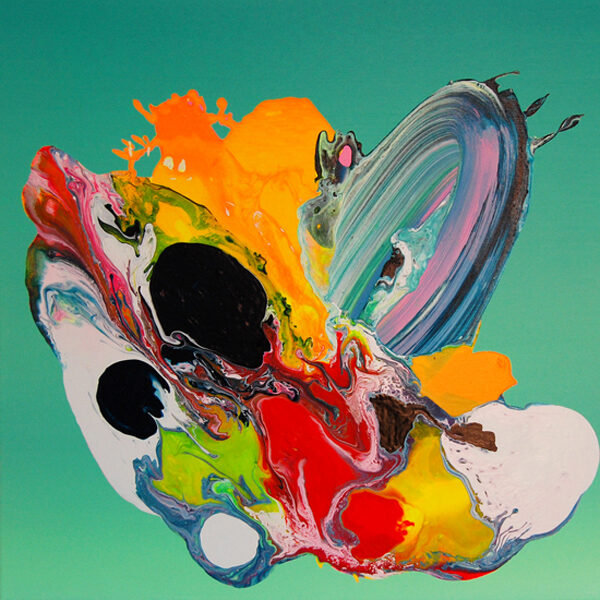
Feeling arty today, inspired by a semi-monthly art outing tradition I have with a couple of friends this afternoon. Most of the time this blog focuses on explaining joy, but today I just feel like sharing some. These paintings are by Berlin-based Barcelona artist Yago Hortal.

Ok, I changed my mind. I was going to just post some art, but as the title of this post suggests, I can’t help but noodle this a little more. Why do colorful swirls of paint make us feel so stimulated and uplifted? Why does art move us so? This question is especially significant in abstraction, where there’s no subject matter to react to, no inherent narrative, just pure sensation dancing about on our rods and cones. I’ve offered up a bunch of ideas on this blog about color, curves, and so on — why specific aesthetic elements may have evolved to make us feel joy. Recently I’ve come across a theory that puts our desire to make and view art in a more macro evolutionary context. In his book The Art Instinct, philosopher Denis Dutton contends that art arose as a (rather sophisticated) way of attracting a mate. He connects art with evolution through sexual selection, the aspect of evolutionary theory that deeply troubled Darwin before he was able to explain it, because it fostered the success of traits at cross-purposes with survival. (The peacock’s tail is the classic example here: Large and brightly colored tails may make a peacock more vulnerable to predators, but they’re selected for anyway because peahens prefer them. Research suggests this is because they indicate a peacock carries a lower parasite load than his dull-plumed buddies.)

Making art may once have said, “I’d make a good mate because I’m clever and creative,” selecting the desire to make and appreciate art, music, literature, and performance into the human genetic makeup. Of course, that doesn’t mean that the link between art and sex is persistent, that our current appreciation of art is akin to artist-lust, that a gift of a painting is foreplay. Evolutionary theory doesn’t offer explanations for our reasoned behavior in the present; it merely gives us origin stories, roots that help explain the common ancestry of our universal predilections. Rather, for me, it’s interesting to know that when we view art, somewhere deep in our brain may be the trace of a neural connection that links such apparently purposeless beauty with the desire that fuels our renewal. That our joy in art is not detached contemplation, but visceral, emotional, and vital.

Yago Hortal via but does it float

Joyfully uninviting

3 June 2010

Can something say “Keep Out!” and still be joyful?

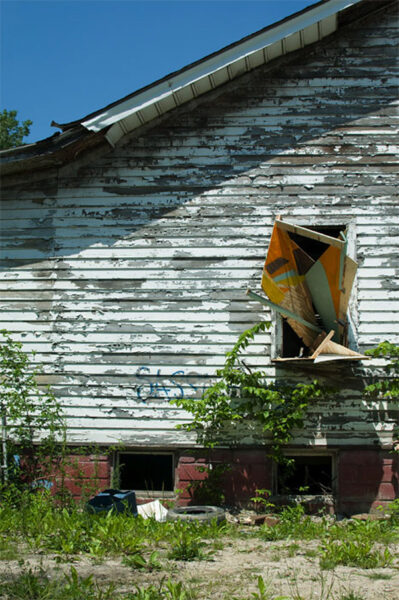
This was the question that popped into my head as I considered the Razzle Dazzle Sculptural Security object, the angular plywood contraption jammed in the window of the house pictured above, by Detroit-based Design 99. The purpose of the Razzle Dazzle (more examples of which you can see below) is to protect empty houses from squatting and vandalization, a common problem in Detroit neighborhoods. An alternative to boarding up doors and windows, the method signifies that someone is interested in looking after a place.

A strong thread of joyful activism runs through all of Design 99′s projects: the brightly-painted Power House, a community space cum sculpture made from a previously empty house, or the Neighborhood Machine, a similarly hued Bobcat with trailers that can be appended for various urban renewal tasks, such as gardening and collecting found material. For these projects, aesthetics of joy such as bright color, stripes, and other patterns catch the eye and raise awareness for urban renewal projects. They also telegraph the spirit of the movement, and offer an exuberant energy that might inspire volunteers and invite onlookers to join in. The aesthetics visually convey the intent of the artists behind Design 99, Gina Reichert and Mitch Cope:

The Power House intends to be a stimulator and not an end in itself as a singular art object. The Power House is a broadcaster of potential ideas and a place to plug those ideas into. The Power House will be used as an interactive site, by us and by our neighbors. The Power House will become a symbol for creativity, new beginnings and social interaction within the neighborhood.

But while the house and the machine seek to invite, the purpose of the Razzle Dazzle is entirely different. It’s a three-dimensional “No Trespassing” sign. So there’s an inherent tension between the spiky, angular form, which articulates (and enforces) the “stay away” message, and the vibrant pattern, which is a visceral enticement. There is also a tension in the way the piece is crafted. The Razzle Dazzle’s form is haphazard, seemingly cobbled together from debris — something you might expect to see at an abandoned site. It looks like it might itself be an act of vandalism. But the deliberate color treatment transforms the meaning of the piece. It says, “Someone put me here on purpose,” and therefore, “Someone cares about this place.”

In this way, the Razzle Dazzle is inviting. Through a splash of color, it offers the promise that a space will be inhabited by people who will care for it and restore it. It’s an invitation to return, suggesting that next time you visit, it may not be an abandoned shack, but a lively business, a vibrant community gathering space, or a home. It’s a joyful “Keep Out,” because it’s also a “Come Back Soon.”

{via Core77}

Power House and Neighborhood Machine

Neighborhood Machine with solar panel trailer attached

Gardening trailer for Neighborhood Machine

Razzle Dazzle Sculptural Security objects