Archive for August, 2010

The joy of solitude

29 August 2010

This was a nice find in an email from a reader this week: a visual poem called “How To Be Alone” by filmmaker Andrea Dorfman and writer Tanya Davis. The joy of being alone is an interesting contrast to all the recent research about how important social connection is to joy and to long-term happiness (some of which I alluded to in my most recent Core77 column). At first it seems that hanging out alone is antithetical to joy, especially given social stigma against it. But I like the poem’s observation that often when you’re alone is actually when you meet the most interesting people. That’s certainly been my experience when traveling — it’s easiest to be alone as a stranger in a strange land, and people often surprise me with their friendliness. I still have friends today that I met on solo adventures in various parts of the world.

Being alone is also an optimal time for finding “flow,” Mihalyi Csikszentmihalyi’s name for being absorbed in creative pursuits. There is also social flow, for sure, but the individual kind has a certain kind of satisfaction to it because it’s all yours.

Solitude is often painted as deprivation, but it can just as easily be self-indulgent. I don’t think I’m one of those people who will ever strap on dancing shoes and go to club on my own (maybe because I just don’t go to clubs that much even with others), but I do savor a little bit of time out every week (this blog being a big product of that). I’ve always been that way too — as an only child growing up in the suburbs, I spent a lot of time watching the world go by from the branches of an old beech tree. It’s nice to see this simple pleasure encouraged, not in the typical authoritative self-help tone, but in a matter-of-fact, yet whimsical way. I like the idea in the poem that to be alone for those not used to it is brave, rather than something you should feel normal doing. We evolved to seek companionship. We find safety in numbers. Solitude can feel unnatural, but rewarding.

It’s not a typical aesthetic of joy. It may even be a counter-aesthetic of joy, in the traditional sense. But I think there’s a quiet delight to be found here.

{Thanks, Johnny.}

Aesthetics of nature

22 August 2010

Well, I’m back after a longish, unscheduled break. Let’s call it a summer (working) holiday. But wow, did I miss it. I don’t plan on taking this much time away from the blog again for a long time. There are just too many interesting and joyful things to write about…

Before I launch into some thoughts on the things I’ve been reading and observing in the last few weeks, I want to just say a quick thank you to everyone who has commented, sent me an email, or sent me links recently. This summer has left me breathless, and I haven’t had a chance to respond to everyone yet, but rest assured that I will, and that I appreciate the kind words, the thoughtful recommendations, and the healthy debate you bring to my inbox. Thanks!

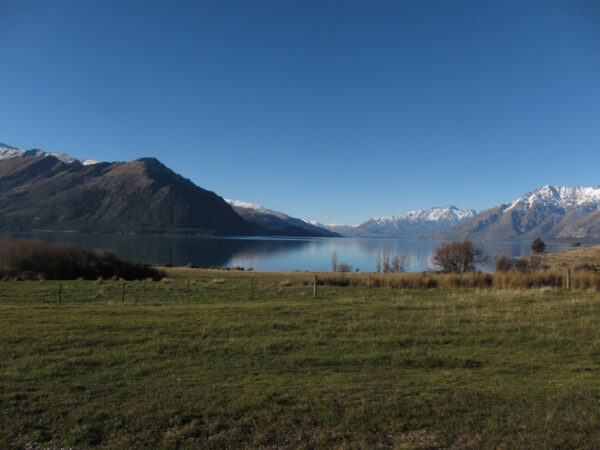
On my mind today are the aesthetics of nature. A big part of my thesis for Aesthetics of Joy is that joy evolved to guide us unconsciously towards things that would have been beneficial for our survival (or more accurately, the survival of our genetic material). It stands to reason that since during the bulk of this evolution humans were nomadic creatures living in an environment with far more trees than skyscrapers, natural environments are going to be replete with stimuli that make us feel joyful. Bright sunlight, ripe fruits, wide open spaces—these primal joys hold clues that give context and meaning to many of the things that delight us in the modern world. And as the research supporting evolutionary theories of psychology continues to accumulate, the evidence suggesting the connection between aesthetics of nature and our wellbeing is beginning to mount.

On his Frontal Cortex blog, now on Wired.com, Jonah Lehrer has a great discussion of some findings from the emerging field of ecopsychology, which looks at the relationship between nature and the mind. (I first wrote about this field of research in February, here.) One study, dating back to the mid-1990s, looked at female housing project residents, some of whom were living in apartments facing city streets and basketball courts, and others who had views of a grassy, landscaped courtyard. The women were tested on everything from attention to their ability to cope with life’s challenges, and those with the more natural view tested better on nearly every measure. Similarly, in a 2008 study led by Marc Berman at the University of Michigan, students who were given time to walk through a park before taking a series of tests performed better on measures of attention and memory than those who had walked through city streets.

According to psychologists, views of nature are restorative. They seem to allow the brain to reset and concentrate again. This reminds me of an insight noted by Chip and Dan Heath in their book Switch: Willpower, they observe, is finite. When you expend a lot of effort trying to control cravings, desires, or emotions in a certain situation, it can be draining, leaving you with little energy to control yourself in others. I wonder if there’s a similar mechanism going on here. Functioning in urban environments takes a lot of mental energy. It requires high alertness, and it’s sensorially complex; there’s a lot to process. I wonder if views of nature provide a reset because they are simply easier on our brains, evolved as they are for processing the stimuli in this environment.

This may be, but it’s not the whole story. Another study, also cited in the article on solastalgia I quoted in my February post, adds another piece to the puzzle. The study, conducted by Peter Kahn, took participants and stressed them out with a series of math tests, and then gave them one of three views to look at: a window facing out onto a tree-filled view, a plasma screen of the same view, and a blank wall. Those looking at the natural scene had the quickest stress reduction (measured by a decrease in heart rate). Those looking at the blank wall had a much slower return to normal heart rate. We could’ve predicted that. Subjects who looked at the nature scene and the plasma screen both looked at their views longer than those looking at the blank wall. Also a no-brainer. But surprisingly, the subjects who looked at the plasma screen showed virtually the same stress-reduction pattern as those looking at the wall. So while we’re drawn towards a views of nature to relieve our stress, it has to be real nature. It’s not something we can trace to one aesthetic element—like the color green or the contours of the leaves—and bottle it. It’s the full multisensory, immersive aesthetics of nature, all together, that foster wellbeing and joy.

Apparently, the kind of nature matters too. Lehrer’s post mentions another study that demonstrated that people who spend time in parks with a greater diversity of plant life score better on tests of psychological wellbeing than those who spend time in less biodiverse parks. A patch of grass may be green, but it’s not nature. A diverse park is more like nature, naturally, and probably a lot more like the environments in which our brains grew up. Variety, as much as greenness or leafiness, is an aesthetic of nature, and it seems it does us a lot of good.

Another fascinating insight about our brain and nature comes from an interview with Mark Changizi, an evolutionary neurobiologist whose latest book explores new research on human vision, on the Neuronarrative blog. Changizi observes that one of the reasons its so easy for humans to read (those of us who are literate read thousands of words in a day) is that our letterforms mimic natural shapes. He suggests that if our words looked like barcodes or fractal patterns, we would not be able to process them nearly as quickly. He says:

To be easy on the eye, writing needs to “look like nature,” just what our illiterate visual systems are fantastically competent at processing. The trick of that research direction was making this “writing looks like nature” idea rigorous, and coming up with ways of testing it. I show that there are certain signature visual patterns found in nearly any natural environment with opaque objects strewn about, and that these signature patterns are found in human writing. In short, writing has evolved so that written words look like visual objects.

I have to pause to marvel at the beauty of this insight, which is nothing short of thrilling for readers, writers, and typographers all. But as the awe subsides, I wonder if this fascinating insight holds a clue to applying aesthetics of nature to design in ways that really do foster our wellbeing. I’m sick of seeing wallpaper that looks like birch trees or tables with grass growing in the middle put forth as design’s  solution to the urban condition. Can’t we do better? As the plasma screen experiment demonstrated, a picture of nature isn’t going to cut it, and while it’s certainly a fine idea to have some plants around, I think we could go about “bringing the outside in” in a more sophisticated way. Perhaps there are visual patterns or spatial arrangements that better mimic a natural environment, design ideas that can be applied to urban planning, architecture, interiors, and products to provide some of the same benefits. It’s encouraging to think that we may be on the cusp of learnings that will help us bring more aesthetics of nature into our citified lives.

Of course, there’s another implication here, not for the design of a home necessarily, but maybe for the design of a lifestyle. Get outdoors. Do it often and especially when you’re stressed. Because no matter how well we’re eventually able to design to mimic nature, there’s no substitute for the real thing.