Archive for September, 2010

Auto-rainbow

26 September 2010

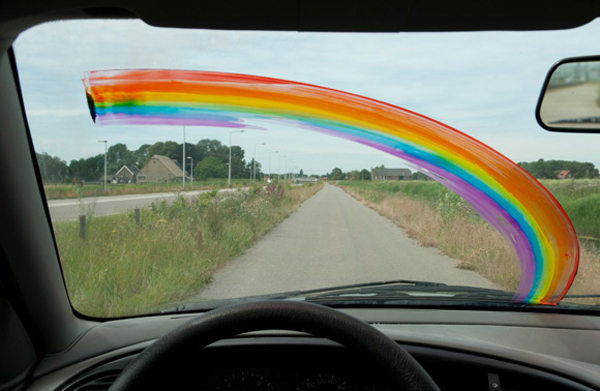
This clever little rainbow by Dutch artist Helmut Smits made me smile. Not quite the reaction of the “double rainbow” guy, but still, there’s something joyful about rainbows…

I love the opportunistic quality of this incredibly simple piece, the way it takes advantage of an existing motion to create something beautiful. For people who regularly sit behind the wheel of a car, the movement of windshield wipers is almost invisible — of course, it’s designed to be that way. Like a kite exposing the movement of the wind, or these speed blend tires embellishing the motion of bike wheels, it’s amazing how a little color can expose the hidden beauty of an ordinary arc.

{via @etsy}

IKEA, herding cats, and happiness

14 September 2010

I often take brands to task for “joywashing”: advertising their products or services with a veneer of positive emotion that is either unsupported by the product itself or completely inappropriate to the product. So I was happy to see this ad from IKEA in the UK that uses aesthetics of joy and comfort in a very fitting way. Say what you will about IKEA, its products enable the transitory and the low-income to create a home, in the context of an extremely expensive category. The aesthetics of IKEA products themselves tend to be bright and cheerful, and yet the simple designs have become a mainstay of the DIY community as a substrate for creativity. We giggle at the Swedish names, smile at the clever design touches, and feel at ease about the prices. So the positioning line “happy inside” doesn’t feel like a reach to me.

There are many lovely things about this ad, (you should watch the “making of” too), and several nice uses of aesthetics of joy. I love the jumping shots, especially slowed down and sped up, and the shots among the lighting. There’s a deliberate sense of lightness throughout, both lightweight and illuminated. And it feels spontaneous because these are real cats, untrained, and you can sense their genuine curiosity as they poke through the textiles and drawers and lampshades. I have to say, it’s not unlike how I feel when I first get to IKEA (before the maze has beaten me down) — energized and curious about what I might find. It’s nice that they kept in one of the little fights, because that’s part of a happy home life too — it’s not all dancing and cuddles and naps on the sofa. Good for IKEA and Mother for not overly staging it and conducting this in an experimental way. Altogether, from how its made to how it appears in the end, it does make me feel “happy inside.”

Though assembling the furniture when you get home — that’s another story.

{via Apartment Therapy}

Joy and death? The Merry Cemetery

4 September 2010

Can death be joyful?

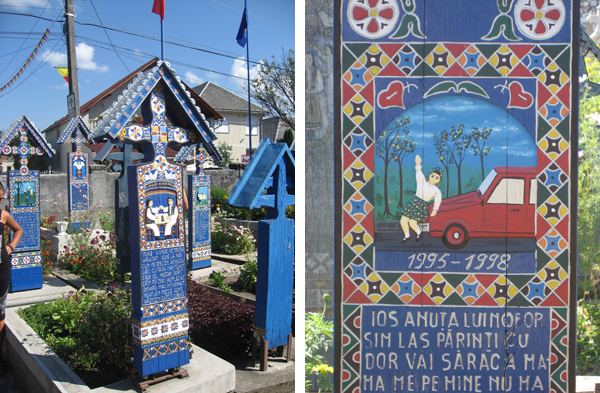
The Merry Cemetery is a real burial site in Romania. But instead of the traditional somber aesthetics of death, the headstones feature colorful designs and scenes that explain how a person died. Some of those scenes are not too joyful (see: “Three Year-old Hit by Car,” above) but they do wrap the experience of death in a more uplifting aesthetic package. It may not make you feel any better about the loss of a loved one, but I wonder if it does change your immediate mindset on entering a cemetery. It sets a lighthearted tone that might remind a visitor that life is fleeting, and to spend the visit remembering the joys of being with the deceased, rather than the pain of being without them.

These somewhat gaudy headstones remind me of a procession that went by on the day we buried my grandmother. We were driving back from the burial, and at that moment a hearse drove up with an enormous picture of a deceased woman on top, ringed with many garlands of flowers. It was so visually loud I had a moment of synaesthesia: I could practically hear a marching band accompaniment to the parade-float aesthetics of the hearse. It was a jarring contrast with the understated, Bach sonata aesthetic of the funeral we had just attended, and my cousin couldn’t help but say, “That is so not Nana!” It was true, and we burst out laughing. Nana was reserved, self-effacing, elegant, in life and in death.

But to each his own. Apart from a merry cemetery or a joyful hearse, have you come across other ways people create a joyful celebration of a person’s life, after death? Do you know of any other joyful funeral rituals, either personal or cultural?

{via boing boing; images: Michael Foord}

The joy of swimming pools

1 September 2010

It’s been a hot summer (today was no exception) and since the first taste of this ebbing-and-flowing heat wave, I’ve been thinking about swimming pools. There is no greater luxury or greater joy in a midsummer city than a swimming pool, a cool watery oasis in a desert of hot reeking concrete. Last summer there was the frenzy of the Gowanus dumpster pools, now converted into a public attraction by the Bloomberg administration for Summer Streets. Before that, the most talked-about New York pool was the floating pool lady, a barge converted to a pool by the city that debuted in 2007 in Brooklyn, and that docks in a different borough each summer. I haven’t managed to swim in either, but this summer I’ve been the benefactor of the generosity of a friend with a private pool, a backyard gem in the East Village that is all the more tantalizing for its secrecy.

After a couple of years living in Sydney, it’s hard to be without a pool. There, private pools are rare, but the public ones are ubiquitous and stunning. There’s the Andrew Boy Charleton pool, a 50m beauty that makes you feel like you’re literally swimming in the harbor. There’s also the North Sydney pool, right in the shadow of the Harbor Bridge. And there are the ocean pools, so beloved by Australians that they have their own culture, a culture robust enough to be the subject of a documentary: Sea Pool: A Life in the Ocean, teased in the video above. Bondi Icebergs, shown in the teaser, is particularly amazing; fed by crashing waves, it is briny and bracing all year round. Membership requires that you swim every weekend, regardless of the weather. Do that for five years, and you’re a member for life. It is the ultimate pool-lover’s pool club.

A frigid pool on a hot day is a delight; on a cold day, it is a trial. This may be an illustration of the difference between joy and happiness. Joy is immediate, momentary. It reacts to stimuli that accompanied the satisfaction of needs over the many generations of our evolution. A hot body in a cold pool is one step closer to homeostasis, and the aesthetics of the swimming pool (cool, shimmering blueness) are all designed to advertise that temperature-regulating function. Hot and cold in tension, moving towards balance: there is a certain kind of harmony there. A cold body in a cold pool, on the other hand, stands in defiance of emotional logic. The winter swimmer must see something beyond the immediate, because the proximate experience is discomfort, possibly even pain. Past the trial must be something: the satisfaction of completing a goal, the strength of physicality inured, the delight of an invitation to a company of like minds. It’s the pre-frontal cortex that envisions and plans this, that looks past disharmony towards a greater future pleasure. Joy, arising unconsciously from the limbic brain, revels in a more immediate gratification.

Along with the harmony of the pool, there is also freedom. Buoyant, liberated from gravity, we float in effortless space. We glide on the edge of another world, one in which the usual rules of movement are relaxed and transformed. I’m reminded of a moment in the John Cheever story The Swimmer:

To be embraced and sustained by the light green water was less a pleasure, it seemed, than the resumption of a natural condition, and he would have liked to swim without trunks, but this was not possible, considering his project.*

The waterborne lightness of swimming does feel natural, even in the truly unnatural setting of the swimming pool. And it feels freeing, even though the pool is a fixed, bounded area. The pool becomes an oasis, a space where the rules, both natural and cultural, are different. Not only are we free to move differently, but we are free to act differently: We do spontaneous headstands, splash around in silly patterns, lounge indolently. We are a bit more childlike, and perhaps more like our real selves. Childlike pleasure is often a breadcrumb on the route to joy, and the child’s love of the swimming pool is a clue to a delight buried within most of us.

Do we grow out of the joy of the pool? Ellen Meloy writes in her ode to the pool, a chapter called “Swimming the Mojave” from her memoir, The Anthropology of Turquoise:

The human body needs the embrace of water. The fifties boom in California swimming pools, and the attachment of pools to the culture of a mobilized America, announced affluence, comfort, and good climate, and it made the embrace available in controlled circumstances: big recreational bathtubs gone outdoors, with no worry about what might lurk in their depths. For everyone but children, for whom it is a baptism of sheer joy, a pool holds more chlorine than wonder.

It’s true that a pool can be fake, and chemical, and wasteful. In a backyard, it can be mundane. In a desert, absurd. But I still think there’s always a glimmer of joy in the swimming pool, regardless of your age. It’s in the faces and movements of those in the video above—a visceral pleasure, a reawakening of body, a liberation of spirit. A pool may be an artificial experience, but the joy is all real.

*The Swimmer tells the story of a man who decides to swim home from a party, dipping into all the pools along the way.

Sea Pool: A Life in the Ocean, by Jason Wingrove
More teasers here and here

{Thanks, Sarah, for the link to the video above, and the swims!}