Archive for July, 2011

Design fictions

26 July 2011

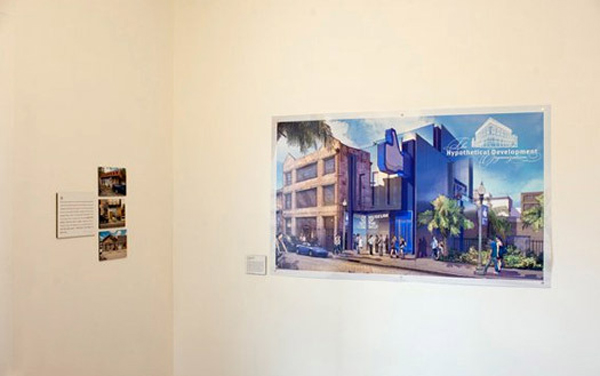
A few months ago I wrote about the Hypothetical Development Project, a collaboration between Rob Walker, Ellen Susan, and G. K. Darby to create “imagined futures” of abandoned buildings, expressed through mock architectural renderings. Over on Places, Rob Walker now has a great piece relating the story of the project, as well as its role in the context of architectural fiction. (The piece also quotes some thoughts from the original Aesthetics of Joy writeup.)

On the surface, design fiction is an odd concept. Design is a functional discipline, a craft driven to make ideas tangible, to concretize solutions into usable forms. Design operates on the principle that by distilling imagination into form, it becomes truth. People can dislike a thing, dispute its purpose, disagree with its intentions – but they cannot deny it exists.

On the other hand, fiction is a lie. A welcome and seductive lie, perhaps, but still a non-truth. And the subject of a lie does not exist beyond the world of its own narrative. So within “design fiction” there is a tension – between tangible and ephemeral, existence and non-existence, imagination and reality. Walker rightly points out that many of the architectural renderings we see are just this kind of designed fabrication. (Many are created as marketing gestures, but the projects they show are never funded and therefore never built.) In this sense, they are less lies, and more, as I noted in my original assessment, manifestations of hope and desire. Unable to predict THE future, they instead try to depict A future, a kind of illuminating untruth. What is illuminated? As Walker points out, both something in the abandoned structure, the forlorn substrate of the fiction, and in the viewer themselves.

The moment that interests me most, I suppose, would be the random passerby who suddenly notices that building he or she has walked past a hundred times, just because there’s this sign on it, this arrestingly uncanny sign that tells a story that’s blatantly and intentionally absurd. I think that moment — the story, in one image, of an implausible future for an unpopular place — makes the building exist again in a new way. It changes nothing into something.

I think it makes the passerby exist in a new way, too.

The role of designer as storyteller is not a new construct in the design world, but I think this project gives it new resonance, or at least reminds us that the value of conceptual design (even absurdist conceptual design with no hope of being made real) need not be subordinate to the design of the functional here-and-now. Design fiction gives us places to go. It highlights features and flaws. It expresses wishes in a voice much nicer than a whine. In some ways, it is a necessary precursor to “real” design, if we want that design to represent progress, and not just continuation.

I say all of this as a former fiction writer, one with great respect for the simple joy of a story told for its own sake. While as a designer I am tempted to look for a practical application for Hypothetical Development, as a writer I’m happy for it just to just contribute to the general joy of our surroundings. As Walker writes, “…I don’t think a story needs to be considered a means to an end. A story is an end. And a sign on an abandoned building is as good a medium as I can think of for telling an entertaining tale.” The beauty of design fiction is the way it fuses the storyteller’s art with the evocative palette of the form-crafter. It’s a rich space, and if I take anything away from the project, it’s that many, many entertaining (and inspiring) tales are waiting to be told.

Places: Implausible Futures for Unpopular Places

The color of time

24 July 2011

Tumblr lopk5z7ADi1qzs3opo1 1280

Seems it is a week for thinking about time. Perhaps it’s the heat, which slows the afternoons to a thickness, reminding us of the elasticity of hours. Or perhaps the long days of summer leave us more light to read and think. Whatever the reason, in the past few days for me have brought a confluence of aesthetics of time.

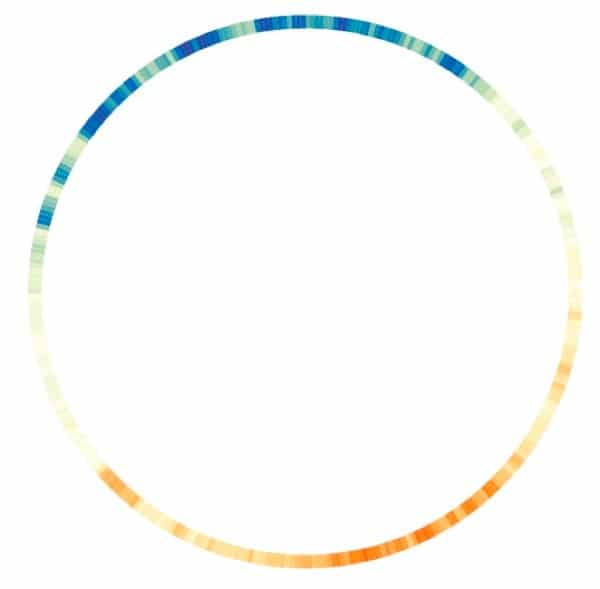
This visualization is a fitting place to start. A piece by the designer Nicolas Troncoso, Colordar represents the average temperature of Helsinki over the course of 2010 by color. There is something satisfying and joyful about seeing the year represented this way, the intensity of the summer and winter tempered by the mildness of the transitional seasons. Of course there is a natural relationship between temperature and color, evident in the way we refer to colors as cool and warm, that makes this visualization feel perfectly natural. It is another type of color language, akin to the ones I have written about in the past, distilling the ambience of time. It might be fun to do this with other geographies (equatorial, desert, polar) as well, nested as concentric circles for comparison, to see space, temperature, and time all at once.

If color here is an output of our experience of time, in other ways color serves as an input, a language that communicates time to our body and brain. We know that the color of light changes through the course of the day, the short-wave bluish rays of the early hours giving way to the longer wavelength light that gives the sunset its rosy hue. But what research now suggests (as reported in a recent article in the NYT) is that these color signals are the basis for our body’s regulation of Circadian rhythms. In other words, our eyes tell time by color.

As the color-receiving cone cells in our eyes absorb different wavelengths of light, they regulate the production of melatonin, a light-sensitive hormone that controls our alertness. (Melatonin is often indicated as a natural remedy for jet lag.) We’ve long known that melatonin levels vary based on exposure to light, but recent research shows that the color of the light makes a dramatic difference. In one study at the University of Basel in Switzerland, thirteen men were asked to sit in front of a computer in the evenings before bed. Both groups of participants sat for five hours in front of a computer screen. But one group looked an old-style fluorescent monitor emitting a range of colors of light from the visible spectrum, while the other group looked at an LED-backed monitor that emitted twice as much blue light. For the blue-light group, melatonin levels took longer to rise, and stayed lower throughout the evening. Other studies have found similar results, one indicating that men exposed to bluer light had melatonin levels 40 percent lower than those exposed to incandescent light.

These discoveries force us to question the consequences of our increasingly illuminated world. As we replace our old CRTs and incandescent bulbs with more efficient light sources, we’re also inadvertently increasing our exposure to the bluer light these devices emit. And as we introduce more and more screens to our world, we add still more blue light to our days. (Through this lens, reading by the cozy glow of an iPad or Kindle is very unlike reading a book with a bedside lamp.) If the world communicates time by its color, our devices speak to our bodies in tongues.

This may be alarming news, but there’s also a positive story here. Blue light increases alertness, and has been shown to have effects on cognition and alertness. One study showed that elderly nursing home residents exposed to just 30 minutes of blue light showed improvement in cognitive abilities in just four weeks. This could be useful from a design perspective, for everything from helping shift workers manage their schedules to promoting alertness for those operating vehicles or machinery (a fact called out to me by Dr. Charles Spence, the director of the Crossmodal Research Lab at Oxford University). Even for sleep-deprived office workers, better lighting could mean more energy and a break from the need for caffeine. One of the researchers behind these studies, neurologist George Brainard, hopes that designers will rise to the challenge and get to work on creating screens and lights that adjust their wavelengths to reinforcing our natural rhythms.

In the end, I come back to the mechanism itself, and the latent poetry of it. Light is merely energy, and blue light, with its short waves, is high-energy luminance. Vibrating and alive, these rays excite the molecules of pigment in our retinas, a revelie that calls our cells to the attention of the day. There’s a beauty in this energetic language, one that reminds us that blue has an inherent joy. Though typically perceived to be a calming color, blue is revealed by these studies to have an intensity we don’t often give it credit for. The brilliant sky of a clear day moves us with a force that speaks directly to the chemistry of our blood. We are helpless to resist. And why would we want to? It’s a primal kind of delight, and we are made for it.

{via @brainpicker and @vaughanbell}

Intangible color

16 July 2011

These last few weeks I’ve been steeped in color. Literally, with the effusion of bright summer hues in the city, and figuratively, as I’ve been devoting many a spare moment to researching it. Color is the subject of chapter two and, as evidenced by the colorful nature of this blog, a nearly endless topic when considering design and joy.

Right now I’m reading a very thoughtful, scientific little book from the 1980s called Colour: Why the World Isn’t Grey, which covers everything from why rainbows appear to why flames are orange to why the sky is blue. As the author Hazel Rossotti demystifies these phenomena, she’s reminding me that some color seems particularly mysterious.

Intangible color – the color of the horizon, of an oil slick on a rain puddle, of a match-strike – has a trickiness to it. We perceive the color, but it is either too distant, too evanescent, or too changeable to feel certain in our impressions. The color feels deceptive, yet tantalizing. Though we know that pursuing it will leave us empty-handed, sometimes we go after it anyway. Like burying one’s nose in a magnolia flower only to find the thrum of fragrance all around, but pale within, we find our rainbows and sunsets accessible only from afar. I suppose we should feel grateful that their photons journeyed such a long way to our eyes in the first place.

Maybe there’s more joy to this kind of elusive chroma, or if not more, then certainly a distinct kind of joy – a delight mingled with longing. And that’s of course what joy should be from an evolutionary perspective. Not perfect satiation, but satiation plus motivation to continue seeking that “passage from lesser to greater perfection,” as Spinoza wrote. With its spiritual airiness, intangible color feels something like a promise, a reminder that still greater beauty is out in the world to be discovered.

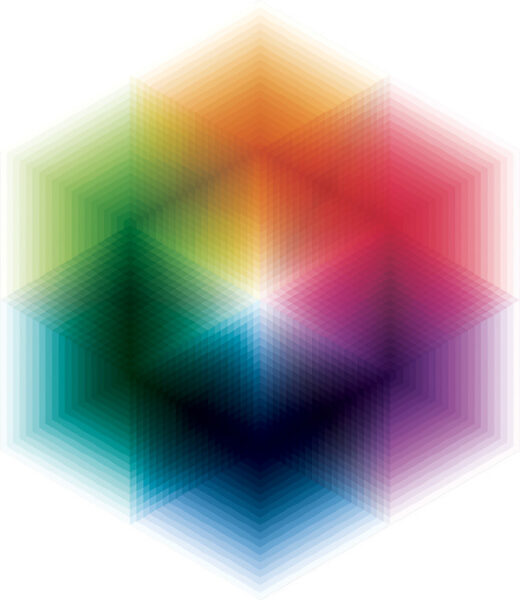
With these thoughts on my mind, I wanted to share a few works that create a similar kind of intangible color, despite being constructed from tangible materials. The first, above, is a recent piece by Andy Gilmore, whose kaleidoscopic works I’ve long enjoyed and have posted in the past. This piece seems to vibrate in those light spaces where the hues fade out in steps. It’s almost as if it’s moving, and therefore impossible to fully take in all at once.

Below is a kind of 3D counterpoint to Gilmore, from artist Gabriel Dawe’s Plexus 4 and Plexus 5 series. These are similarly vibratory, almost spatial rather than material, like a dense chromatic fog. You almost feel as if you could walk right through them, though in fact they’re constructed from thousands of strands of thread. Like many natural examples of intangible color, these installations seem to radiate their own light, making them even more ethereal and compelling.

I hope you’re out enjoying a colorful weekend somewhere, intangible or otherwise…

Xx Ingrid

Aesthetics of Joy for birds

15 July 2011

For about thirty seconds after coming across this piece, “Housing Boom, if You’re a Bird,” in the NYT, I was enchanted. I read:

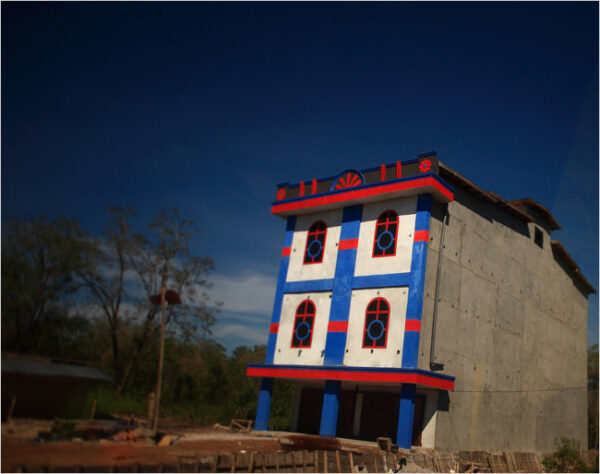
Along the spine-jarring road that runs through this city on the South China Sea, in between the sparse, waterlogged shacks of corrugated aluminum and wood, colorful buildings have begun to sprout.

They tower over their low-slung surroundings with dollhouse facades, colored in baby blues, sunshine yellows and ruby reds.

Then I realized that the reason these homes were being built was to harvest the edible nests of the avian inhabitants to sell to China, and the piece became less charming. I loved the idea of a colorful spate of birdhouses being built all over Indonesia, for conservation or simply enjoyment. But for commerce – a kind of semi-parasitic home-stealing commerce – the birdhouses suddenly feel less appealing. A kind of Aesthetics of Joy used as deception, like a marketing bait-and-switch.

But regardless of the intention, there’s a joy-related insight here. It intrigues me that the builders of these houses use color to attract the birds, while when left to their own devices the swiftlets typically nest in caves. Is it that we are so inexorably attracted by bright color that we believe other species will be too? Or is there evidence that the birds prefer color, just like we do? Either answer makes a statement on the power of color to engage us and arouse our emotions.

If anything, birds may be even more sensitive to color than we are. Most birds are tetrachromats, meaning that they have four types of cone cells in their retinas, which are the cells that sense color. While humans have cones with red, green, and blue receptors, birds have a fourth cone that lets them see into the ultraviolet range. This means that birds may see colors we don’t even know exist!

Whether this brings them joy, we can only guess. But I guess it can’t hurt, if you’re building a birdhouse, to pull out all the stops (and the colors of the rainbow).

Grazie, Dario, for the link! And thanks to @markchangizi for first pointing out to me tetrachromacy in birds.

The joy of bubbles

12 July 2011

John Nese, proprietor of Galco’s Soda Pop Stop, exudes a childlike exuberance when he talks about his favorite subject: the independent and small batch bottles of pop he sells in his store. In this wonderful video interview by Chowhound, he reveals all kinds of interesting factoids about bubbly beverages, and projects an infectious enthusiasm for the topic.

Soda’s a hard one to claim as joyful, given its contribution to the obesity epidemic and myriad other health problems. But Nese reminds us that soda is a treat, something to be enjoyed occasionally, not guzzled in place of water as so many people do. When asked about diet sodas, he condemns most of them as unsavory, and says, “Drink less. How’s that? Have six ounces rather than twelve, and then you get 60 calories instead of 120 calories. And then you’re satisfied and you’re happy.”

Of course, moderation is hard when you’re facing the trifecta of color, sweetness, and bubbles. Especially the bubbles. Watching the solution fizz and sparkle, seeing the tiny orbs appear from nowhere, feeling them glitter on the palate – carbonation is an oddly magical pleasure. Upon discovering champagne, the monk Dom Perignon was said to exclaim, “Come quickly! I am tasting stars.” Though this story may well be apocryphal, the quote captures our sense of awe and delight at effervescence (alcoholic or otherwise). Something about bubbles seems to elevate us. They carry us upwards with their inexhaustible lightness, buoying our celebrations, our moments of refreshment and play.

We’re evidently not the only species that enjoys bubbles, either. While writing this post I remembered this sweet video of SeaWorld’s dolphins, which have turned bubbles into a novel underwater toy. Enjoy!