Archive for October, 2011

Joyspotting 1: shredding rainbows

29 October 2011

CR Shredder

Every week my inbox is filled with more joyful images, events, and links than I can possibly write about. So I’m toying around with the idea of a weekly or semi-weekly collection of joyful links. Let me know what you think.

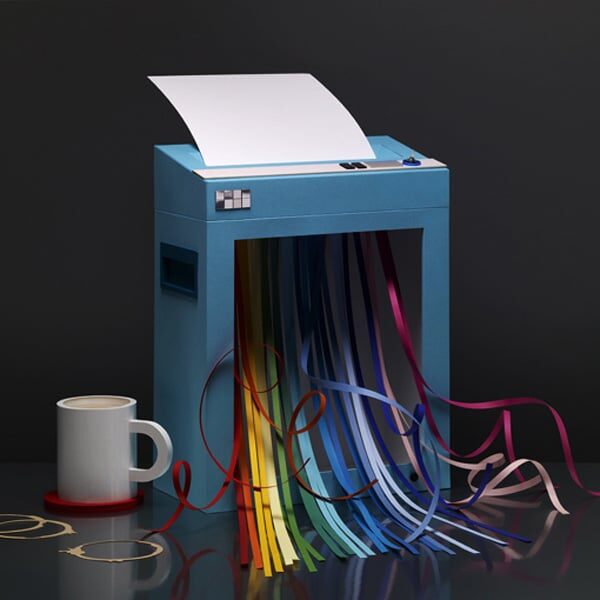
Rainbow shredder: wouldn’t it be amazing if all your bills came out like this? By Chrissie Macdonald, photograph by John Short, {via Birdwatching, a very cool site featuring the work of female graphic designers}

Slate: Why are car paint colors so boring? {via @mimiochun}

Guardian: Northern lights appearing much further south this year than usual – amazing photos. (I’ll be on the hunt for these in Iceland this new year’s eve…)

A team of researchers has developed a 360 degree panoramic ball camera. I love how this adds a playful gesture to a functional object. The camera takes a full panoramic photo when thrown up in the air – must be seen to be believed. {via @brainpicker}

And finally, AoJ was selected as a Weekly Best by the beautifully visual news reading app Flud last week!

I’m in Portland this weekend, and will be joyspotting here. What shouldn’t I miss?

Joy in the news: Small wonders

26 October 2011

26ALTSMALL SPAN articleLarge

Last week I was interviewed for this great piece on the trend towards “tiny sweets” by New York Times writer Julia Moskin. In the article I try to demystify why it is we’re attracted to mini-canolis or Baked by Melissa cupcakes (above) and talk about the “Alice in Wonderland effect,” where big changes in the scale of objects around us, either tiny or huge, make us reconsider our scale in relation to the world in a joyful way.

For more, check out past posts on tiny sweets, giant sweets, and the joy of miniaturization.

NYT: “Small Wonders”
Image: Tony Cenicola/New York Times

Color in the crevices

25 October 2011

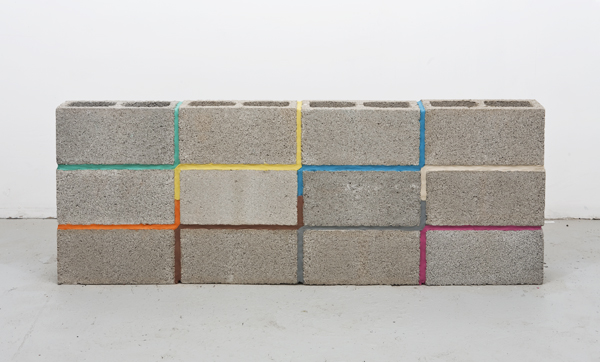
Color doesn’t have to be poured out by the gallon to create a sense of joy. In fact, it’s often better in small doses, as in these works by Ethan Greenbaum. When people say “good fences make good neighbors,” maybe this is what they have in mind.

There’s also a human equivalent. I’ve featured in the past the kooky performance art of Companie Willi Dorner, a troupe of artists who wear brightly colored clothes and then squeeze themselves into tight urban spaces. I recently came across these images, which I hadn’t seen before, of a performance they did in New York last year.

OB KE584 0926bo J 20100926154404

OB KE583 0926bo J 20100926154402

OB KE599 0926bo J 20100926154415

Against a field of grey, color means more. It is a spark of something that has its own energy, something dynamic that has the potential to erupt, to bring more color. As Johannes Itten, father of contemporary color theory, put it: “Color is life: for a world without colors appears to us as dead.” Color, even in tiny doses, signals a desire for life.

Images: Ethan Greenbaum via the artist. Companie Willi Dorner via WSJ.

Emotional cities

18 October 2011

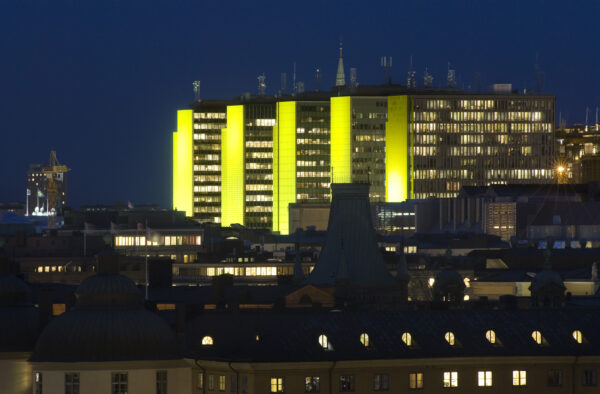
I’m spending quite a bit of time lately contemplating the emotional lives of cities. Between my talk at makeCalgary on designing joyful cities and a related installment in the works for my Core77 column, the topic of how our urban environments make us feel is top of mind at the moment. But it’s rare to see the city reflect our own emotion back at us. This project, Emotional Cities, is a novel exception, using light installations to project the collective emotional state of the city. City dwellers can input their mood on a web site via a simple color-coded schema. The original installation was in Stockholm (above) and a subsequent version was temporarily installed on the Palace Albania in Belgrade.

The project blog is unfortunately a bit dated, so it’s unclear whether it’s still going, but it’s a beautiful experiment nonetheless. I wonder what the effects are of knowing what everyone else in your city is feeling. If it’s a purple day (the lowest of the doldrums, on the Emotional Cities scale), do you feel dragged down? If it’s a red day (the happiest), do you feel a boost?

I can imagine we’ll see more of these types of projects in the near future, as the technology to create light installations is becoming more accessible and platforms like Twitter and Facebook are offering a robust and constantly updated data set on emotion and mood. It would be fun to see more buildings that become, as Emotional Cities says, like thermometers for the feelings of a city.

Ice cream for Africa

9 October 2011

110426 RW Inzozi 40

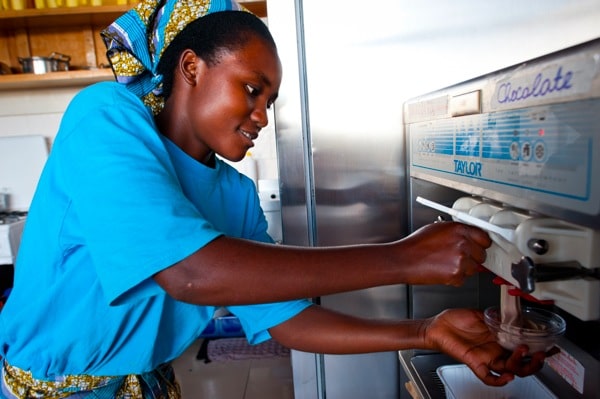
When a country has suffered a devastating genocide and come out the other side to rebuild, the last thing you expect someone to say is, “They could really use some ice cream!” But it’s exactly what Rwandan playwright Kiki Gakire was thinking when she asked Brooklyn ice cream makers Blue Marble to partner with her in opening the first-ever ice cream shop in her recovering country. The shop is profiled in this season’s issue of Edible Brooklyn, and, in addition to filling my eyes with tears, it reminded me that the need for joy is sometimes counterintuitive.

We tend to believe that people who have suffered and are suffering – those who are hungry or destitute or illiterate or injured– must have only rational needs. We see them struggling in the lower tiers of Maslow’s pyramid and we believe that our only way to help them is to address their physical circumstances. With all our best intentions, we build hospitals and schools, wells and roads. And while these are critical applications of our generosity, and we could redouble these efforts many times over and still not meet the need, some very real and valid emotional needs are pushed to the background. As Blue Marble co-founder Alexis Miesen recalls Gakire saying, “There’s no room to dream when survival is the only goal. You can’t just rebuild roads; you have to repair people, and show that life is good.”

Marie rose and jess

After all, survival is not living. And what “superficial” joyful moments (such as those spent catching cold drips off a cone with sprinkles) do for us is give us a model for what living looks and feels like. It restores our will to strive, when we know what we’re striving for. I was first made aware of this in the preface to Virginia Postrel’s The Substance of Style, where she discusses men’s rush to shave, women’s application of nail polish, and the reopening of beauty salons in war-torn Afghanistan after the fall of the Taliban government. She writes, “Liberation is supposed to be about grave matters: elections, education, a free press. But Afghans acted as though superficial things were just as important.”

Reflecting on this, and the Rwandan ice cream shop, I find my hackles raised at the arrogance of judging such desires and efforts frivolous. In a nation whose founding documents enshrine the pursuit of happiness as a right, how can we dismiss this same pursuit in others as wasteful? It’s unreasonable to expect that people wait until basic needs are met to create joy. It’s not how we are built –and with good reason.

These words of Gakire, quoted from the Blue Marble Dreams website leave me ever more convinced that the pursuit of joy in design is vital. These words will stay with me a long time.

Because we struggle most of the time, we find ourselves aggressive against happiness, love, joy, life. When we have children, we teach them that happiness doesn’t exist; that there is no pure love and as legacy, we give them our despair, our debts, our doubts, our tears, our failures… Rwandan women… want to reshape life in its simple and sweetest form. We want to share moments that are not embossed by despair and death… We want to create a space where poverty, disease, illiteracy… are not obstacles to happiness and barriers between human beings… We have to, for the sake of the health of our soul. The ice cream will have the power to reconcile people with life by providing privileged moments when life reminds them that it is also sweet.

You can read more about the shop here, and support Blue Marble Dreams here.

{via Edible Brooklyn}

Stick bombs (what the?)

6 October 2011

Stick bombs. Did you know such a thing existed? This is totally something I would’ve been building as a kid (along with those extremely satisfying domino chains) had I known it were possible. I put a lot of stock in this kind of play: mundane objects elevated by creativity. It’s through these kinds of hands-on explorations that we learn the forces that govern the world, both their limits and their potential.

The best part is the kid’s tutorial about how to make a stick bomb. I especially love the distinction between a “baby cobra weave” and “the other kind of weave.” Send it along to all the kids in your life with a pack of jumbo* popsicle sticks, and get cracking!

*Don’t forget to get the jumbo kind, otherwise it will be really really really really really really hard!