Archive for January, 2012

Joymaker: Naomi London, visual artist

19 January 2012

Jamwall001

Joymaker is a new series spotlighting people who seek to create joy in their work.

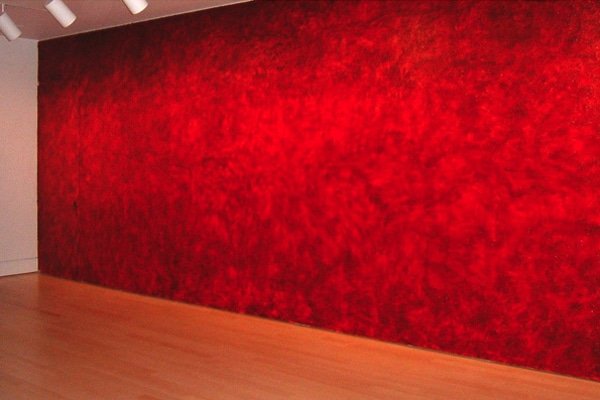
It takes a kind of joyful madness to hand-apply 100 lbs. of raspberry jam to a gallery wall. And that’s exactly what attracted me to the work of Naomi London, a visual artist based in Montreal, who tries to bring a voice for joy and play to contemporary art. London uses joyful forms, visual metaphors, and textures (such as polka dots) to give her audience a sense of delight.

I’m fascinated by the shiny, sticky surface of this enormous red wall. While a red wall might typically take on a violent or alarming quality, the material makes it totally disarming, even childlike. I wonder if it stayed sticky throughout the installation, and slightly fluid, shifting its mottles in a slow gravitational creep towards the floor. Or whether it stayed firm, drying like a giant fruit roll-up. I didn’t ask Naomi these silly questions, but I did ask her some others:

How do you want people to feel when they engage with your work?

I’m very interested in the notion of play in art. I’m hoping that when people see the Jam Wall they can appreciate the unexpected beauty of the colour, as well as the playful absurdity of using this material.

Can you talk more about this connection between joy and absurdity?

I associate absurdity very much with play, and play is joyful. Other connections include humour in the absurd, e.g. the odd rhymes and tongue twisters of several early Dr. Seuss books. I find that there is pleasure in being in a ‘non-logical place’ in your head, which is how I think of the absurd. It’s about the unexpected, fun, and delight that can be felt when exploring things that deliberately don’t make logical sense, but are full of wonder and joy. There is an importance in the purposelessness of the absurd, which is something that makes is joyful (to me) and thus also linked to play.

Jam wall installing

Jam wall sample

What is the role of joy in your work?

I think that joy, beauty, humour and play have been underrepresented in contemporary art over the last few decades. I’ve been interested in trying to address joy and happiness in my work for past ten years or so. I’m currently working on a sculpture installation project in homage to my mother, (who died just over two years ago). Even though it is a memorial work of sorts, I hope that it still somehow evokes a sense of joy.

I’m making a series of balls which are made exclusively out of fabric inherited from my mom. (She was a talented seamstress and made almost all my clothes during my childhood.)

What one object most symbolizes joy to you?

I think I’m torn between seeing the first tulips in early Spring and my favorite large white mixing bowl that I use when I bake a cake.

What’s inspiring you right now?

Colour, and the unexpected use of saturated colour: chartreuse yellow + green, fire engine red, brilliant orange.

What other designers, artists, or creators should Aesthetics of Joy readers know about?

There is an interesting website run by a researcher/academic in Rotterdam:  The World Database of Happiness. The layout of the site is dry aesthetically but I think that its wonderful that the subject of happiness is being studied in this way.

I like the work of Franz West very much. Another artist whose work I really like is Ana Rewakowicz.

You can see more of Naomi’s work here. (In particular, make sure to check out Polka Dot Wall, a site-specific installation I find very joyful.) Images courtesy of Naomi London.

Artful sweets: Rothko tribute

8 January 2012

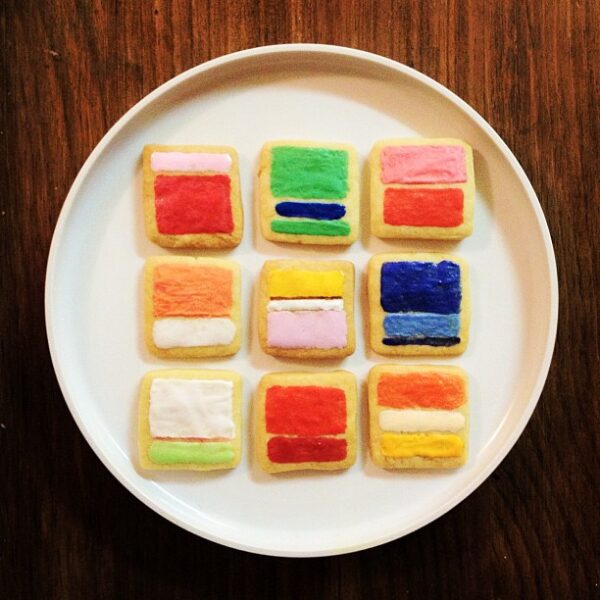
When my brilliant friend Mimi O Chun posted this picture in her Instagram stream with the description “Rothko tribute,” she received a veritable ton of likes and comments, many urging her to turn the concept into a series, or even a full-fledged art bakery. Though Rothko himself was not a terribly joyful sort, these colorful, charming cookies are, and I couldn’t resist sharing the image with you all.

So, let’s hope this becomes the first of many in the Dead Artist Baked Goods series, as Mimi puts it. Though similar in feel to this first installment, I’d like to see some Albers cookies; I also think that Pollock would be pretty fun to make. Whose art would you like to see made into sweets?

Mimi O Chun on Instagram and Twitter

Joyfully over-complicated

8 January 2012

This morning I read with delight about Brooklyn-based artist Joseph Herscher, who is reviving the joy of the Rube Goldberg machine, a device “that accomplishes a simple task in the most complicated way possible.” Using objects such as rolling balls, burning fuses, watering cans, ladles, fly swatters, and even a pet guinea pig, Herscher creates sprawling kinetic sculptures that perform mundane actions such as fixing a cocktail or turning the page of a book. The video above shows one of his simpler machines, La Macchina Botanica, performed at the Venice Biennale and constructed with the help of forty local children. The video on the New York Times site has a broader overview of his work, as well as a new piece called Page Turner, and is well worth a look.

Listen to the crowd as La Macchina Botanica unfolds; their responses offer an illustration of the workings of joy. Around :48, as the long mallet moves so slowly it almost seems stuck, there’s an audible swell of anticipation, followed by a cheer of release as the ball eventually starts rolling again. (Is it possible not to smile along with this moment?) The anticipation breaks the rhythm and creates a point of tension, which provides an opportunity to offer relief. When a piece moves unexpectedly, there are similar exclamations of surprise and enchantment. The unpredictability of the device disrupts our expectations in a clever, pleasurable way. And at the end, when the piece achieves its objective, there is collective celebration, with an outpouring of applause and acclaim. It’s a moment of completion, of joyful narrative resolution. After all, what the device is really doing is imposing a storyline onto a thoughtless act. The task becomes relatively unimportant, as we know it can be accomplished by other means. What is important is completing the story, watching the machine glide smoothly over all the hairy, implausible connections with balletic ease, and resolving the tension introduced by the complexity of the stage set.

At its core, the Rube Goldberg machine is playful, and this is the essence of its allure; it is a task that has been turned into a game. This playful tendency sits in tension with the basic premise of a machine, which Herscher comments on in the Times video: ”Usually machines are things you have to make your life easier, to do things more efficiently.” And efficiency is rarely a route to joy. Play has no role in a world governed by efficiency, because by definition play is not an efficient act. An apparently purposeless activity that is enjoyed for its own sake, play is inimical to the virtues of efficiency: it is slow, wasteful, and distracting. So a playful machine is an inherent absurdity, but as playful creatures living in an increasingly mechanistic world, we finding it intensely compelling. For this reason, the more mundane the task and the more extravagantly silly the process of achieving it, the better the machine. It seems that Herscher’s work is evolving in that direction; it will be interesting to see what he does next.

NYT: Who Says Machines Must Be Useful?

Polka-dotted joy

5 January 2012

It’s a good thing on this blog when something like consensus emerges, and so many of you have sent this my way that it seems we all agree: This is joyful!

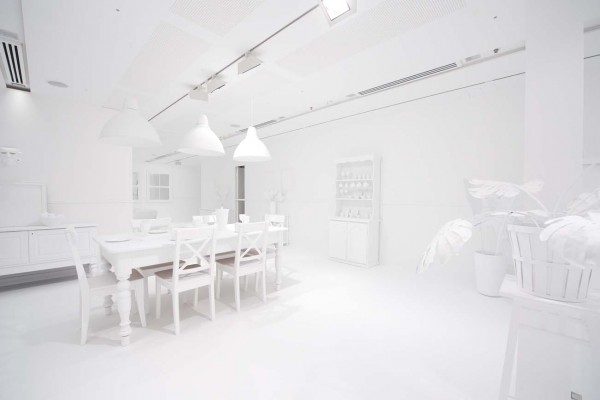
An interactive installation at the Queensland Gallery of Modern Art by the self-described “obsessive artist” Yayoi Kusama, The obliteration room offers a whitewashed home interior as a blank canvas for children visiting the museum to cover with colorful dots. It’s a joyful exercise in participatory art, in abundance, in layering and accretion. Visitors leave their traces on the space. Their experience of the exhibit becomes manifest in the exhibit. And through the innocent randomness of children’s choices, a pleasurable kind of order emerges. The impulses to cover and to cluster — to cover and conquer a new white space or to cluster around a social crowd of others — make the distribution playful and human.

You wonder about the title: obliteration room. Obliteration feels like a word of violence, of emptiness and destruction. How does this jibe with the impetus towards joy? I believe what Kusama is after here is a kind of transcendence. Though the dot has always been a motif in her work (a childhood portrait of her mother shows it covered with polka dots), these vast fields started to become most prominent in her “happenings,” public events designed as protests to the Vietnam War, where people would gather naked to be painted with dots. As Kusama writes in her autobiography Infinity Nets:

Polka dots, the trademark of “Kusama Happening.” Red, green and yellow polka dots can be the circles representing the earth, the sun, or the moon. Their shapes and what they signify do not really matter. I paint polka dots on the bodies of people, and with those polka dots, the people will self-obliterate and return to the nature of the universe.

The polka dots are unifying; they transform individuals and bodies into a larger being. In that process, the self is “obliterated,” so that this sublime feeling of unity can be obtained. You know it if you’ve been part of a synchronized dance, sung in a choir, or participated in another kind of expression of collective joy — for some moments, you cease to be you-in-the-world, and you become an element in a larger organism, a symbiotic cell in a web that sustains and is sustained by you. In this process, pattern and repetition are intensely powerful mechanisms of transcendence (more on this here).

What about the dot itself? Kusama says the shapes do not really matter, but I don’t believe her. The shape of the dot is the cell; it’s the module upon which the whole system is built. A brick of a charcoal is not a block of ice because the atoms of their essence are different. The dot is the atom of the pattern, and it matters. Kusama describes the significance of the dots in her book Manhattan Suicide Addict:

…a polka-dot has the form of the sun, which is a symbol of the energy of the whole world and our living life, and also the form of the moon, which is calm. Round, soft, colorful, senseless and unknowing. Polka-dots become movement… Polka dots are a way to infinity.

There’s an elemental quality to the circle, a primal symmetry that makes it naturally joyful. Roundness connotes safety, invites touch and play. (More on the joy of circles here.) Which brings us back to The obliteration room, which is at its heart deeply playful. Kusama is a heady woman, and there’s a darkness at the root of much of her work (she suffers from hallucinations and lives by choice in a mental institution near her studio in Tokyo), but what I love is that play and joy rise up through these struggles to become the overriding impression of her work. What Kusama achieves in her work is perhaps the greatest transcendence of all: the transformation of pain into joy.

Part of a larger exhibit of Kusama’s work (much of it joyful) called Look Now, See Forever, The obliteration room is on view until March 2012. Thank you to @benbob2u, @jacobyryan, and Liz McCarty for the tips.

For more kids and Kusama, check out this joyful video of a child’s delight at discovering one of her dot rooms.

Via: This is Colossal.
Images: the first four from Queensland Art Gallery and photographer Mark Sherwood, others from Stuart Addelsee, and heybubbles.

Gleðilegt nýtt ár!

4 January 2012

IMG 4934

Happy new year from Iceland!

Beginning a new year in this magical place has me brimming with energy and excitement for the year ahead. It’s been a beautiful and comforting trip, filled with new discoveries, friendships, and moments that simply took my breath away. I have thousands of photos to sort through, and stories aplenty to share with you in the coming days.

I feel restored in a way I haven’t felt in a long time, and this trip has afforded me many chances to reflect on what gives me inspiration and energy to compose and create. As I look back at 2011, I realize that at times I was guilty of living through my laptop, instead of placing myself in the circumstances of the joys I write about, and writing from the feeling. There are times for self-discipline, but that can have its own inertia, and it can lead to writing by brute force, rather than affection. Coming to Iceland, in search of light and magic, was an inspiring way to start a new habit. It will not always be international adventures (if only!), but in 2012 I’m resolved to spend lots more time outside the studio. I hope Aesthetics of Joy will be better for it.

Through the vicissitudes of work and life, across time zones and seasons and continents, I find myself ever grateful to have found such a solid source of happiness in writing this blog. I’ve met more kindred spirits through Aesthetics of Joy than I believed existed when I started. (New Year’s Eve was a perfect illustration of this, but more on that to come.) Thank you for the joy you’ve brought me in 2011, and here’s to even more joy for you all in 2012. Gleðilegt nýtt ár!