Archive for August, 2012

Vibrant apparitions

24 August 2012

Bronsoncaves01

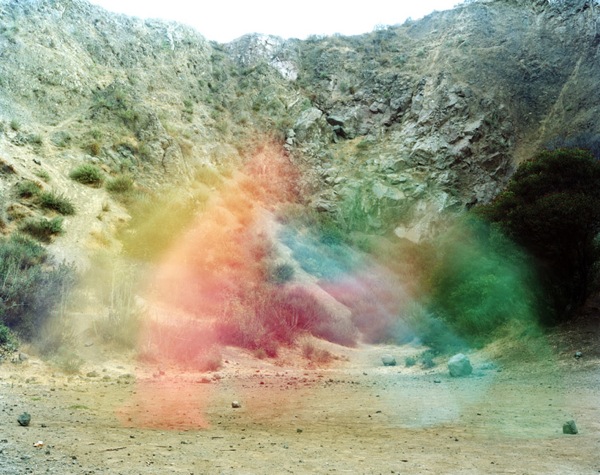
If all ghosts looked like this, perhaps we’d be less afraid of them. These colorful phantasms are the work of artist Brice Bischoff from a series called Bronson Caves. Looking at the piece above, I initially thought these had been done with explosions of colored powder, a technique that has been used in similar works. But for these, Bischoff used a long exposure to photograph dances with large sheets of colored paper. The photographs become records of movements, which gives them a dynamic quality even as stills.

See the rest of the series here, and have a colorful weekend, wherever you are!

Bischoff Bronson Caves 01

Bronsoncaves04

Bronsonadd02

Bronsonadd01

Bronsoncaves02

Bronsonadd03

Via designboom

Writing retreat

17 August 2012

Photo

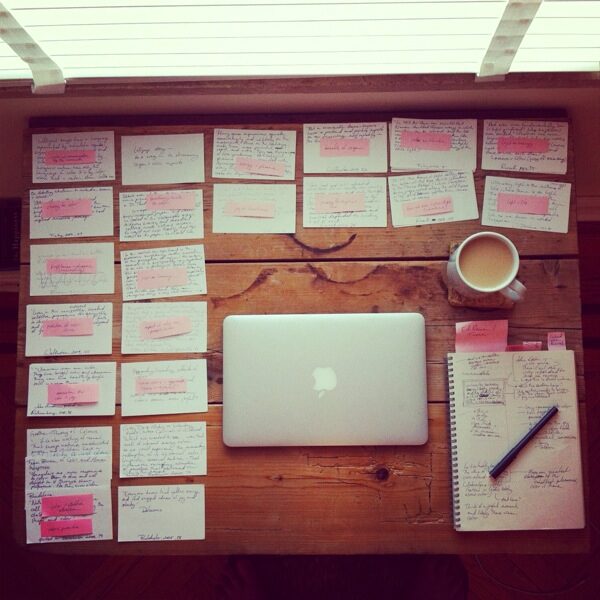
Here’s a little postcard from my Miami writing retreat, where I’m working on chapter two of the book, slowly but surely. I have an endless supply of notecards, a bottomless cup of tea, a quirky dog for company, and family to distract me when I’m ready to take a break. It’s a good way to work.

While looking up a reference yesterday in Diane Ackerman’s breathtaking A Natural History of the Senses, I came across a passage that stopped me in my tracks, and I wanted to share it with you.

When you consider something like death, after which (there being no news flash to the contrary) we may well go out like a candle flame, then it probably doesn’t matter if we try too hard, are awkward sometimes, care for one another too deeply, are excessively curious about nature, are too open to experience, enjoy a nonstop expense of the senses in an effort to know life intimately and lovingly. It probably doesn’t matter if, while trying to be modest and eager watchers of life’s many spectacles, we sometimes look clumsy or get dirty or ask stupid questions or reveal our ignorance or say the wrong thing or light up with wonder like the children we are. It probably doesn’t matter if a passerby sees us dipping a finger into the moist pouches of dozens of lady’s slippers to find out what bugs tend to fall into them, and thinks us a bit eccentric. Or a neighbor, fetching her mail, sees us standing in the cold with our own letters in one hand and a seismically red autumn leaf in the other, its color hitting our senses like a blow from a stun gun, as we stand with a huge grin, too paralyzed by the intricately veined gaudiness of the leaf to move.

This is the wonderfully uncool essence of joy for me: trying too hard and caring too deeply. At the end of the day, you regret the things you didn’t do more than the ones you did.

Have a joyful, creative weekend. I hope you’re out with people you love, or getting lost in something that inspires you. Be clumsy, get dirty, grin big. What else are you here for?

Xx ingrid

Joyful art: Kristen Rego

14 August 2012

Click

While prints are a good way to cover a desert of empty walls without breaking the bank, nothing quite matches the texture and emotional appeal of an original. Enter Buy Some Damn Art. BSDA works with up-and-coming artists to offer original works for sale at reasonable prices. Sales start every Tuesday, flash-sale style, with six to eight pieces by a single artist at a time.

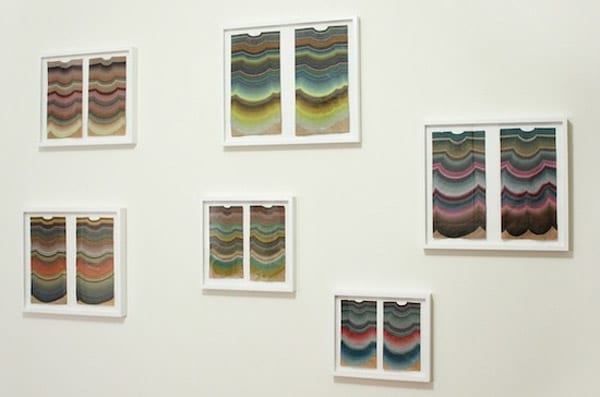
These paintings by Kristen Rego caught my eye; you may have to fight me for one of them. They sort of have a Rosita-Missoni-goes-to-Bushwick vibe, no? I love the cadence of soft gradients and intense, vibrating stripes. Says the artist:

This series began as a secondary practice in the studio. While painting, I began recording each color I mixed on the paper bag to better understand my palette. By the time I reached the bottom, a composition revealed itself. Each line of paint worked together as a whole to create an unexpected illusion. This unintentional break through caught me off guard. It became something to investigate further.

Investigate further (or purchase) here.

Duro10frame full grande

Duro3det 2 grande

12det 1 grande

Images: courtesy of BSDA

Joymaker: Emmanuelle Moureaux, architect

7 August 2012

SugamoShimura307

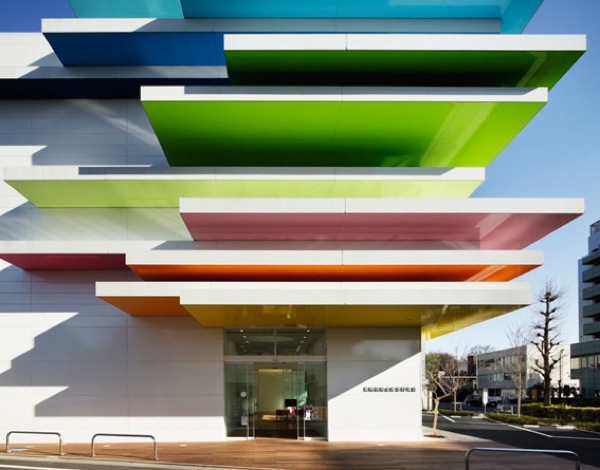
I spend a lot of time looking for joyful things to write about — but sometimes they just manage to fall into my lap. I arrived back from Japan to a note from Emmanuelle Moureaux, a Tokyo-based French architect who works with colors in stunning ways. (I’m particularly enamored of this design above, for the Sugamo Shinkin Bank in Shimura, which she describes on her site as a “rainbow mille-feuille.” Isn’t it just exactly that?) It kills me that I missed seeing her work in person there, but I thought she’d make a great “Joymaker” profile, and she kindly agreed to answer a few of my questions. As you’d expect from looking at her work, she has a deeply thoughtful, intentional approach to working with color. Here’s what she had to say.

How do you want people to feel when they encounter your work?
“Color” is the concept of all my works. With colors, I design new concepts, new atmospheres which will give emotions to people. I use colors in order to give emotions.

SugamoTokiwadai01

SugamoShimura717

What is the role of color in your work?
I use colors as three-dimensional elements, like layers, in order to create spaces, not as a finishing touch applied to surfaces.

When I first visited Tokyo, I was shocked by the city brimming with colors. Bright colors overlapping and intermingling with each other, buildings with different volumes and layers of electric cables forming the cutout sky. To my eyes that grew up in a town made of stone, they appeared beautifully like a painting. I want with my design people feel emotion as I felt when I saw the beautiful colors of Tokyo.

I also feel in the city of Tokyo a sense of layers (buildings with different volumes, electric cables, signboards… overlapping like layers in the space). This layered structure of Tokyo gives me the feeling of depth.

These two elements (colors and layers), inspired by Tokyo, are the basis of my design. “Colors” and “layers” are expressed in a concept I develop in all my projects, the concept of “shikiri”, a made-up word literally meaning “dividing (creating) space using colors” in English. The colors, detached from two-dimensional walls or other surfaces, seem floating in the space and structure it. For example, in the Sugamo Shinkin Bank / Niiza Branch, “squares of colors ” floating in the space structure it, giving it its form and depth. For the Tokiwadai Branch, “leaves of colors” play the same role.

Ed. note: I absolutely love that so many of these projects are banks, places we think of as dry and corporate. (And pretty much the last place you’d expect to find a rainbow!)

“Shikiri” is a colorful partition series, inspired by the Japanese traditional sliding screens. Sliding paper or wood partitions used in the past in all the Japanese houses have almost disappeared now. I feel sad to see these very functional and beautiful Japanese traditional sliding screens fading away now days, so I continue to bring out the essence of the old, and turn them into something modern and practical, which still can be used today. I am trying to reintroduce them in a different way with the concept of “Shikiri”.

CSDesignCenter07

If you were a color, what color would you be?
Multicolor : I never use one color but always combine several colors.

What are some objects that symbolize joy to you?
Color palettes (Pantone etc…), color samples (color acrylic, color textile…)…  Everything which has a lot of colors in the palette makes me happy.

What is one project hiding in your sketchbook that you’d love to build one day?
“Shikiri house”: its concept is defined so I would like to build it. Also, there are very strong relations between the products I design (better to call them “mini architectures) and architecture. Stick chair, shibafu table are designed as buildings. Puzzle box too. Toge would be the structure for a building…. So I would like to realize them in a big scale.

ABC Nihonbashi01

ABC AeonKyoto11

ABC AeonKyoto06

SugamoNiiza26

SugamoNiiza37

I could only post a small fraction of Moureaux’s joyful work here — there are so many more vibrant works on her site. See more here. Incidentally, her thoughts on Tokyo color mirror my reactions to the place, which I posted last week. See here, if you missed it.

Images: courtesy Emmanuelle Moureaux

Polka-dotted house

4 August 2012

Tumblr m0f7y1BqNB1r9qhhio1 1280

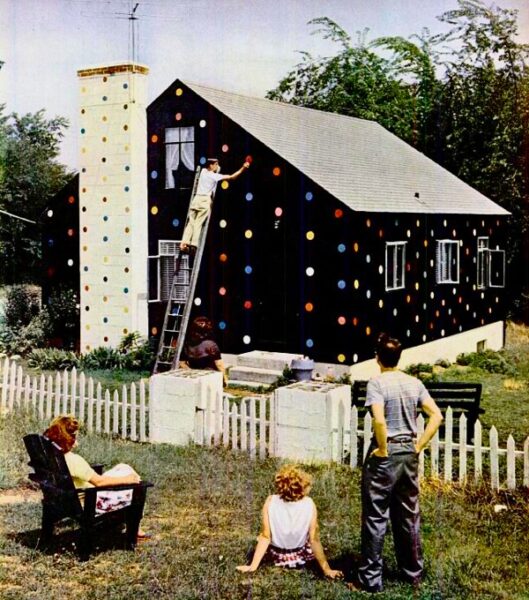
I came across this polka-dotted house on Pinterest and it just made me smile. I had to a do a bit of digging to learn more about it, but managed to find it in an April 14, 1952 issue of Life magazine. The house was the work of Emery Jernquist, who had painted his Warwick, RI house black, but then decided it looked too somber. Says the article:

He and his family painted the house black, then decorated its walls and white chimney with bright-colored polka dots—and it looked just fine. At first people were skeptical but, as he answered their questions politely, Jernquist conducted a private poll and came up with a confident statistic. Seventy-two percent of the critics, he says, like the dots just as much as he does.

Not sure I can vouch for Jernquist’s approach to research, but I’m definitely with the majority on this one. It’s a lovely reminder that what we find joyful is pretty much timeless, a reassuring thought. For more dots, which are ever on my mind these days, check out my pinboard devoted to them.

Joyful packaging: Bermellón

3 August 2012

Anagrama bermellon 01

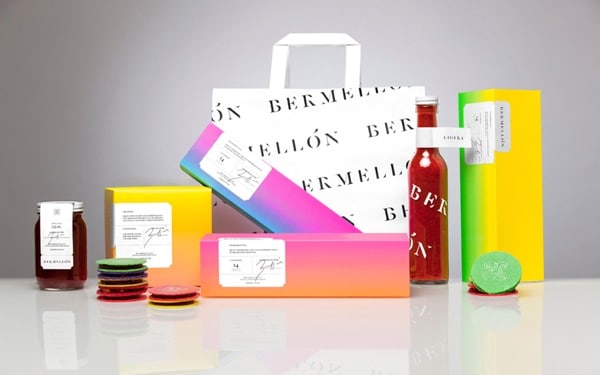
I love the rich, bright gradients on these packages from Bermellón, a Mexican confectionary shop. (Not to mention the bright colors of the sweets themselves.) The colors are as functional as they are eye-catching, reflecting the intense spicy and sour flavors with which Bermellón infuses its sweets.

In this way, the packaging essentially replicates the vibrant skins of fruits, which advertise their sweet, flavorful contents. Research suggests our color vision evolved to find those ripe fruits, so it’s no surprise we feel delight when our food comes wrapped in bright colors. More than just a pretty wrapper, these boxes tap into some of the most primal associations we have with nourishment: they feed the eyes, and also the soul.

Anagrama bermellon 03

Anagrama bermellon 04

Anagrama bermellon 05

Anagrama bermellon 02

9

Also, how great is the pop of yellow on the inside of the bag? A little flash that proclaims: “good stuff in here!”

Images: Anagrama, via Designboom

Gray Malin, À la plage

2 August 2012

Pampelonne Beach St

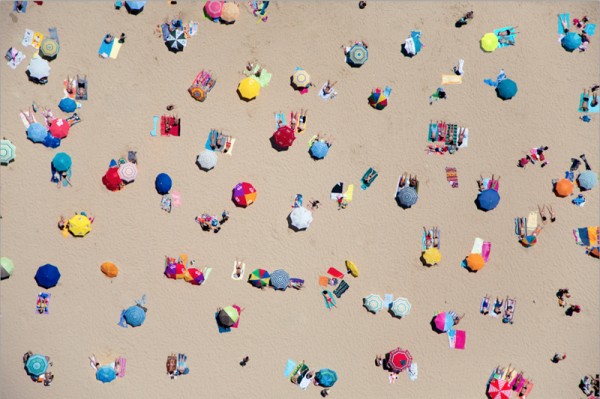
Gray Malin’s À la plage series is like a cross between Massimo Vitali and Richard Misrach, combining the joy of things viewed from above with the sensorial pleasure of beach aesthetics. Malin says:

People and objects become patterns creating repetition, shape and form. These photographs are a visual celebration of color, light, shape—and summer bliss.

What Malin’s done is use perspective to transform a beach into a pattern. Clever, right? In fact, it’s a pattern I was just expressing my love for in my previous post. Polka dots! Essentially, Malin has made patterned canvases from two things we love: polka dots and the beach.

The weekend’s almost here. I hope there’s a beach in your near future, and that you make of yourself the most joyful kind of dot.

Costa de Caprica Portugal 600x399

Secret Beach St

Malibu California 600x399

Coogee Beach Australia 600x399

Nude Beach San Francisco 600x399

Screen shot 2012 07 17 at 12 14 55 PM

Screen shot 2012 07 09 at 7 30 39 PM

Screen shot 2012 07 05 at 11 30 58 AM

Cascais Portugal 600x399

Images: Gray Malin. You can purchase many of these here.
Via: Because I’m addicted (with a hat tip to Em!)