Tickled by Tokyo

18 July 2012

Tokyo7x

In May, I went to Tokyo for work. (If you follow me on Instagram, you may have seen a number of photos with the tag #joyinjapan.) For some, this might mean sitting in a conference center most of the time, getting to eat some sushi between lectures and walk around Shibuya a bit. But lucky me (and I mean that — lucky, lucky me), my job involves being completely out there, talking to people, experiencing the city’s smells, sounds, and colors, drinking a place in until I’m drunk.

Where do I begin with it all? I felt so joyful in Japan I could hardly stand it. Like when someone is tickling you and you’re laughing and you get to a point where feel like you’re going to explode and you beg them to stop — “Please, please, no more!” — and as the feeling subsides and you’re able to breathe again a quiet little voice pipes up inside you, whispering…

“More. Please, just a little more.”

There isn’t one thing to point to, but a thousand small gestures that accumulate to leave you almost woozy with delight. Tokyo is a relentless layering of vibrant color palettes, cute icons, sweet miniatures, subtle textures, and delicate objects arranged just so. (And also some things that are so crazy they make your head spin around in full revolutions.) It’s a testament to a people that has a true material culture, a people that feels kinship with the objects in their lives and understands that beautiful things are valuable not as status symbols but because they suffuse beauty into the spaces around them.

Alain de Botton writes: “What we seek, at the deepest level, is inwardly to resemble, rather than physically to possess, the objects and places that touch us through their beauty.” This is the crux of what I felt in Tokyo. I sensed the beauty that emanated from the perfectly balanced, crafted way of things, and wanted to strive for more of this in myself. A beautifully crafted plate of food or a carefully lettered sign showed care, and it made me want to slow down and appreciate the care my hosts put into these small gestures. My travel companions and I all changed our behavior over the course of the week. We were more polite, we noticed more, we ate more slowly. We let the place change us in a good way.

IMG 7950

Tokyo7x6

IMG 3821

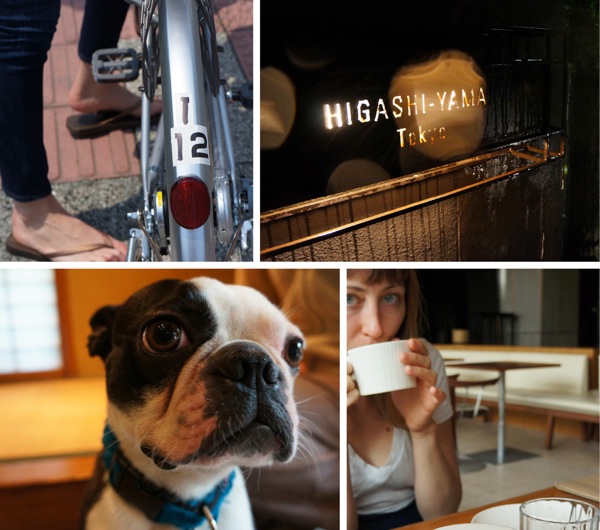
Every day we walked the city until our feet hurt. At night, I would wake up at about 4am from the jet lag, my feet still pulsing, hoping a few more hours of sleep would ease them. We took thousands of photos. There was a surprise around nearly every corner — we were afraid to put our cameras away. My travel companions, fellow IDEOers Anthony and Erika, and I (all above) were lucky to have some amazing hosts. In some of my photos you’ll see Mike, a good friend of mine since my first day at IDEO, who is now in our Tokyo office. He wins the “host of the year” award, making sure we saw his favorite places (such as the tiny coffee shop pictured top right and lower left, below), ordered for us in places with no English menus, and even pointed us towards very specific observations, like that that gorgeous reflection of the copper sink in Higashiyama’s bathrooms (below).

I was also excited to spend some time with Azusa, a friend of mine from Pratt (you may remember her joyful work from this post a few years back). Azusa took us one night to get yuzu ramen (noodles flavored with yuzu, a Japanese citrus fruit) and after, we discovered a tiny little bar with only about ten seats. There, a bartender proceeded to make the most thoughtful screwdriver I’ve ever seen. The screwdriver must be the most thoughtless of cocktails, sloshed together in questionable proportions, often in a Solo cup. But this bartender showed me the screwdriver-as-art-form: squeezing the juice by hand, shaking the drink as if he were in slow motion. I don’t think I will ever see a cocktail performed in that way again, totally simple, yet with honor for its simplicity.

Tokyo7x7

We stayed our last few nights at the Claska, technically the only boutique hotel in Tokyo. The Claska is a wonderful, odd place for many reasons. It is a bit out of the way, but it has a gorgeous sixties modern lobby and the most beautiful gift shop, full of perfect, quirky artifacts. But by far my favorite feature of the Claska is the retro dog grooming salon just off the lobby (pictured above). A long window, positioned at eye level just by the lobby bar, peeks into the space, where you can watch dogs get fluffed to the max by a passel of groomers using humorously space-age dryers. I never saw a dog walk out of there that didn’t look like it couldn’t blow away on a light wind.

Sushi

A highlight was a visit to Midori Sushi in Shibuya, where you order from an iPad and the sushi is delivered to your table by toy trains. Toy! Trains! You might think that with such an emphasis on precision and self-control, the Japanese would not show much evidence of their “inner child.” But in fact, the inner child is alive and well in Japan, breaking through in an unabashed embrace of cuteness and play, even in serious situations. The toy train idea is something that seems to have been thought up by an eight year-old. Here in the states it would be discarded as ridiculous, but fortunately the Japanese don’t censor themselves in this way.

Tokyo7x5

On our very last day in Tokyo, Erika and I were wandering around the area near Gakugei-Daigaku station and spotted these beautiful books. Stripped of their jackets, they were selling for pennies apiece, and we spent the better part of an hour looking for ones with interesting illustrations to bring back with us. Inside one were these very simple, beautiful erotic line drawings. (Japan has a long tradition of exuberant erotic art, mostly woodblock prints known as shunga.) Azusa was embarrassed but obliging in translating the chapter headers for us. (Nothing too exciting, or I promise I would’ve written them down to share.)

IMG 3837

Hidari Pocket in Naka Meguro is the tiniest, cutest café I have ever seen. The garlands, the little drawings on the side of the van, the tiny weathered stools, the drawings of flowers in the foam on the mocha — it was just too much. In moments like this, we often found ourselves overcome, aesthetically, with the experiences we were having. It was almost as if the circuits in our brains couldn’t handle all the beauty, harmony, cuteness, and cleverness. By a few days in, we actually coined a name for this: design convulsions. Suffice it to say, when three out of four designers at a table have their cameras pointed at a very ordinary object, you can be pretty sure it’s a collective design convulsion.

IMG 7039

Tokyo7x4

There is a palimpsestic quality to Tokyo that you start to discover, as you adjust to it and it starts to unfold for you. There are layers that smack you in the face with their daring or their sweetness. But underpinning these are tiers of sensation: patterns, textures, and reflections that are seductive in their simplicity. I came back so filled with inspiration, I was nearly vibrating. I’ll share more in the coming days, about some specific things that just took my breath away. In the meantime, have you been to Tokyo? What joys did you see there?

Images: a mix of mine and Erika Lee’s; most of the better ones are Erika’s!

Joyspotting 2: little, simple, wonderful

18 December 2011

Extraordinary art on pencil tips by dalton ghetti

In the busyness of the holidays, sometimes it’s hard to find time to stop, breathe, and take note of joyful moments. Slow down for a minute with some tiny things:

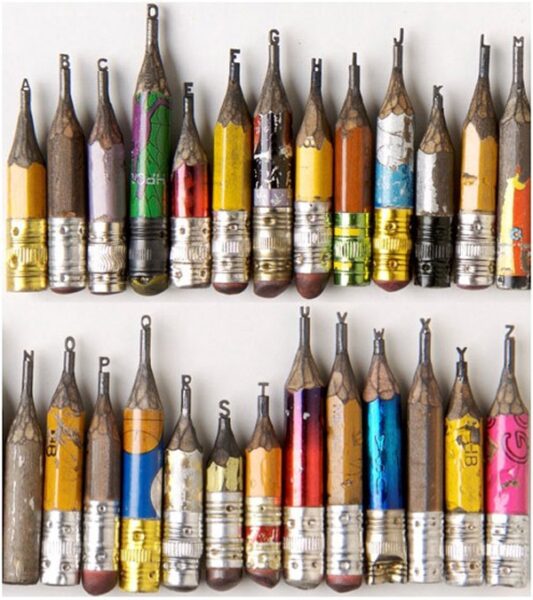
Artist Dalton Ghetti carved this amazing alphabet on pencils. Odd but lovely. {via Odd Stuff Magazine}

Many small pleasures beat a few larger ones. (More reason to indulge in tiny sweets!)

Bees have feelings, too. New research in Scientific American suggests these remarkable little insects have an emotional life.

Silly little art project, low-fi and delightful: Single Lane Superhighway. Go draw a car. It makes you feel a part of something. {via @alexandrapulver}

“It was like finding little gems.” Photographer David Liitschwager captured all the living creatures within a cubic foot in a variety of different climates to draw attention to the abundance of denizens of a swath of habitat that “could fit in your lap.” National Geographic. {via The Guardian}

Stay sane this pre-holiday week. Try not to rush through, but find the beauty in the craziness, and savor it!

Joy in the news: Small wonders

26 October 2011

26ALTSMALL SPAN articleLarge

Last week I was interviewed for this great piece on the trend towards “tiny sweets” by New York Times writer Julia Moskin. In the article I try to demystify why it is we’re attracted to mini-canolis or Baked by Melissa cupcakes (above) and talk about the “Alice in Wonderland effect,” where big changes in the scale of objects around us, either tiny or huge, make us reconsider our scale in relation to the world in a joyful way.

For more, check out past posts on tiny sweets, giant sweets, and the joy of miniaturization.

NYT: “Small Wonders”
Image: Tony Cenicola/New York Times

Wearable microcosms

17 December 2009

cute_rings

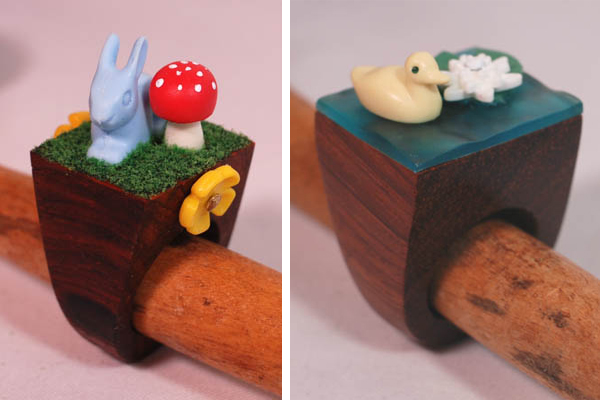
These sweet rings by John Medley and his partner just make me smile. They’re like little wearable worlds —  cute microcosms that travel with you wherever you go.

Available here. (I find their profile totally joyful too!)

Little sweet tooth

10 September 2009

tiny-sweets

I’m glad Stéphanie Kilgast mentions that these delicious-looking treats are 1:12 scale on her Flickr page, because otherwise I would be calling to ask how she could FedEx over some of those macaroons from Paris. Unfortunately you can’t eat these tiny cakes, but you can buy them on her Etsy page, or gaze admiringly at the many others on her photostream.

I’ve written about miniaturization before on the site, and why we seem to love tiny things. It’s a phenomenon I trace back to childhood and the downscaling of all the elements of real life into toys. As adults, tiny things give us an Alice-in-Wonderland kind of perspective shift. They make us aware of our scale, and allow us to see things in a new way. (They’re also just pretty darn cute.)

Thanks to Lisa at My Artful Life for the tip!

Stamps to make you repatriate…

27 August 2009

stamps

I’d consider leaving the country to get to use these on my mail, if only they weren’t fictitious!

From A Field Guide to the Stamps of the World by Gavin Potenza, available in poster form here.

The joy of faux tilt-shift photography

17 July 2009

3485168390_a701503c5a_b

The scene in the photo above has the precious quality of a carefully constructed scale model, the meticulously crafted miniature boats floating in an inch-deep bay. But in fact, this fakeness is fake, because this is no model — it’s a real scene made to look tiny and toylike with the use of a Photoshop technique known as faux tilt-shift photography.

You can see many more examples like this on Flickr, in pools like this one, where tilt-shift enthusiasts showcase their best work. It’s especially amusing when tilt-shifters use photos with people in them, as in the one below. The people look like toy figurines, and it’s easy to forget for a moment that those are real people with names and lives, and not molded pieces of polystyrene.

tiny_people

It’s also wonderful when you see a familiar scene, like this typical New York City block, transformed through tilt-shift. This transformation, from familiar to strange, is at the heart of what’s joyful about tilt-shift. It’s about more than just getting the joke. Yes, there’s a moment of revelation where you discover what you’re looking at is actually a new perspective on something you know well. But jokes get old, punchlines fail to have the same impact once you know what’s coming, and yet these photos make me smile whenever I see them. I think it’s because the apparent scale shift jars us out of our customary position in relationship to the world around us. Through these distortions, we’re given a moment in which we can realize how small we are, how tiny even our biggest structures can seem, and this momentary change in perspective is liberating.

ny_tilt_shift

Photos, top to bottom: mellocakes, nurpax, agent j loves agent a

Small pleasures: the joy of miniaturization

15 July 2009

img_3205

It starts with babies. Tiny people with tiny ears, tiny noses, and tiny toes. Tiny hats and shoes follow, and for some reason these ordinary things, shrunken down to impossible proportions, give us a big swell of joy.

Kids get bigger, but the miniaturization continues. Toy cars, soldiers, and animals fill our days, all perfect scale models of the real things. Dollhouses — entire worlds in miniature — involve us in hours of joyful play. And I don’t know if it’s because tiny things remind us of these toys and the freedom of childhood, or whether we have a purely visceral reaction to their comical scale, but it does seem that many miniatures have a joyful quality to them and we often seek to miniaturize things even in the adult world.

Think about cupcakes, a craze you’d have to live under a rock not to have noticed. In recent years these small doses of sweetness have been in such high demand by adults, they seem to be capable of keeping entire blocks of the West Village economically afloat. Fruit is getting smaller too. Clementines and cherry tomatoes have been around awhile, but there’s been a growing prevalence of those tiny apples and pears, and now apricots (which already seemed pretty tiny to me) have shrunken into candycots, and watermelons have gotten “personal-sized.”

There’s a pragmatic rationale for small urban cars, but it doesn’t explain why drivers of the Mini Cooper and the Smart car always seem so smiley. We also find miniatures associated with special occasions known to be joyous, such as Christmas ornaments, souvenirs of famous places, and those bride-and-groom caketop miniatures without which any wedding would surely be incomplete. These “tiny worlds” designed and sold on Etsy by Amy Powers seem take a cue from these inspirations, trying to distill moments of joy into something small, pure, and permanent.

5

Miniatures are like suggestions of another world, a world of a different scale, but often also a world of a different time or place. Like these miniature tuk-tuks (which, even at life-size, are already miniatures) ensconced in the lighting fixtures of New York Thai restaurant (top photo), they bring distant memories or dreams into a concrete physicality. They also work on a purely visceral level, transforming the world around them in powerful ways. These lamps would look quite ordinary, but the mini tuk-tuks make them look enormous, like giant soap bubbles in comparison. Much the way our hands look giant when held palm-to-palm with a child’s, or a Great Dane looks like horse next to a toy poodle, our world reveals itself to us in new ways in the presence of an out-of-scale element. There’s a transcendence in that feeling that the world is larger than life, or in feeling like we’ve become kids again.