Gray Malin, À la plage

2 August 2012

Pampelonne Beach St

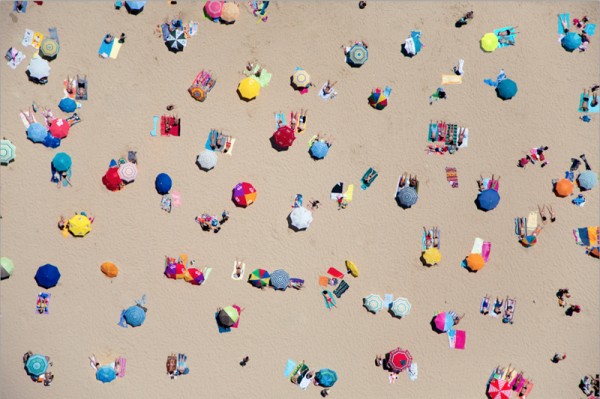
Gray Malin’s À la plage series is like a cross between Massimo Vitali and Richard Misrach, combining the joy of things viewed from above with the sensorial pleasure of beach aesthetics. Malin says:

People and objects become patterns creating repetition, shape and form. These photographs are a visual celebration of color, light, shape—and summer bliss.

What Malin’s done is use perspective to transform a beach into a pattern. Clever, right? In fact, it’s a pattern I was just expressing my love for in my previous post. Polka dots! Essentially, Malin has made patterned canvases from two things we love: polka dots and the beach.

The weekend’s almost here. I hope there’s a beach in your near future, and that you make of yourself the most joyful kind of dot.

Costa de Caprica Portugal 600x399

Secret Beach St

Malibu California 600x399

Coogee Beach Australia 600x399

Nude Beach San Francisco 600x399

Screen shot 2012 07 17 at 12 14 55 PM

Screen shot 2012 07 09 at 7 30 39 PM

Screen shot 2012 07 05 at 11 30 58 AM

Cascais Portugal 600x399

Images: Gray Malin. You can purchase many of these here.
Via: Because I’m addicted (with a hat tip to Em!)


Aromatic graffiti

30 September 2009

scent_graffiti

I love non-traditional street art. Yarnbombing, seedbombing, mossbombing, LED throwies — anything that brightens and transforms the urban environment really brings me a sense of joy.

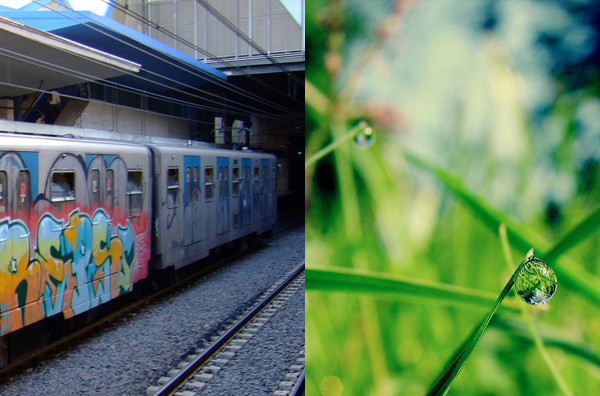
So this scent graffiti by Mitchell Heinrich really charms me. Scent is a particularly interesting medium for several reasons. Heinrich says:

Scent is interpreted by the limbic system which is very closely tied to emotion and memory. This leads me to believe that interacting with people using scent can potentially be a much more powerful medium than paint since people experiencing it can’t help but react to it. The goal of this project is to realize the potential of smell as art and to explore different ways of using it to interact with people.

True, but this is only part of the story. Scent requires proximity in a way that vision does not. Visual understanding is nearly immediate once something enters our eyeline. But scent is based on the diffusion of volatile chemicals through the environment, so it reaches us in a more gradual way. It’s like vision is a sudden downpour and scent is a slowly increasing drizzle. So the quality of the surprise achieved is fundamentally different.

Also, in a chat I had a few weeks ago with Dr. Pamela Dalton at the Monell Chemical Senses Center, I learned one of the most important factors in scent processing is context. Many scents occur in multiple contexts. One example is butyric acid, a molecule that in some situations we recognize as aged cheese, and in others we recoil from as the odor of sweaty feet. Without realizing it, we constantly use contextual information to interpret scents and determine how to react emotionally to them. This fact creates some interesting possibilities for scent art. By taking scents strongly identified with a particular context — say cut grass or baking cookies — and pairing them with urban contexts that have a strong associated odor, the effect could be quite dazzling and dislocating. It could also work the other way, creating a powerful negative emotional response. But either way, it likely would cause to reflect on the environment more mundane sensory stimuli as well, and develop a clearer picture of how those make us feel.

Scent graffiti is also fleeting, and that transience is appealing. So often graffiti is not about destruction but about reclamation: the desire to form some kind of personal relationship with the anonymously-designed city that contains and constrains us. To shape this looming environment in some small way. The evanescence of aroma allows for continually shifting scent-images to alter the city, allowing a constant redesign and rediscovery of public space.

Here’s a link to an instructable on how to create your own scent spray cans. Images: attack the darkness and circulating.

{via PSFK}

Differences between happiness and joy

25 May 2009

happiness-wide

A friend sent me this fascinating article from June’s Atlantic on the Grant Study, a 60+ year exploration into what makes people live happy and fulfilled lives. In some ways, this long-term macro focus is the opposite of my work, which looks at the micro, the momentary flashes of delight in our lives. But there’s a common goal, to understand the underpinnings of positive emotion, and to understand how to create more of it.

The most interesting aspect of the article to me is how the writer and the scientist grapple with the inconsistencies in the data, the people who had every reason to be happy but turned miserable, or the people who led underwhelming lives but looked back on them with beatific satisfaction. These paradoxes recall others in the study of happiness, namely this oft-cited one also mentioned in the article: “How is it that children are often found to be a source of “negative affect” (sadness, anger)—yet people identify children as their greatest source of pleasure?”

I wonder if the answer lies in the moment to moment nature of life, and of joy. Children bring moments of joy, even if they also bring other effects (like less time for other passions, tiredness from keeping up with them, and certain relationship stresses and conflicts) and the intensity of those moments outweighs longer periods of feeling other emotions. Certain experiences occupy disproportionate amounts of space in our memories, such that 2 weeks of vacation a year holds more emotional memory value than 50 weeks of work.

I’d go further to speculate that the pleasurable experiences that constitute joy tend to be richer in sensory value than our everyday experiences, both because of their natural intensity and because of the relative difference between them and the sensations to which we’ve become habituated. So perhaps in storage and on recall they activate more brain regions than normal memories? I don’t know, I’m not an authority in this area, but it’s a question for the neuroscientists…