Artful sweets: Rothko tribute

8 January 2012

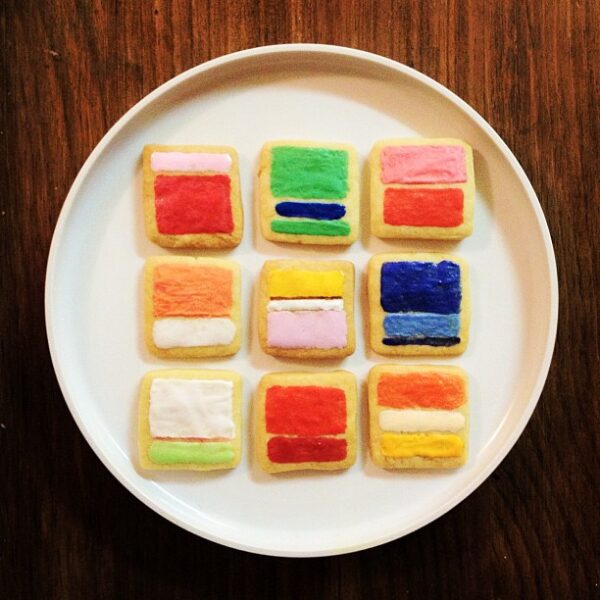
When my brilliant friend Mimi O Chun posted this picture in her Instagram stream with the description “Rothko tribute,” she received a veritable ton of likes and comments, many urging her to turn the concept into a series, or even a full-fledged art bakery. Though Rothko himself was not a terribly joyful sort, these colorful, charming cookies are, and I couldn’t resist sharing the image with you all.

So, let’s hope this becomes the first of many in the Dead Artist Baked Goods series, as Mimi puts it. Though similar in feel to this first installment, I’d like to see some Albers cookies; I also think that Pollock would be pretty fun to make. Whose art would you like to see made into sweets?

Mimi O Chun on Instagram and Twitter

Lollipop law

18 August 2011

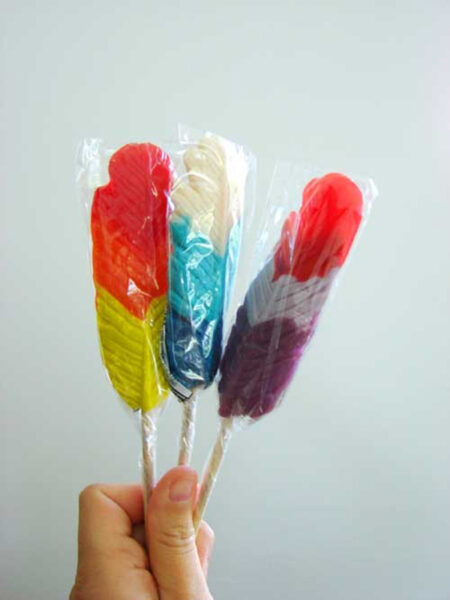
What do lollipops have to do with keeping the peace? Surprisingly, more than a little. A recent initiative by a city council in the city of Victoria in British Columbia offered free lollipops to drunken revelers leaving bars to cut down on noise and violence after a night out. Councillor Charlayne Thornton-Joe explained that the treats make it hard for inebriated partiers to be too loud, and that they minimize dialogue that could lead to brawls. More practically speaking, they also regulate blood sugar and, like pacifiers, have a calming effect.

While there’s no hard evidence that the lollipops worked, councillor Thornton-Joe says that it seemed to be so effective that the city is considering making it a permanent program. It’s a charming idea – that something so childlike and innocent could disarm a rowdy bunch. And it makes for a joyful image, to imagine adults appeased by candies on sticks.

This is aesthetics of joy at their beguiling best. Sugar, color, and a form that evokes nostalgia for childhood – these things have real power. Contrary to so much of what we are taught, they are not just styling or superficial extras. They are phrases in the language with which our stuff speaks to us, quietly shaping our desires and our behavior. It’s a joy to see them applied in a such a novel way, and for such playful problem-solving. I hope to see this idea take off in other places too.

Photo: Beautiful feather lollipops by Abbey Hendrickson of Aesthetic Outburst, via Pinterest
NPR: “Lollipops: Pacifiers for Bar Patrons?” 

Cotton candy

16 October 2009

cottoncandy2

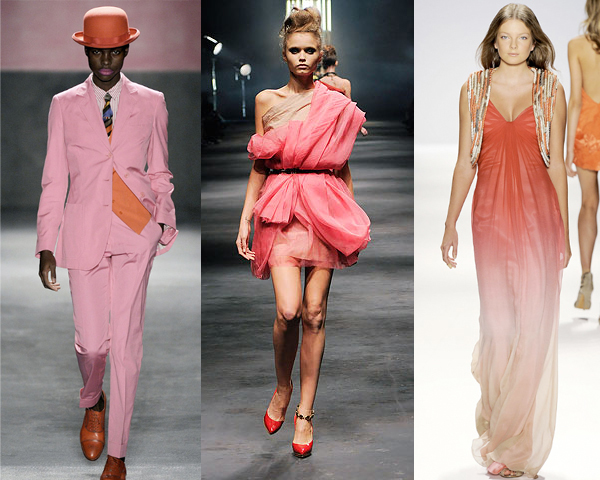
Wrapping up the post-game fashion week joyfinding, it’s time to let the inner child out. The Barbie-loving, Bubble-Yum chewing, magenta tutu-wearing little girl inside of me danced around the apartment when she saw these light, confected pinks, and then ran off to eat pashmak for breakfast.

The cotton candy vibe extended weirdly even to the hair at some shows, where technicolor riffs on afros (almost none of them black) sweetly framed the traditional model death-stares. Vuitton took the cake for volume, but it was Rei Kawakubo’s stiff, fuzzy ponytails that managed the fine balance between kawaii and cool, and really captured the irrepressible joy of spring.

hair1

L to R, Top: Paul Smith, Lanvin, Carlos Miele. Bottom: Luella, Louis Vuitton (I almost wrote Vuitoon – Freudian slip?), and Commes des Garcons. There were candy colors (not just pinks) at tons of other shows — Giles, V+R, etc. Also, Tavi made a rainbow of Lanvin dresses that is worth a peek.

I’m lying low this weekend to work on the book (the rainclouds above have thoroughly endorsed this plan) so you may see a few atypical weekend posts. Happy Friday!

Gourmet + the joy of food

6 October 2009

gourmet

Oh, how I loved Gourmet. By far my favorite of the foodie mags, it’s always been a voice for the joy of food. Gourmet celebrated not just food’s flavor and aroma, but food as a visual art, food as a universal language, food as a carrier of cultural meaning and dialogue, food as biography of a food-lover’s life. It facilitated this passion for the short on time or skills to some degree, but never compromised the indulgent joy of a day arranged around cooking and eating by bludgeoning it with excessive pragmatism (ahem, Bon Appetit). I would have subscribed at three times the price to have kept it alive.

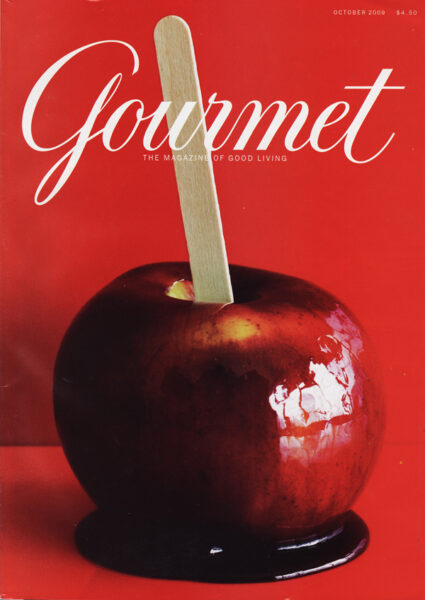
Aesthetics of joy are alive and well on this penultimate cover, so much so I’d already planned a post around it before this sad news arrived. Bright, vibrant color; the spherical apple; the shiny surface; the sticky sweetness you can practically taste just by looking at it — this is the joy of autumn made visible, and a clear illustration of what food culture is losing in Gourmet.

Big sweet tooth

11 September 2009

giant_sweets1

Yesterday I posted on miniature sweets and the perspective shift that comes from out-scaled items. On the opposite extreme, giant sweets seem to captivate artists and designers the world over. And because their enormity makes them impossible to overlook, the giant objects seem to have an even stronger Alice-in-Wonderland effect.

Claes Oldenburg and Coosje van Bruggen’s Dropped Cone makes me feel like a Lilliputian living in a land where if I’m lucky, I might catch a dripping from a giant toddler’s melting ice cream. Martha Friedman’s Waffle (currently on view here in Brooklyn) and street artist Celso’s Apples have the similar effect of making me reconsider my own scale and the scale of all the common objects around me.

Of course, scale shifts can go both ways. Oversized objects can have the effect of making us feel ill at ease with our place in the universe and out of control of the events that shape our lives. Oldenburg and van Bruggen’s Knife Slicing Through Wall sculpture highlights this darker side of scale shifting. But sweets are inherently joyful — the sugar, the color, the aroma of baking, the ritual of eating — so giant treats create a much more pleasurable transformation of perspective: magical, childlike, and fun.

Brooklyn designer and studiomate of mine Azusa Hirota brings this whimsical quality to functional objects, allowing interaction with these giant sweets, instead of just viewing. Her chair, a giant cupcake, puts the user in between the cake and icing, so that you’re literally surrounded by the experience. Everyone I’ve seen sitting in it seems to have a big smile on their face. Her giant doughnut, designed in collaboration with Tawny Hixson, transforms a common inner tube into an object of delight. I remember my days spent tubing down the Nam Song river in Vang Vieng, Laos, and it strikes me that it would have been such a wonderful thing to see fellow travelers drifting gently downstream on giant Krispy Kremes!

giant_sweets2

See more of Azusa’s work here. Thank you Maggie, for the waffle tip that inspired the idea for this whole post!

Did I miss any wonderful giant sweets out there? Let me know.

Little sweet tooth

10 September 2009

tiny-sweets

I’m glad Stéphanie Kilgast mentions that these delicious-looking treats are 1:12 scale on her Flickr page, because otherwise I would be calling to ask how she could FedEx over some of those macaroons from Paris. Unfortunately you can’t eat these tiny cakes, but you can buy them on her Etsy page, or gaze admiringly at the many others on her photostream.

I’ve written about miniaturization before on the site, and why we seem to love tiny things. It’s a phenomenon I trace back to childhood and the downscaling of all the elements of real life into toys. As adults, tiny things give us an Alice-in-Wonderland kind of perspective shift. They make us aware of our scale, and allow us to see things in a new way. (They’re also just pretty darn cute.)

Thanks to Lisa at My Artful Life for the tip!