Joymaker: Emmanuelle Moureaux, architect

7 August 2012

SugamoShimura307

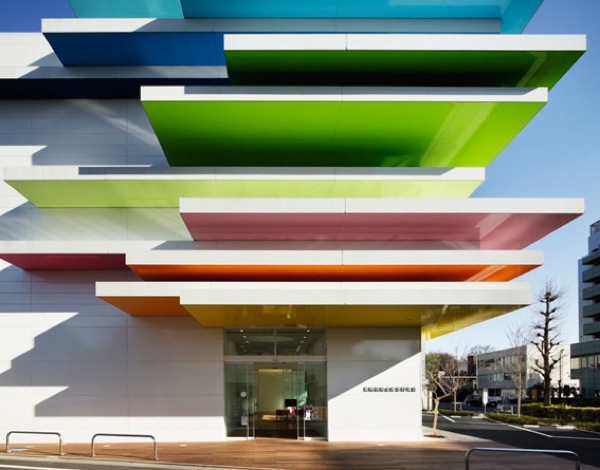
I spend a lot of time looking for joyful things to write about — but sometimes they just manage to fall into my lap. I arrived back from Japan to a note from Emmanuelle Moureaux, a Tokyo-based French architect who works with colors in stunning ways. (I’m particularly enamored of this design above, for the Sugamo Shinkin Bank in Shimura, which she describes on her site as a “rainbow mille-feuille.” Isn’t it just exactly that?) It kills me that I missed seeing her work in person there, but I thought she’d make a great “Joymaker” profile, and she kindly agreed to answer a few of my questions. As you’d expect from looking at her work, she has a deeply thoughtful, intentional approach to working with color. Here’s what she had to say.

How do you want people to feel when they encounter your work?
“Color” is the concept of all my works. With colors, I design new concepts, new atmospheres which will give emotions to people. I use colors in order to give emotions.

SugamoTokiwadai01

SugamoShimura717

What is the role of color in your work?
I use colors as three-dimensional elements, like layers, in order to create spaces, not as a finishing touch applied to surfaces.

When I first visited Tokyo, I was shocked by the city brimming with colors. Bright colors overlapping and intermingling with each other, buildings with different volumes and layers of electric cables forming the cutout sky. To my eyes that grew up in a town made of stone, they appeared beautifully like a painting. I want with my design people feel emotion as I felt when I saw the beautiful colors of Tokyo.

I also feel in the city of Tokyo a sense of layers (buildings with different volumes, electric cables, signboards… overlapping like layers in the space). This layered structure of Tokyo gives me the feeling of depth.

These two elements (colors and layers), inspired by Tokyo, are the basis of my design. “Colors” and “layers” are expressed in a concept I develop in all my projects, the concept of “shikiri”, a made-up word literally meaning “dividing (creating) space using colors” in English. The colors, detached from two-dimensional walls or other surfaces, seem floating in the space and structure it. For example, in the Sugamo Shinkin Bank / Niiza Branch, “squares of colors ” floating in the space structure it, giving it its form and depth. For the Tokiwadai Branch, “leaves of colors” play the same role.

Ed. note: I absolutely love that so many of these projects are banks, places we think of as dry and corporate. (And pretty much the last place you’d expect to find a rainbow!)

“Shikiri” is a colorful partition series, inspired by the Japanese traditional sliding screens. Sliding paper or wood partitions used in the past in all the Japanese houses have almost disappeared now. I feel sad to see these very functional and beautiful Japanese traditional sliding screens fading away now days, so I continue to bring out the essence of the old, and turn them into something modern and practical, which still can be used today. I am trying to reintroduce them in a different way with the concept of “Shikiri”.

CSDesignCenter07

If you were a color, what color would you be?
Multicolor : I never use one color but always combine several colors.

What are some objects that symbolize joy to you?
Color palettes (Pantone etc…), color samples (color acrylic, color textile…)…  Everything which has a lot of colors in the palette makes me happy.

What is one project hiding in your sketchbook that you’d love to build one day?
“Shikiri house”: its concept is defined so I would like to build it. Also, there are very strong relations between the products I design (better to call them “mini architectures) and architecture. Stick chair, shibafu table are designed as buildings. Puzzle box too. Toge would be the structure for a building…. So I would like to realize them in a big scale.

ABC Nihonbashi01

ABC AeonKyoto11

ABC AeonKyoto06

SugamoNiiza26

SugamoNiiza37

I could only post a small fraction of Moureaux’s joyful work here — there are so many more vibrant works on her site. See more here. Incidentally, her thoughts on Tokyo color mirror my reactions to the place, which I posted last week. See here, if you missed it.

Images: courtesy Emmanuelle Moureaux

Designing joyful cities

30 September 2011

MakeCalgary

Tonight I had the privilege of speaking at makeCalgary, a conference that looks to design for inspiration on instigating catalytic change in cities. The theme is “provoking Calgary’s next chapter,” and to that end I’ll be sharing some design principles for joyful cities, using examples from New York (which has been experiencing its own waves of inspiring change lately). I was incredibly impressed with the level of dialogue and especially the sensitivity to emotion among the crowd. Calgary is clearly primed for joyful change.

One fascinating discussion emerged around the idea of winter. A commenter observed that very few images in the presentations showed winter, of which Calgary has a hefty one. How do we create joy when the landscape forces us indoors, or at least makes it less natural to want to be outside? A fellow speaker, Rob Adams, head of urban design for the city of Melbourne offered a nice piece of advice from the Danes: “There is no bad weather. Only bad clothing.” I love this because it underscores that joy so often lives outside of the comfort zone. In North America we overwhelmingly design for comfort. But comfort is often inimical to joy because it is so cozy we become complacent and insular, rather than openminded, exploratory, and social. Better to take the advice of a commenter from Winnipeg who noted that residents of that city often skate to work on their river once it has frozen over!

Tomorrow, I’ll be helping to lead a charrette to apply some of the diverse inspirations from different cities to a site within Calgary. Looking forward to sharing back after the conference.

If you’re curious to hear more about what I’ll be sharing, here’s a link to a podcast interview I did with two of the conference’s organizers, Matt Knapik and Kate van Fraassen. Fun!

House of dreams

21 February 2010

Sometimes the house of the future is better built, lighter and larger than all the houses of the past, so that the image of the dream house is opposed to that of the childhood home…. Maybe it is a good things for us to keep a few dreams of a house that we shall live in later, always later, so much later, in fact, that we shall not have time to achieve it. For a house that was final, one that stood in symmetrical relation to the house we were born in, would lead to thoughts—serious, sad thoughts—and not to dreams. It is better to live in a state of impermanence than in one of finality.

— Gaston Bachelard, The Poetics of Space

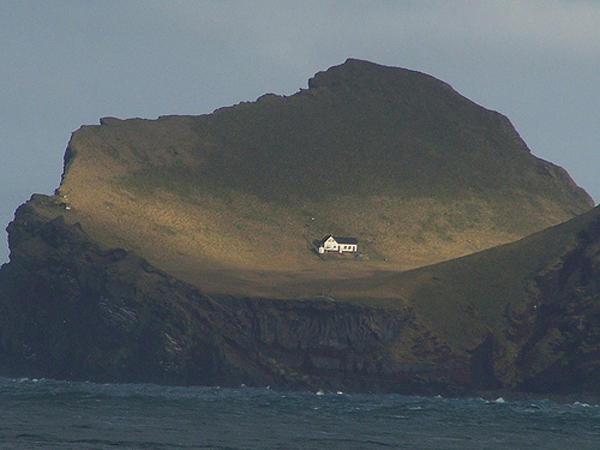
I’ve been dreaming about this house, on the island of Elliðaey in Iceland, since I saw it here. Apparently the house was a gift from the government of Iceland to singer Bjork for raising the country’s global profile. Then I saw this quote by Bachelard and started to feel a little better about the fact that I don’t live in it. I may never get to live in anything quite as remarkable as this, but I find great joy in the houses of my daydreams, and it makes me wonder if sometimes there isn’t as much joy in desiring as possessing.

Solastalgia

4 February 2010

Fascinating piece by Daniel B. Smith in Sunday’s NYT magazine about the emerging field of ecopsychology, which studies the relationship between the health of the natural world and that of the mind. The field views mental health more broadly than any preceding branch of psychology, suggesting that our sanity is inextricable from the vitality of our surroundings and the strength of our connection to them.

This makes intuitive sense to me. After all, our physical health is deeply dependent on the health of our immediate environment. Perhaps before the Industrial Revolution we could have conceived of our bodies as separate entities, impermeable to pollution. But now we know that chemicals in our waterways end up in our veins and that smog chokes our lungs as much as our visibility. The link between environmental soundness and mind is less apparent, but still plausible. If we evolved for an environment filled with the aesthetics of lush, green life, but we live in an environment that deprives us of these aesthetics, isn’t it possible that this state of being becomes like a nutritional deficit of the mind? That robbing our environment of certain essential stimuli decreases mental performance and makes us not only less happy but also less functional?

There are already disorders recognized to have a relationship to the stimuli we take in from our environment. The appropriately named SAD (seasonal affective disorder) is a kind of depression related to the low levels of available light in winter. SAD is worst at higher latitudes where the light difference between seasons is most extreme. Yet some Scandinavian peoples, such as Icelanders, have been found to have an immunity to this condition, perhaps because it was selected as a favorable survival condition by evolution. This is only one data point, but it suggests to me that people may evolve for certain environments, that our brains may be subtly wired through generations of interactions with a place, and that the rapid rate of change (/devastation) of those places could be a latent source of emotional trauma.

Australian philosopher Glenn Albrecht terms this trauma solastalgia, which combines the Latin solacium, meaning comfort, and the Greek root -algia, meaning pain. He defines his coinage as “the pain experienced when there is a recognition that the place where one resides and that one loves is under immediate assault…a form of homesickness one gets one when is still at ‘home.’ ” It’s an instantly evocative word to match an evocative concept (though perhaps not so precise — I can think of lots of cases of comfort-pain that have nothing to do with place). Smith notes that the word has spread rapidly, not just in academic or journalistic circles, but as a title for songs and works of art. The idea of defending our land as a people is nothing new, but throughout history usually it is from invasion, and what we are defending is livelihood — the resources for living and the livelihood we have created in a place. This goes much deeper to say that environmental destruction is a slow, creeping invasion, and what we are defending is not just our livelihood, but our sanity.

The most interesting aspect of this discussion, for me, is the recognition of certain kinds of environmental aesthetic stimuli as essential to mental health. We know that the brain is a sensing, processing machine, requiring constant stimuli to make sense of the world. Remove all stimuli, and people quickly go insane; without new data points, the brain stops making sense of itself. Too much stimuli and we become overloaded — equally unhealthy. But beyond variations in quantity, there are also variations in kind to pay attention to. Are there certain qualities of light that better enable us to function? Are there proportions and perspectives that make us feel in balance and emotionally secure? (For example, having evolved in an environment where trees have a certain proportional relationship to the human body, say between 2x and 8x as tall, does living in an environment that is more vertically structured, up to 220x in height maybe, create a sense of insecurity? I wonder this as a devoted city-dweller — I love skyscrapers, but is there another level on which they are making me anxious? Would I be smarter or calmer if I lived in the forest?)

One study, done by Peter Kahn, a developmental psychologist and member of the editorial board of a new journal called Ecopsychology, suggests that natural stimuli effect our physiology in basic ways. Kahn tested a group of adults subjected to mild stress while looking at one of three different views: a window looking out over a scene of grass and trees, a 50″ plasma screen of the same scene in real time, and a blank wall. Measuring the heart rates of the subjects showed that they decreased fastest in the group looking at the real nature scene, while those looking at the TV had the same results as those facing the wall. This suggests that not only does environment unconsciously effect our reactions, but also that we can’t fake it. An authentic aesthetic experience is necessary to feel the benefits of the interaction with the natural environment.

What does this have to do with joy? Many of the stimuli we consider to be aesthetics of joy are natural and environmental. Sunlight, lushness, open and expansive spaces. The emotion joy evolved at a time in human history where there was no dichotomy between artificial and natural — before industrialization, before agriculture, when our connection to the environment meant survival. The ideas of ecopsychology — solastalgia and the idea of an ecomental system — resonate so strongly with me because of this history. Joy isn’t a result of what goes on in the mind alone; joy is an ecomental interaction, a constant dialogue between the brain, the senses, and the things we encounter in the world. It’s often said that happiness comes from within, but joy comes from without — from the impressions made by pleasurable things on our retinas, our fingertips, and our tongues, the way they disrupt the flow our thoughts and focus them on beauty and wonder. For me, this piece was an important reminder that those wonderful, natural things may be instrumental not just in joy, but in the whole of mental health — and therefore an important reminder that so much depends on our willingness to defend them.

NYT: Is there an ecological unconscious?
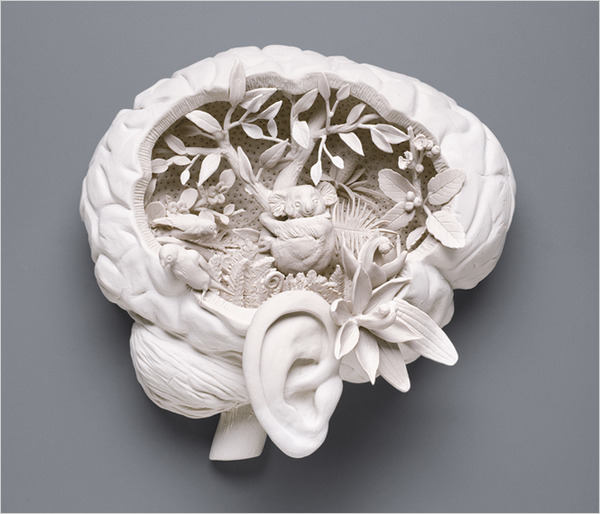
Illustration: Artwork by Kate MacDowell; photograph by Dan Kvitka for The New York Times

Stripes!

20 November 2009

rebecca_ward

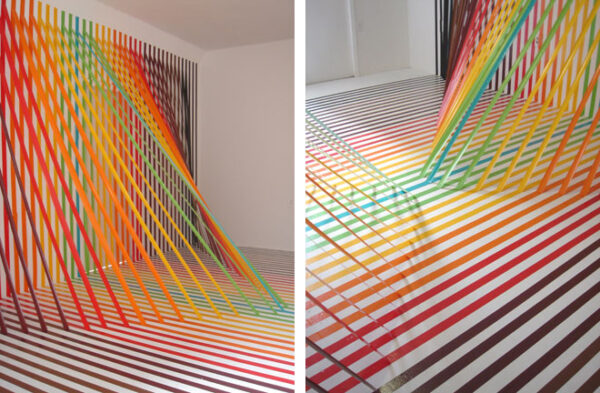
I love how the stripes feel like they’re coming to life in these colorful tape installations by artist Rebecca Ward.

{via @design_sponge}

Making merry

21 October 2009

merry1

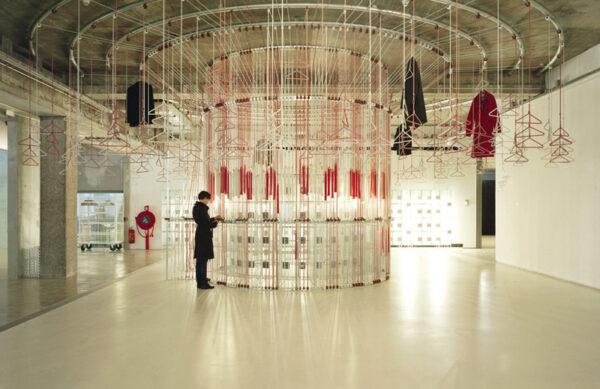
A simple way to make a mundane object more joyful is to transform it using aesthetic elements of an object you already know is joyful. Designer Wieki Somers’s Merry-go-round coatrack takes a garden variety museum cloakroom and uses the form, scale, and movement attributes of a popular playground toy to transform it into a delightful spectacle.

The coatrack was installed in 2008 in the Boijmans van Beuningen Museum in Rotterdam.

{via Core77, where you can see a film of the piece in action}

merry2

Using aesthetics of joy to create behavioral change

14 October 2009

Design is at its most effective when it encourages or transforms human behavior for the better. There’s a lot of talk about how we need adopt healthier or more eco-friendly habits. The onus is on us to make the changes, but design can facilitate the behavior and make it easier or more enjoyable to change. Examples abound: the George Foreman grill, dedicated recycling bins, 100-calorie snack packaging. All of these things make it easier to do the right thing. Easier, yes, but not necessarily any more pleasurable, which is where The Fun Theory comes in.

An initiative of Volkswagen, the Fun Theory is a series of experiments that demonstrate how joyful design can encourage positive changes in behavior. In the video above, a staircase goes from being the less-chosen alternative to the escalator to the preferred path after the addition of some giant piano keys. In another video, litter collection rises after an amusing noise is introduced to a public trash can.

The pre/post measurements are striking and really prove the point that aesthetics of joy — through interaction, play, sound, and surprise — can create real, immediate change in the way we live.

{via PSFK}

Visible storage

12 October 2009

met_roof_sunset

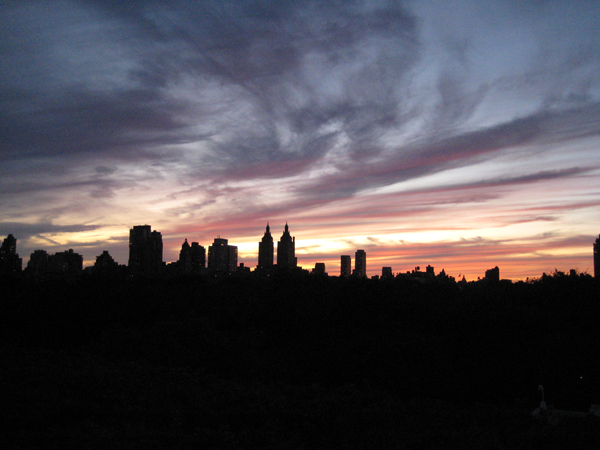
Indian summer is the gift that keeps on giving in New York this year. Perhaps to make up for the drizzly summer, we keep getting these gorgeous sunny, mild weekend days. This Saturday I walked through the park and met my friend Emily on the steps of the Met. We set out in search of the Vermeers, which are quietly luminous and very worth the trip. But we soon discovered what felt like the real find of the visit: visible storage.

I’ve been going to the Met for a long time, since I was a child, but I was surprised and delighted to find this wonderful set of displays. It feels like you’re getting a behind-the-scenes tour, with all the paintings and artifacts crammed in together in row after row of glass partitions. The closeness of everything forces new connections, new relationships between items. Without the artful arranging, you’re free to see things in a new way. It feels a little like a treasure hunt, and was easily the most exciting part of the visit.

The roof is still open for drinks, and we arrived just in time for the spectacular sunset above. It’s always hard to believe when the blue sky turns pink and purple, and the art took a back seat for a moment as everyone turned towards the city and watched the beautiful spectacle unfold.

visible_storage

visible_storage2

Sunset image, mine. Met images, pazzia.

Aromatic graffiti

30 September 2009

scent_graffiti

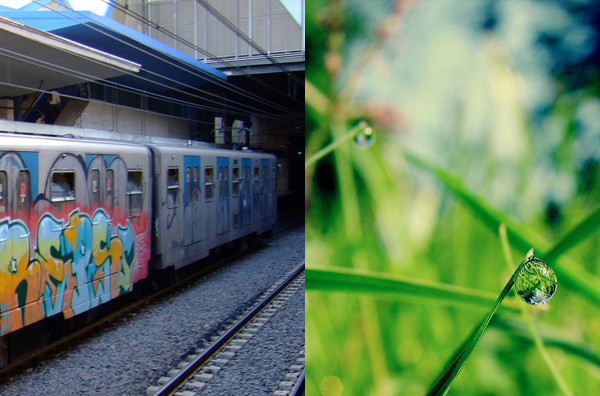
I love non-traditional street art. Yarnbombing, seedbombing, mossbombing, LED throwies — anything that brightens and transforms the urban environment really brings me a sense of joy.

So this scent graffiti by Mitchell Heinrich really charms me. Scent is a particularly interesting medium for several reasons. Heinrich says:

Scent is interpreted by the limbic system which is very closely tied to emotion and memory. This leads me to believe that interacting with people using scent can potentially be a much more powerful medium than paint since people experiencing it can’t help but react to it. The goal of this project is to realize the potential of smell as art and to explore different ways of using it to interact with people.

True, but this is only part of the story. Scent requires proximity in a way that vision does not. Visual understanding is nearly immediate once something enters our eyeline. But scent is based on the diffusion of volatile chemicals through the environment, so it reaches us in a more gradual way. It’s like vision is a sudden downpour and scent is a slowly increasing drizzle. So the quality of the surprise achieved is fundamentally different.

Also, in a chat I had a few weeks ago with Dr. Pamela Dalton at the Monell Chemical Senses Center, I learned one of the most important factors in scent processing is context. Many scents occur in multiple contexts. One example is butyric acid, a molecule that in some situations we recognize as aged cheese, and in others we recoil from as the odor of sweaty feet. Without realizing it, we constantly use contextual information to interpret scents and determine how to react emotionally to them. This fact creates some interesting possibilities for scent art. By taking scents strongly identified with a particular context — say cut grass or baking cookies — and pairing them with urban contexts that have a strong associated odor, the effect could be quite dazzling and dislocating. It could also work the other way, creating a powerful negative emotional response. But either way, it likely would cause to reflect on the environment more mundane sensory stimuli as well, and develop a clearer picture of how those make us feel.

Scent graffiti is also fleeting, and that transience is appealing. So often graffiti is not about destruction but about reclamation: the desire to form some kind of personal relationship with the anonymously-designed city that contains and constrains us. To shape this looming environment in some small way. The evanescence of aroma allows for continually shifting scent-images to alter the city, allowing a constant redesign and rediscovery of public space.

Here’s a link to an instructable on how to create your own scent spray cans. Images: attack the darkness and circulating.

{via PSFK}

Neutral canvas, pops of color

9 September 2009

coupland2_up1

This house is a great example of the way pops of color on a white or neutral canvas create an aesthetic sense of joy. Writer Douglas Coupland’s polychrome collections could look like a circus in a house with a lot of color. Showcasing them against a mostly white or otherwise muted background creates moments of intense color with enough room to breathe.

In this way, design should mimic emotion. You don’t want to be feeling intense joy all the time — it would be exhausting, and it wouldn’t be possible to appreciate it. As one wave of joy recedes, you want a little bit of stillness, the rest that allows you to rediscover the joy and feel it all over again. This principle echoes the Japanese aesthetic idea of ma, the white space that is essential to any composition or design. Ma can be spatial or temporal, visual or textural, and in all cases results in an emotional feeling that allows a design to achieve the right level of poignancy.

Another joyful aspect is the unexpected nature and placement of these collections. Mundane spools of thread are elevated to high art by their gridded placement on a white wall. Dice, when laid out above an entryway, become a surprising lintel. Taken out of their usual context, these objects become fodder for unanticipated moments of delight.

28464252

28464302

NYT: The House Next Door, via Ouno