The joy of illegal rainbows

2 January 2011

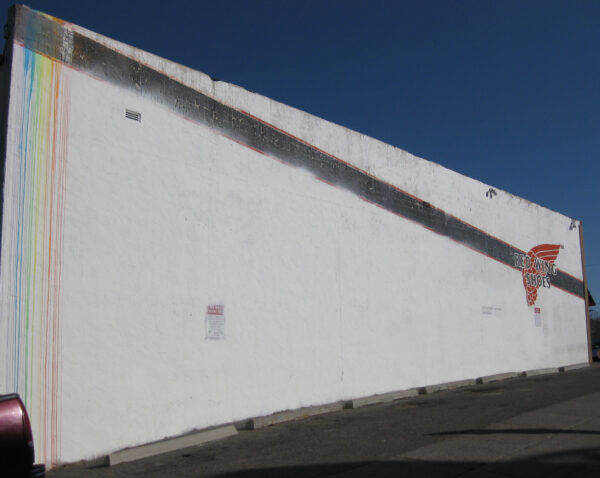
A wonderful find, from my dear friend Mara of Neither Snow, is this “rainbow warrior.” The warrior is a street artist working in Albuquerque, using spilled paint to pour rainbows off the tops of buildings. He (or she)’s really got some people riled up (see newscast, here) and it strikes me as remarkable that people can be so dour in the face of rainbows.

The charm of the story is in how the community has rallied to the warrior’s defense. This Facebook page has drawn 1,492 fans “in support of the Rainbow Warrior, whomever s/he may be.” And the soul of the story is in the warrior’s own words. This is the warrior on his/her inspiration for painting the rainbows:

About three or four years ago … I was feeling really depressed and I had this notion that if I went out and painted a rainbow, maybe someone would see it and feel what I was feeling or feel anything as intensely as I was. The first one I did, I just literally dumped the paint over the side of a pretty ugly, abandoned, alleyway building.

And this is the warrior on street art:

I want to inspire other people. That’s part of all my art; it’s always positive. I think I chose street art to inspire somebody else in a way that’s outside of the box. Like somebody who wouldn’t normally be exposed to street art, somebody who would just walk past it. Street art really saves a lot of people who are down in their lives and on their luck. This is their one and only outlet. Plus, you get an immediate response from people. A lot of times it’s just, Look at that graffiti on that freeway wall. But maybe the graffiti on the freeway isn’t the ugly thing, maybe that’s not what they’re angry about. Maybe they’re angry about how for the last 10 years you’ve been driving through this prison freeway with these big ugly gray walls and it just took the graffiti to point out the ugly that was already there.

I find this tension – between the forbidden act of graffiti, technically vandalism, and the delight people are discovering as a consequence – acutely compelling. Is an illegal rainbow still joyful? Here’s a letter writer commenting on the rainbow warrior situation:

So, somebody lays down a rainbow on the thing, a piece of art (and yes, it is art, even if it is “free,” and maybe especially so) that pokes fun at the mess, that makes me grin and say, “That’s a little better!” As a life-long citizen of Albuquerque, as someone who has had his very personal property damaged by genuinely malicious individuals: this isn’t the same thing. Is it graffiti? Yeah. Is it the same as somebody tagging a vulgar word on the car my parents gave me when I went to college? No. The intention of the rainbows is perhaps mischievous, but it is definitely not malicious. The intention, and the execution, is a wink, a laugh, a little unexpected burst. Worth a slap on the wrist and a good talking to, nothing more.

(Ok, and now I’m going to pause, because the 400 words and 45 minutes I just spent finishing this post have vanished into the ether that is this charming second day of the new year. [Deep breath and a moment to convince myself it will come out better the second time around.] Ok…)

I like this distinction between mischief and malice. The mess the writer refers to is the Anasazi building, the most public of the warrior’s targets, a high-rise which had recently been taken over by the Albuquerque government because the developer was charged with fraud, (a crime with no discernible aesthetic value). I like the idea that the rainbow has in a way recast an unfortunate incident for the citizens of the city. Redemption, via transgression.

How important is this element of transgression in the joy we feel from street art? Is there something inherent in the violation of boundaries that fuels our pleasure when we look at it? The carefree disregard of the strictures of private ownership and the numbing conventions of urban aesthetic culture? Maybe our delight is less about the vibrancy of the color, and more about the irrepressible spirit that put it there.

I’ve been wondering this in the wake of a visit last week to Wynwood Walls, a collection of murals in an artfully dingy Miami neighborhood. Wynwood brings together works by a range of street artists, well-known names like Futura, Shepherd Fairey, Nunca, Space Invader, etc. under the sanction of gallerists and developers, in a project that dropped out of Art Basel 2009. I really like a number of these works (particularly the piece by Nunca, below), and I recognize that the mainstreaming of street art gives these artists a chance to make a real living, but I can’t help but wonder: Is some of the joy lost by bringing these works into this kind of walled garden? Tamed by the light of legality and legitimacy, are they just a bit less vibrant, a bit more inert?

Maybe my previous question – Can an illegal rainbow be joyful? – had it backwards. Maybe it’s precisely the illegality that touches us. Mischief, with its attendant unpredictability and freedom, makes us feel vicariously free.

Thoughts?

By the way, if you find yourself in Miami, definitely make your way over to Wynwood and see it for yourself. Have lunch at the Wynwood Kitchen and Bar and wander the zillions of galleries which seem to have sprung up, perfectly distressed-looking, practically yesterday. It’s a nice day out, and a welcome departure from the excess of the design district.

Rainbow Warrior images via Patricia Austhoff and The Fibe Squad. And again, thanks, Mara.

The joy of jumping on the bed

4 April 2010

Yes, that is Desmond Tutu in the midst of all those children jumping on a bed! For a project called Play Jump Eat, Kelly Wainwright of Messy Monkey Arts managed to coax not just the Reverend Archbishop, but also fishermen, surfers, schoolkids, and others to let go of their inhibitions and be photographed in odd situations, bed-jumping.

Jumping on the bed is an example of a joyful pleasure at its most democratic: an activity that is accessible to nearly everyone. It’s a childish pleasure, one we associate with being small in the expanse of our parents’ beds, but it can be rediscovered at any time. (Confession: I sometimes can’t resist a jump or two in a hotel room.) There’s just something so totally liberating about jumping; it’s a slightly transgressive, freeing feeling that brings laughter and optimism up to the surface. Even just looking at these photos evokes a vicarious burst of delight!

I hope the full series will eventually be posted online. Read more about the project here.

{Via @vpostrel}

Update: Kelly pointed out to me that prints are available here and that a portion of the proceeds benefit the Tertia Kindo Arts Project, a children’s dance school. The comments also made me realize that I failed to credit Inge Prins, the photographer on the project. Lovely work!

Bubble wrap turns 50

26 January 2010

The world’s most joyful packaging material turns 50 this week. Go pop some in its honor!

Or live vicariously and feel the delight emanating off the screen from the bubble wrap scene in Wall-E. What does it say about our culture that we we envision such an oddly iconic pleasure as a connection point between two futuristic robots? What timeless part of our psyche does bubble wrap speak to?

Joyful library: Let the Great World Spin

4 January 2010

spin21

It’s been three years since I last let myself read fiction. In these years of study and transformation, there have always been factual gaps that needed filling, lacunes in knowledge, crevasses into which curiosity swelled, all-consuming. Narrative felt like an impermissible indulgence, empty calories, dangerously unproductive. Countless times in the last year I browsed the tables at bookstores only to demur, to put myself off with a quiet promise of “December,” as if that month would be the break fast of fiction, a buffet of stories with world enough and time to read them.

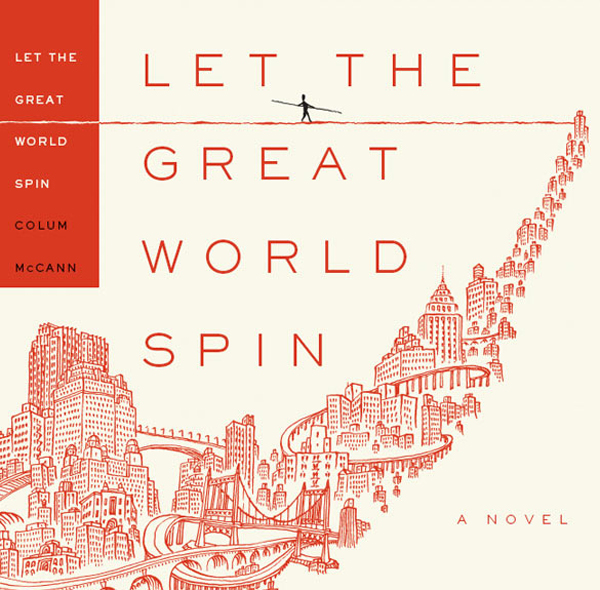
As soon as I heard the subject matter, my first choice to dip my toe back in was obvious: Colum McCann’s Let the Great World Spin. The book’s impetus is the famous 1974 tightrope walk by Philippe Petit between the twin towers of the World Trade Center, one hundred and ten stories above the ground. A magical, subversive, absurd act of transcendence, arrogance, and grace — Petit’s walk has captivated me from the first moment I knew about it. Any work similarly inspired by this exquisite moment had to be my kind of book: joyful, at least in some measure.

philippe_petit_01

In reality, the walk is only a minor player in the book, and Petit is effaced by his function and by characters far more emotionally grounded and present. Let the Great World Spin is really about their mundane poetry, their strange connections, their peculiar urban unity of grit and joy and loss. But the walk runs like a thread through the book, tugging a reader (sometimes reluctantly) into the repeated introductions of new narratives, cold loose ends that spark and warm as they loop back into familiar territory. I wish the walk itself was more powerfully entwined in the lives of the characters in each individual vignette. And I wish we did not know whether or not the walker would fall. But these are minor quibbles in an adept journey.

I won’t spoil the story for anyone who might like to read it. But I will say what I am most struck by is the twin impulse towards joy in both Petit and McCann. Petit’s motivation was transcendence, even as a consequence of transgression. From the moment he first encountered them, he saw the towers as an opportunity to create art, to give not just New York but the whole world a momentary gift of joy through the stretching of our concept of what is possible in the world. They were a joyful canvas, those towers, a base on which to layer joy upon joy, by taking a stroll in the sky and not falling out of it. I can only think of a handful of acts that are comparable in the way they transformed our emotional sense of possibility. First transits, such as the walk on the moon, or first discoveries, such as of electricity, telephony, and flight, come to mind. But the analogy is imperfect. Those discoveries were linear demarcations of befores and afters. They expanded possibility in a permanent way, heralding irrevocable change. Petit’s walk was transient because it was confined to one man’s extraordinary ability. It expanded the world of human potential, then contracted it again. It bore no actual relevance to anyone else’s daily lives, and yet, magical thinkers that we are, it captivates us, even those of us like me who were barely a germ of an idea in two strangers’ brains at the time of its occurrence.

This timeless magic makes it the ideal catalyst for McCann’s sort of joy, which is joy in redemption. Petit’s act of creation, though it predated 9/11 by 27 years, seems the ideal antidote to the towers’ destruction. Aesthetically, Petit’s climactic moment is one of rising, hovering, and dancing, of lightness, buoyancy, and air. The towers denouement is falling, crumbling, and burning, fire and ash, earth and bone. The image of Petit’s unlikely defiance of gravity burns in sharp contrast to the towers equally unlikely fall. Chronology is no matter, as aesthetics of joy can be permanent in our souls.

Of course, the real redemption is in the art that juxtaposes the two, that offers to replace this pitted hole in our world with a new image. This is McCann’s task, as he observes in the reader’s guide that accompanies the paperback edition:

But stories are there to be told, and each story changes with the telling. Time changes them. Logic changes them. Grammar changes them. History changes them. Each story is shifted sideways by each day that unfolds. Nothing ends. The only thing that matters, as Faulkner once put it, is the human heart in conflict with itself. At the heart of all this is the possibility, or desire, to create a piece of art that talks to the human instinct for recovery and joy.

I love the confluence at the end of this statement — between instinct, humanity, redemption, and joy. A central premise of my thesis is that joy is fundamentally human, an instinctual gift of evolution that rewards our struggles and propels us forward with the promise of its rediscovery. By this logic joy is also directly related to the survival instinct. We exist to seek joy, and we strive to continue to exist so we can seek more of it. Joy is an essential motivator, not just for creation, but for life itself.

Petit’s walk was an affirmation of the possibility that joy could come of out nowhere, on clear dull day, and transform us. McCann’s book, for me, is a testament to the persistence of that joy and its relentless tendency towards renewal.

Get Let the Great World Spin on Amazon.
Read more about it on the author’s site.
See Man on Wire, the documentary about Philippe Petit’s 1974 walk.

Why is bubble wrap so good?

30 September 2009

2601498908_bd8aba83e7_b

Every now and then I have a look to see what search terms are bringing new visitors to the site. It’s always interesting to see how people find the site and what topics readers are most curious about. My favorite among the search queries of the past month is “Why is bubble wrap so good?” bringing people to this earlier post I wrote exploring the subject.

It delights me that there are others out there who wonder why bubble wrap (or rainbows or cupcakes or fireworks) bring us joy. These questions may seem unimportant in the face of all we are confronting at the moment, but they speak to profound curiosities about our human nature and our world, curiosities that are no less important for being about what creates pleasure than about what helps avoid pain.

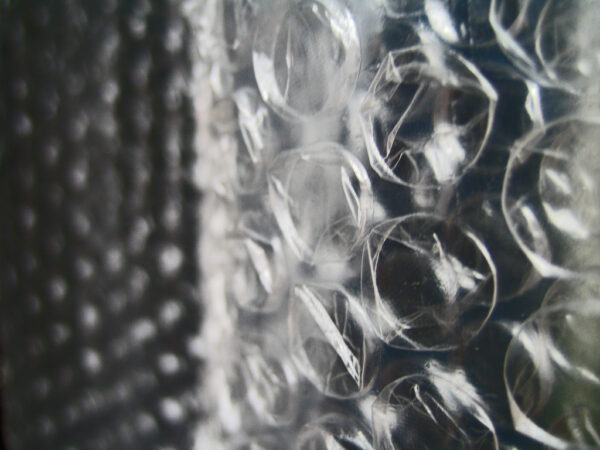
Re-reading the earlier post, I think my answer is still the same, but I’d add two things. First, bubble wrap has a certain amount of magic to it because it contains air in a permanent way, in contrast to all the bubbles of natural world. Bubble in water float to the surface, bubbles in air pop, bubbles trapped in ice eventually melt. So bubble wrap makes the elusive air bubble tangible in a way that seems mundane but is actually quite magical.

The other thing I would say is that it also has something to do with sensory immersion. Bubble wrap has a unique tactile sensation, and it’s also an aural experience. This richness contrasts with many materials which have expected textures and that don’t “speak” to us. Bubble wrap could be an even richer sensory experience, and in fact there’s at least one person out there who intends to make it so. Check out this genius patent I found for scented bubble wrap. It’s like the love child of bubble wrap and the scratch ‘n sniff sticker.

And finally, here’s a fun bubble wrap fact: did you know that it was an accidental innovation? The inventors were actually trying to create a new kind of easy-to-clean wallpaper! Thankfully, the experiment went awry and the world’s most joyful packing material was born.

Image: Feeline
Original post

What happens when your aesthetic of joy is another’s eyesore?

13 August 2009

moran8-15-2The headlines have been comical. “Richard Perry in the Sky With Diamonds,” reads one. “Jeff Koons’s Blinding Bling,” blares another, calling out the controversy over hedge fund founder Richard Perry’s installation of a giant green diamond-shaped sculpture by Koons on the terrace of his penthouse apartment.

Art is a terribly subjective thing, which is how you get debates such as this one, which has led to myriad complaints and has even forced Perry to shift the direction of the sculpture to prevent light reflections from its mirror-polished surface from “burning like lasers” in a neighboring penthouse. (Ah, the problems of the very rich!)

You could argue an aesthetic of joy here — the oversized scale, the delicious shininess — though perhaps it’s not so layered as joy and may be more novelty than joy. My friend Deirdre says it makes her happy, though she can see how the neighbors might not be so thrilled. When private taste impinges on public eyeballs, the line between joyful and hideous can get awfully blurry. Is a work of art or a piece of decor still joyful if it bothers some to the point of agitation?

2009_7_1sps2

The joy of color: William Eggleston

13 July 2009

los_alamos_kI discovered William Eggleston, the iconoclast whose super-saturated prints brought color photography into art world’s mainstream, at the recent show at the Whitney Museum. The retrospective is now at the Corcoran in DC, bringing him back into the spotlight again and giving east-coasters who missed it in New York a second chance to see this wonderful body of work.

tricycle

What’s joyful about Eggleston’s work? The unexpected hits of color, for starters. In this piece on NPR, Claire O’Neill writes about the transformative power of his color vision:

Although he doesn’t quite understand what people mean when they tell him, “You changed the way I see the world,” the fact remains that he has. Perhaps the living legend is an accidental genius, but before his lurid color prints hit the gallery walls, few people would have found beauty in their own rundown suburban backyards. Whether or not he meant to, and whether or not he cares, Eggleston has taught us to open our eyes and see the wide spectrum of colors around us. He says he doesn’t think much about it. But a few subtle winks and a glimmer in his eye tell me he knows exactly what he’s doing.

The article makes clear this approach was born out of Eggleston’s pure joy at seeing his world in vibrant color. Looking at his photographs, the energy seems to bleed off the print, an irrepressible vitality that stretches beyond the borders and makes each image feel hugely alive. But it also suggests Eggleston has the mischievous spirit of a kind of benign provocateur. Playfully transgressive, his goal is not to destabilize, but simply to liberate art from arbitrary rules that limit us from beauty in our own backyards.

troubled_waters_c

Eggleston’s subjects are not always joyful; indeed, they often have a sort of forlorn or derelict beauty that inspires sad nostalgia rather than joy. Others are wonderfully weird, with an internal tension that asks you to consider joyful aesthetic elements — symbols of childhood, fluffy clouds or cotton candy, holiday motifs—in all their bizarre beauty, almost without emotion.

But regardless of the specific elements featured, to me the body of work as a whole exudes joy, arising as it does from the mind of a man who revels in color. In the audio slide show that accompanies the NPR piece, the final question is, “Do you dream in color?” There is such savory delight in the laugh that punctuates his response: “Oh yes. Wonderful pictures that don’t exist. I would love to print every single one of them. So. . . brilliant.”

From NPR, via tipster-extraordinare: Dad

troubled_waters_h

los_alamos_m

The joy of little dogs

10 July 2009

1501407755_d4ec992d22_oToday I have a post on DeepGlamour about the history of lapdog glamour, investigating how tiny pups became associated with Hollywood and high fashion. But the whole idea for the post started because while I see that Paris Hilton and her many imitators tote around their Chihuahuas in their designer bags like status symbols, I just don’t get it. Those little dogs are so impish and funny that they’re like a living parody of the whole idea of glamour. For me, little dogs are not about status or sophistication but about joy.

Small dogs are pure personality coated with fur. I see them on the city streets and everything they do just makes me laugh. They’re the anti-trophy, the anti-status symbol. They love unconditionally, indiscriminately, energetically, and with abundance. Their values are the opposite of the scarcity and exclusivity that define status. Unlike the affected aloofness of the high-class, small dogs (actually, all dogs) are interested in everything and everyone. They trample joyously over the carefully constructed distance that celebrities create for themselves, romping over to sniff a potential buddy, oblivious to the fact that they might expose their owner to unwanted conversation.

Perhaps this is the allure. Perhaps the little dog becomes the way to break down barriers for those of a certain social strata. Even socialites and starlets need joy, especially when it can be disguised as a posh Chihuahua in an in-season purse.

Image: Nutloaf

HappyHappy by Choi Jeong-Hwa

1 July 2009

3663275723_9f953797f0_b

HappyHappy is a site-specific installation designed by the Korean artist Choi Jeong-Hwa for the Los Angeles County Museum of Art, as the prelude to an exhibit entitled “Your Bright Future: 12 Contemporary Artists from Korea.” Choi is considered the father of Korean pop art, and over time has demonstrated a strong interest in creating art from recycled plastic materials, though the containers used in this installation are from local 99c stores. Near the entrance to the museum, visitors can walk through the installation and are free to touch as they pass by. You can see a slideshow here.

Being free to touch makes things much more joyful. Deepening the sensory experience ensures that people relate to an object or a space in a more immersive, complete way. And of course, in a museum, there is always the transgressive pleasure of touching the artwork, as this commenter notes. It’s also telling the way people react in the space, which in at least for the person above is with a joyful exuberance seemingly absorbed from the bright, saturated colors. I love the whimsy of the way ordinary objects (like the wiffle balls, below) are transformed by abundance and scale.

My only ambivalence is plastic. The benefit of plastic is that it allows for such wonderful colors and is relatively lightweight. But aside from its environmental negatives (like the fact that it will be around forever), it’s also remarkably asensory. It has a superficial kind of molded texture, but no deep, innate tactility (like ceramic, glazed or unglazed, for example, or metal, or wood). Its temperature is unremarkable, its luminosity changeable but somewhat flat. Of course, many many joyful things are made of plastic, and its infinite malleability does lend itself to joy in some sense, but I wonder if a deeper level of emotion could be invoked with a different material.

happyhappy1

HappyHappy appears to be a theme for Choi, who has created other artworks under the same name, such as this installation at a Seoul stadium (more photos here) and many participatory HappyHappys filed here under Public Art.

Top image: jek in the box, Bottom image: LACMA

Tip via Virginia Postrel

The limits of joy

3 June 2009

mansonap3108_468x705

This morning, the driver of my taxi here in Montreal advanced his own theory of joy. “Joy,” he said, “is anything you love to do.” But this theory of his has attenuating complications. As my driver said, “When a serial killer murders people, he feels joy too.”

Can this be possible? We think of joy as a wholesome, innocent sort of feeling — how could something so horrific bring joy? It seems to violate one of the key premises of joy, that joy comes from things which are generally good or at least neutral for humanity, not things with damaging consequences. There are joys that have a mischievous feel which I call transgressions, but these transgressions are notable for having no real harmful consequences: the trivial destruction of bubble wrap, the illicit pleasure of jumping on the bed, the forbidden delight of dessert before dinner, where the only thing ruined is an appetite. (And as Jerry Seinfeld says, it doesn’t really matter if you ruin your appetite because there’s always another one right behind it.)

Joy may not always be universal, but it usually has the potential to be shared and appreciated by others through participation, observation, or retelling. I may not myself enjoy spinning until I’m dizzy, but watching a trio of girls do so probably would bring a smile to my face.

Not so with murder, which makes me say that while a serial killer might feel pleasure from his actions, he doesn’t feel what we call joy. It may feel good for him, but it’s not transcendent, it’s not taking him out of his everyday prism and changing his perspective. If anything, like an addict, it’s only deepening his narrow field of existence. In that case, we might say the serial killer feels a sort of euphoria, an emotional high that does not shift your perspective, but just provides a temporary peak.

My thinking on this is evolving, but it is a worthwhile practical challenge to the theory. I’d love to know what people think. Do serial killers feel joy?