Make your own fun

10 February 2013

Winterfun 3

I came home last Sunday evening to sounds of laughter and the smell of woodsmoke coming up from the backyard. It was one of those frigid nights we’ve been having, the kind of night when a balaclava seems to make sense for something other than a bank robbery. I pressed my nose up to the window to look outside, and it sent a chill right to the root of my spine. But then I saw it: first the flicker of the campfire, illuminating a handful of bundled revelers holding sticks with marshmallows. And then, squinting into the dim light, something even better: a slick of ice, and boys on skates.

This is a Brooklyn backyard we’re talking about here, about as small a patch of real estate as you could imagine. And yet, faced with an endless stretch of freezing temperatures, my neighbors decided to make their own fun. They flooded a patch of the concrete yard with a hose, let it freeze, and had their own ice-skating rink (barely larger than a dining table, mind you), their own winter wonderland.

Winterfun 2

Winterfun

You might ask what this has to do with design. It has everything to do with design. This is people altering their environment, using the tools at hand, to create joy for themselves and others. We often say: design loves constraints. And this is a brilliant design under the constraints of winter in a dense northeastern city, a way to be outside and together when the mood gravitates towards being inside in solitude. It’s a beautifully aesthetic moment too—light, movement, warmth, the sweetness of marshmallows, and the small swooping curves of skaters on their tiny rink—an oasis in what can often be a bleak time.

Make your own fun, this winter or whenever. Make your own joy.

Vibrating color: Jim Lambie

9 July 2012

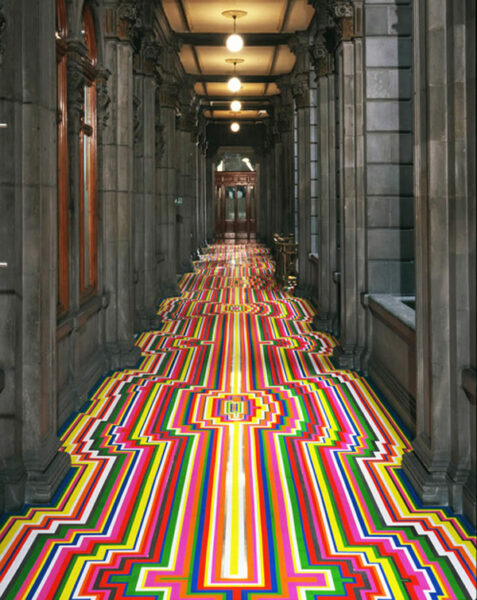
Glasgow-based artist Jim Lambie creates installations out of vinyl tape that make spaces come alive with an intense energy. Tracing the contours of a room’s perimeter, his work seems to magnify the lines of the structures, surfacing patterns from static-seeming architecture. It’s almost as if he’s liberating the movement from the space, giving it voice through color.

The kinetic force of Lambie’s work may stem from his origins in music. He has said:

You put a record on and it’s like all the edges disappear. You’re in a psychological space. You don’t sit there thinking about the music, you’re listening to the music. You’re inside that space that the music’s making for you.

This is true about music: it’s something you inhabit rather than something you regard. It’s also true that music has an inherent movement, a temporal thrust, a pace and vibration. Music, with its long oscillations, jostles the air around us, scatters its molecules and sends them pinging against our eardrums. We don’t see it, but music transforms a room into a thoroughly kinetic space. Lambie’s color similarly fills the space with vibrations.

While I object to the comparison with Pollock, I feel sympathy with Jonathan Jones of The Guardian when he writes in 2008:

Like Pollock he pours colour and line in ways that liberate energy and suggest the inner structures of the cosmos. Above all, Lambie is a pure artist – his art is totally self-sufficient in its worth and power. It is distilled energy, concentrated life. Marvellous stuff.

Right now I’m steeped in the study of energy – photons, pulsations, valences, spectrums – and thinking a lot about movement at all scales, from the quiver of electrons to the whirl of the planets. But it all comes back to aesthetics for me: how we feel this energy through our senses, and once felt, how it affects us. Lambie’s work is just poppy and irreverent enough to seem like play, but that hides its power. This is potent stuff: bracing, fervent, and vital.

Via: Bjorn’s Randoms

Joyfully over-complicated

8 January 2012

This morning I read with delight about Brooklyn-based artist Joseph Herscher, who is reviving the joy of the Rube Goldberg machine, a device “that accomplishes a simple task in the most complicated way possible.” Using objects such as rolling balls, burning fuses, watering cans, ladles, fly swatters, and even a pet guinea pig, Herscher creates sprawling kinetic sculptures that perform mundane actions such as fixing a cocktail or turning the page of a book. The video above shows one of his simpler machines, La Macchina Botanica, performed at the Venice Biennale and constructed with the help of forty local children. The video on the New York Times site has a broader overview of his work, as well as a new piece called Page Turner, and is well worth a look.

Listen to the crowd as La Macchina Botanica unfolds; their responses offer an illustration of the workings of joy. Around :48, as the long mallet moves so slowly it almost seems stuck, there’s an audible swell of anticipation, followed by a cheer of release as the ball eventually starts rolling again. (Is it possible not to smile along with this moment?) The anticipation breaks the rhythm and creates a point of tension, which provides an opportunity to offer relief. When a piece moves unexpectedly, there are similar exclamations of surprise and enchantment. The unpredictability of the device disrupts our expectations in a clever, pleasurable way. And at the end, when the piece achieves its objective, there is collective celebration, with an outpouring of applause and acclaim. It’s a moment of completion, of joyful narrative resolution. After all, what the device is really doing is imposing a storyline onto a thoughtless act. The task becomes relatively unimportant, as we know it can be accomplished by other means. What is important is completing the story, watching the machine glide smoothly over all the hairy, implausible connections with balletic ease, and resolving the tension introduced by the complexity of the stage set.

At its core, the Rube Goldberg machine is playful, and this is the essence of its allure; it is a task that has been turned into a game. This playful tendency sits in tension with the basic premise of a machine, which Herscher comments on in the Times video: ”Usually machines are things you have to make your life easier, to do things more efficiently.” And efficiency is rarely a route to joy. Play has no role in a world governed by efficiency, because by definition play is not an efficient act. An apparently purposeless activity that is enjoyed for its own sake, play is inimical to the virtues of efficiency: it is slow, wasteful, and distracting. So a playful machine is an inherent absurdity, but as playful creatures living in an increasingly mechanistic world, we finding it intensely compelling. For this reason, the more mundane the task and the more extravagantly silly the process of achieving it, the better the machine. It seems that Herscher’s work is evolving in that direction; it will be interesting to see what he does next.

NYT: Who Says Machines Must Be Useful?

Bringing color to life

19 October 2010

I love this new ad from Canon Pixma, which is the result of an unexpected combination of paint, sound, and a macro lens. It almost feels like peering into a magical world: The slow speed and tight focus allow us to see transient sculptures that would just be a mess of splatters to the unaided eye. It’s also an intriguingly experimental approach. I feel like there is a rising trend lately towards experimentation in ads, events, and art pieces; people set up systems of conditions and allow unpredictable variation to determine the results. Mother’s ad for IKEA is a recent example, where cats, with all their mercurial whims, were released into the store to see what interactions might occur. As in this case, the “making of” video is as significant as the final result — the process is as joyful as the outcome. The work of design shifts from creating a beautiful thing to orchestrating a beautiful system, from controlling variability to modulating it.

The ad first caught my eye as a possible example of joywashing. I did an interview the other day during which I was asked to talk a bit about the concept, so it’s been top of mind. I said that joywashing itself isn’t harmful — more aesthetics of joy in the world is hardly a bad thing — but that it bothers me to see advertising that puts a chipper veneer on an ordinary product and claims it will make you happy. I’d rather see the design of the product reflect the emotional claim. If the product fails to deliver on the joyful promise, then it’s joywashing. But seeing this ad makes me want to refine that statement a bit.

I have no idea if the Pixma printer is a good one or not, whether it produces dazzling color or only so-so color, whether a print it makes is any more likely to cause delight than a print from any other printer. So on those grounds this ad would be suspect in my book. But I think this marketing effort transcends joywashing because the ad itself is truly joyful. In contrast to most ads, which say their brand is joyful (usually they shout it at you), this ad instead offers a brief experience of joy. Through an artful experiment full of delightful aesthetics, it creates a minute-long immersion into a surreal, uplifting world. I found myself spellbound by the ethereal forms and celebratory movements — it’s a great illustration of just how emotionally evocative abstraction can be.

I hope the product delivers on the tagline: Bring color to life. But even if it doesn’t, the ad doesn’t feel like joywashing because it can be appreciated and enjoyed all on its own. If the product doesn’t live up to the promise, I’ll buy something else, but at least I can appreciate the fact that the company has invested in creativity, and has chosen to put something inspiring out there, instead of insincerity, hoodwinking, and self-congratulation. I’d love to see the creativity and joyful spirit of the ad spark user’s creativity in similarly delightful ways. Even better would be if Canon had an events program up its sleeve, like Levi’s Workshops, for example, that will teach people ways to “bring color to life.” In this case, the ad, events, and products would all be parts of the Pixma experience, and the brand’s delivery against the promise of delight.

The joy of swimming pools

1 September 2010

It’s been a hot summer (today was no exception) and since the first taste of this ebbing-and-flowing heat wave, I’ve been thinking about swimming pools. There is no greater luxury or greater joy in a midsummer city than a swimming pool, a cool watery oasis in a desert of hot reeking concrete. Last summer there was the frenzy of the Gowanus dumpster pools, now converted into a public attraction by the Bloomberg administration for Summer Streets. Before that, the most talked-about New York pool was the floating pool lady, a barge converted to a pool by the city that debuted in 2007 in Brooklyn, and that docks in a different borough each summer. I haven’t managed to swim in either, but this summer I’ve been the benefactor of the generosity of a friend with a private pool, a backyard gem in the East Village that is all the more tantalizing for its secrecy.

After a couple of years living in Sydney, it’s hard to be without a pool. There, private pools are rare, but the public ones are ubiquitous and stunning. There’s the Andrew Boy Charleton pool, a 50m beauty that makes you feel like you’re literally swimming in the harbor. There’s also the North Sydney pool, right in the shadow of the Harbor Bridge. And there are the ocean pools, so beloved by Australians that they have their own culture, a culture robust enough to be the subject of a documentary: Sea Pool: A Life in the Ocean, teased in the video above. Bondi Icebergs, shown in the teaser, is particularly amazing; fed by crashing waves, it is briny and bracing all year round. Membership requires that you swim every weekend, regardless of the weather. Do that for five years, and you’re a member for life. It is the ultimate pool-lover’s pool club.

A frigid pool on a hot day is a delight; on a cold day, it is a trial. This may be an illustration of the difference between joy and happiness. Joy is immediate, momentary. It reacts to stimuli that accompanied the satisfaction of needs over the many generations of our evolution. A hot body in a cold pool is one step closer to homeostasis, and the aesthetics of the swimming pool (cool, shimmering blueness) are all designed to advertise that temperature-regulating function. Hot and cold in tension, moving towards balance: there is a certain kind of harmony there. A cold body in a cold pool, on the other hand, stands in defiance of emotional logic. The winter swimmer must see something beyond the immediate, because the proximate experience is discomfort, possibly even pain. Past the trial must be something: the satisfaction of completing a goal, the strength of physicality inured, the delight of an invitation to a company of like minds. It’s the pre-frontal cortex that envisions and plans this, that looks past disharmony towards a greater future pleasure. Joy, arising unconsciously from the limbic brain, revels in a more immediate gratification.

Along with the harmony of the pool, there is also freedom. Buoyant, liberated from gravity, we float in effortless space. We glide on the edge of another world, one in which the usual rules of movement are relaxed and transformed. I’m reminded of a moment in the John Cheever story The Swimmer:

To be embraced and sustained by the light green water was less a pleasure, it seemed, than the resumption of a natural condition, and he would have liked to swim without trunks, but this was not possible, considering his project.*

The waterborne lightness of swimming does feel natural, even in the truly unnatural setting of the swimming pool. And it feels freeing, even though the pool is a fixed, bounded area. The pool becomes an oasis, a space where the rules, both natural and cultural, are different. Not only are we free to move differently, but we are free to act differently: We do spontaneous headstands, splash around in silly patterns, lounge indolently. We are a bit more childlike, and perhaps more like our real selves. Childlike pleasure is often a breadcrumb on the route to joy, and the child’s love of the swimming pool is a clue to a delight buried within most of us.

Do we grow out of the joy of the pool? Ellen Meloy writes in her ode to the pool, a chapter called “Swimming the Mojave” from her memoir, The Anthropology of Turquoise:

The human body needs the embrace of water. The fifties boom in California swimming pools, and the attachment of pools to the culture of a mobilized America, announced affluence, comfort, and good climate, and it made the embrace available in controlled circumstances: big recreational bathtubs gone outdoors, with no worry about what might lurk in their depths. For everyone but children, for whom it is a baptism of sheer joy, a pool holds more chlorine than wonder.

It’s true that a pool can be fake, and chemical, and wasteful. In a backyard, it can be mundane. In a desert, absurd. But I still think there’s always a glimmer of joy in the swimming pool, regardless of your age. It’s in the faces and movements of those in the video above—a visceral pleasure, a reawakening of body, a liberation of spirit. A pool may be an artificial experience, but the joy is all real.

*The Swimmer tells the story of a man who decides to swim home from a party, dipping into all the pools along the way.

Sea Pool: A Life in the Ocean, by Jason Wingrove
More teasers here and here

{Thanks, Sarah, for the link to the video above, and the swims!}

The magic of illusions

17 July 2010

I’ve been wanting to do a post on illusions for a while now. There’s something interesting to me in the way illusions create a sense of wonder, revealing magic in seemingly ordinary images and forms. Illusions can also be somewhat unsettling, forcing us to accept that our usual standard for proof — “I’ll believe it when I see it” — is not always so reliable. This tension, between wonder at the impossible and subsequent distrust of our faculties makes illusions a fascinating area of exploration for aesthetics of joy. What determines whether an illusion brings joy or anxiety? And why are we so transfixed by illusions in the first place?

I started thinking about a piece on illusions after receiving an email about a new public installation (above) by the artist Felice Varini in New Haven, presented by Site Projects. The name was familiar, but I didn’t know his work; after a bit of exploration, I discovered that Varini specializes in the creation of a particular variety of trompe l’oeil illusion. The artist paints a large-scale graphic shape on three-dimensional surfaces so that when viewed from one particular spot, there is an illusion of a two-dimensional graphic superimposed on the scene. It’s hard to explain, but easy to understand if you look at these images or watch this video.


Trompe l’oeil (meaning “trick the eye”) illusions  like this can be particularly satisfying because they involve the demonstration of artistic skill. Usually this skill is used to create depth where none exists; Varini flips the convention on its head and creates an illusion of impossible flatness. To watch how he does this is extraordinary (see this video) because it is just so simple. Using projected light, he is able to identify and fill in the essential surfaces for his enormous illusions.

As often happens when you get an idea in your head, you start seeing instances of it everywhere, and suddenly I found myself surrounded by illusions. I attended a wedding in Santa Fe and found this installation on a wall in that city’s history museum. (The second photo shows how it works.)


Then Scientific American Mind magazine released a special issue on illusions, featuring over a hundred different examples, noting, “Illusions push the mysterious and wondrous brain into revealing its secrets.” And shortly thereafter I ended up at a SciCafe event at the Natural History museum here in New York only to hear astrophysicist Dr. Neil deGrasse Tyson weigh in on the subject. As he waxed philosophical about the limits of human intelligence, he inquired, “Why do we call them optical illusions? We should call them brain failures!”

There’s an interesting tension in those last two views, both perspectives from science. Are the effects of illusions a demonstration of the brain’s wondrous workings, or are they evidence of its foibles and failings? Perhaps both. As neuroscience researchers Susana Martinez-Conde and Stephen L. Macknik observe in SciAm Mind, “Although our sensations feel accurate and truthful, they do not necessarily reproduce the physical reality of the outside world.” We trust the inputs from our senses when faced with conflicting information about something in the world. If we see an elephant but someone tells us we’re looking at a giraffe, we trust our eyes more than our companion. But when information from our senses conflicts with understood laws of nature, such as in this illusion (below) where a printed graphic appears to be moving, we become aware of the limits of our brain and our senses. Illusions are like test cases at these outer limits of perception. They reveal the boundaries of our brain’s ability to interpret the world in our minds, but in doing so, they also reveal just how successful the brain is at that task of interpretation most of the time.

Am I off-topic here? What does any of this have to do with joy?

I think there is a strong connection between magic and joy: when the world presents us with an experience that is somehow impossible, implausible, or inexplicable by intuitive logic. Magic implies a contradiction inherent in the world. It brings joy when it’s non-threatening (otherwise it breeds anxiety) and when its secret is obscure enough that it can be re-experienced again and again. Optical illusions perform this kind of magic. Even when you know what kind of trick the illusion is playing with your brain, you cannot prevent yourself from experiencing it, which leads to a particular kind of rediscoverable wonder. Illusions are particularly fruitful for design because of this rediscoverability. They are more than visual jokes; they are satisfying even when you know the punchline.

The reality is that the magic of illusion is not evidence of a contradiction in the world. It’s a contradiction somewhere between the world and our own minds. They are lost-in-translation moments, “brain failures” in Dr. Tyson’s parlance. But our ability to find ways to play with these quirks at the margins of our perception has made them delightful failures — an accidental, yet beautiful sort of aesthetics of joy.

Felice Varini images courtesy of Site Projects. Installation will be up until June 2011.

Joyful commuting

20 June 2010

Yesterday while riding the Q train into Manhattan, my friend Maggie and I made a joyful discovery! She noticed it first — flashes of graffiti that looked cute, almost childlike. Then as we watched, the recurring images resolved themselves into an animation, a kind of underground zoetrope.

I was too slow with the video camera to catch it, but courtesy of YouTube, you can see it above. A little googling revealed that the work is called Masstransiscope, and was installed on a disused subway platform by independent filmmaker Bill Brand in 1980. Evidently it fell into disrepair, but was restored in 2008.

The piece is pure joy. It has no other purpose than to be a surprising bright spot in a morning commute, an interjection of whimsy into the dark underground. Does that make it frivolous? It reminds me of a post I wrote last summer about public art, which speculated on the purpose and value of art commissioned for communal spaces. The post was a response to an article that disparaged recent works in this field as amusing but “relatively empty experiences,” and in it I argued that joy is a very valid, and indeed, an important purpose for public art.

Recently, I read something that bolstered my conviction on this point. In Architecture of Happiness, Alain de Botton references a theory advanced at the turn of the 20th century by German art historian Wilhelm Worringer. One component of his theory explains our collective taste in art as a kind of craving for what we lack as a society. In de Botton’s words, a society “would love in art whatever it did not possess in sufficient supply within itself. Public art, then, serves a critical rebalancing function, especially in cities. Color, light, and playful forms restore harmony to a dense gray city. Lighthearted art creates moments that break the stress of urban living. Soft sculptures create ease in a hard, concrete landscape. They are emotional oases, and in my view, they are essential to a vibrant, healthy city life.

I think there’s food for further thought here. Some things have no justification on rational grounds. They could seem pointless or even wasteful, but our increasing awareness of the importance of emotion may illuminate their value. What else seems frivolous or unnecessary, but might actually be vital because of its emotional function?

Animo kid’s chair at imm Cologne

19 January 2010

A small note of shameless self-promotion: my Animo kid’s chair is being exhibited at imm Cologne, which runs today through the 24th. The exhibit is part of a collaboration between Pratt and Germany’s Folkwang academy called “Take a Seat.” You can see some of my co-exhibitors here. I’m very excited to have my work showing at this amazing international venue and with such talented designers!

The chair was inspired by watching the way children move: joyfully, experimentally, and totally unselfconsciously. Intended for experimental learning environments such as museums, it supports these healthy movements through a unique system of energy absorption. Based on the tensile balance of a highly elastic material (bungee cords) and an inelastic one (nylon panels), it translates a child’s energy into a dynamic visual display. More info about the chair, including models that show how the mechanism was developed, is here.

Also, I just want to give a public “thank you!” to the amazing John Medley, who fixed the prototype after the tension from the bungee cords bent it out of shape — John definitely saved the day.

Joyful spinners

5 January 2010

My studiomate Rikki sent me a link to these joyful spinners months ago and I’m just now getting to post them. The installation is Les Danseuses by Swiss design group Atelier Oï, and it was displayed in the Vitra showroom in Zurich. (It looks particularly gorgeous in these photos.) They remind me of flamenco dancers or whirling dervishes, and they make me wonder what other wonderful things you could create with a bare ceiling fan mount as a starting point.

Something about the display reminded me of these striking images from Prada’s “Waist Down” exhibit from a few years ago.

prada_green_apr_06-1

prada-skirt-spring-summer-2004

prada_td_apr_06

prada_print_apr_06

The displays are delightful acts of transformation. Arranged this way, the pieces cease to be skirts — they are visual metaphors: a cabbage leaf, a tutu, a circular painting, a textile doughnut. Then, while digging up the images, I found that the Prada exhibit, designed by OMA, used an identical spinning device to the one in the video above to show some of the skirts, right down to the mirrors on the floor reflecting upwards.

20090506_skirts

Which came first? The Prada exhibit occurred in the mid-2000s, while the Les Danseuses is dated 2009. Is it a creative homage or just a case of “great minds think alike”? I dunno, but for me the edge goes to OMA for execution. I guess when your raw material is Prada, it’s pretty tough to make it look anything but beautiful.

What else could you put on a spinner? And what else spins? I’m envisioning some kick-ass joyful store displays using record turntables, toy tops, and a merry-go-round…

Joy is a green Christmas tree

15 December 2009

tree_power1

These joyful Christmas cones in Barcelona’s Mercat Santa Catarina square are bike powered! Passersby can hop on for a few minutes to keep the LEDs going. Now if only they could find a way to get the Rockefeller Center skaters to fire up NYC’s big tree…

See more bike-powered holiday installations on Vanessa’s joyful blog for the love of bikes.