Vibrant apparitions

24 August 2012

Bronsoncaves01

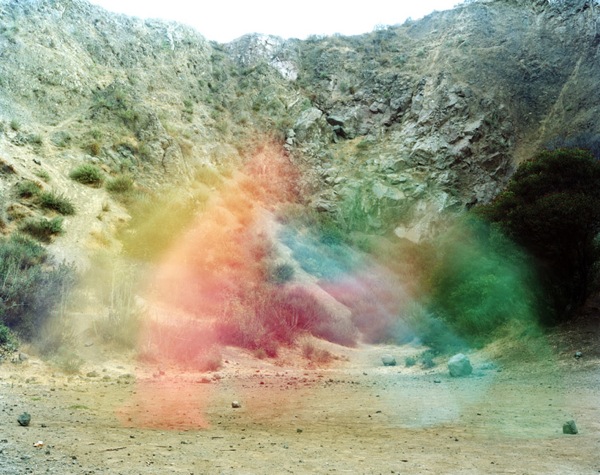
If all ghosts looked like this, perhaps we’d be less afraid of them. These colorful phantasms are the work of artist Brice Bischoff from a series called Bronson Caves. Looking at the piece above, I initially thought these had been done with explosions of colored powder, a technique that has been used in similar works. But for these, Bischoff used a long exposure to photograph dances with large sheets of colored paper. The photographs become records of movements, which gives them a dynamic quality even as stills.

See the rest of the series here, and have a colorful weekend, wherever you are!

Bischoff Bronson Caves 01

Bronsoncaves04

Bronsonadd02

Bronsonadd01

Bronsoncaves02

Bronsonadd03

Via designboom

Gray Malin, À la plage

2 August 2012

Pampelonne Beach St

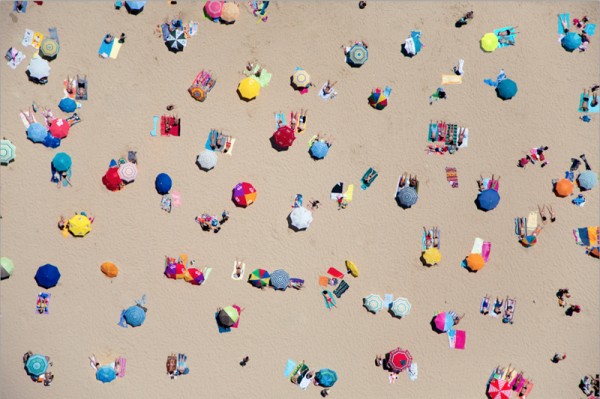
Gray Malin’s À la plage series is like a cross between Massimo Vitali and Richard Misrach, combining the joy of things viewed from above with the sensorial pleasure of beach aesthetics. Malin says:

People and objects become patterns creating repetition, shape and form. These photographs are a visual celebration of color, light, shape—and summer bliss.

What Malin’s done is use perspective to transform a beach into a pattern. Clever, right? In fact, it’s a pattern I was just expressing my love for in my previous post. Polka dots! Essentially, Malin has made patterned canvases from two things we love: polka dots and the beach.

The weekend’s almost here. I hope there’s a beach in your near future, and that you make of yourself the most joyful kind of dot.

Costa de Caprica Portugal 600x399

Secret Beach St

Malibu California 600x399

Coogee Beach Australia 600x399

Nude Beach San Francisco 600x399

Screen shot 2012 07 17 at 12 14 55 PM

Screen shot 2012 07 09 at 7 30 39 PM

Screen shot 2012 07 05 at 11 30 58 AM

Cascais Portugal 600x399

Images: Gray Malin. You can purchase many of these here.
Via: Because I’m addicted (with a hat tip to Em!)


Urban abundance

30 December 2010

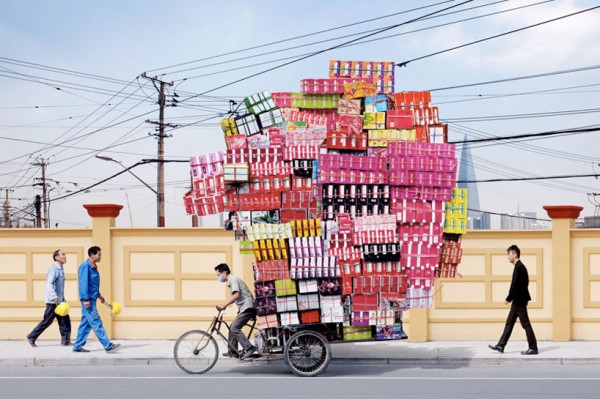
Recovering from a holiday of excess, I want to be in austerity mode, but I can’t help being drawn to the almost comical sense of abundance in these images from photographer Alain Delorme’s Totems series. If you’ve spent any time in the developing world, you’ve seen that these laden bicyclists are the normal mode of transportation for all kinds of goods, and it’s a source of great delight to see how cleverly the operators pile their wares onto such delicate craft. I know this is hard work, and I don’t mean to romanticize their labor, but having seen many of these kinds of carriers in person, I’ve been consistently surprised by their apparent lack of struggle. Despite the top-heavy proportions of their loads, their  balance seems remarkably effortless, and I find that looking at them evokes a sort of reverence for this almost magical skill.

On the DesignBoom blog, Andrea Chin writes:

The verticality of these formations echoes the incessant expansion of the urban area, constantly under construction. Here, De lorme gives a new vision full of humor and poetry of those porters – both super heroes and ants with impressive loads of tires, water containers, office chairs, flowers… Distanced from the typical photos of China portraying immense crowds, he has focused on the individuality of these workers, as opposed to all those identical and interchangeable objects.

While I can see the urban expansion metaphor and the emblematic reflection of the spread of materialism, it’s not the first place I go when I look at these images. For me, the reaction is much more emotional, and focuses more on the latter statement about the individuality and humanity of the workers. Unlike the numberless trucks that ferry goods around western cities, their facades obscuring their contents, each of these improvised structures is a unique composition, a transient artifact of human ingenuity. They’re less elegant than purpose-built cargo transports, but they have a kind of ramshackle beauty. Accidental sculptures, they remind me of the limitless nature of human assiduity, and the joy that lies in so many ordinary acts.

Alain Delorme: Totems
via: Erin Loechner’s lovely Design for Mankind

The joy of jumping on the bed

4 April 2010

Yes, that is Desmond Tutu in the midst of all those children jumping on a bed! For a project called Play Jump Eat, Kelly Wainwright of Messy Monkey Arts managed to coax not just the Reverend Archbishop, but also fishermen, surfers, schoolkids, and others to let go of their inhibitions and be photographed in odd situations, bed-jumping.

Jumping on the bed is an example of a joyful pleasure at its most democratic: an activity that is accessible to nearly everyone. It’s a childish pleasure, one we associate with being small in the expanse of our parents’ beds, but it can be rediscovered at any time. (Confession: I sometimes can’t resist a jump or two in a hotel room.) There’s just something so totally liberating about jumping; it’s a slightly transgressive, freeing feeling that brings laughter and optimism up to the surface. Even just looking at these photos evokes a vicarious burst of delight!

I hope the full series will eventually be posted online. Read more about the project here.

{Via @vpostrel}

Update: Kelly pointed out to me that prints are available here and that a portion of the proceeds benefit the Tertia Kindo Arts Project, a children’s dance school. The comments also made me realize that I failed to credit Inge Prins, the photographer on the project. Lovely work!

Dreams of flying

2 March 2010

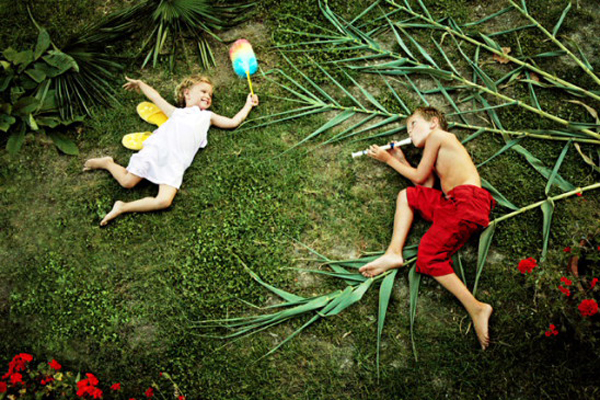
This whimsical series of photos by Jan von Holleben has me totally charmed. There’s something so sweet about the landlocked restaging of childhood fantasies of flight: Peter Pan, Superman, The Red Balloon, etc. It looks like it would be such fun to be one of the kids in the photos. It also highlights a connection I hadn’t noticed before — the link between childhood and a fascination with flight.

So many characters in children’s stories fly: superheroes, fairies, wizards. Many toys fly as well, from balloons to paper airplanes, kites to whirlygigs. There’s something enchanting, liberating about flight and I wonder if children are more fixated on flight or just less inhibited about imagining it. As we get older, the characters in our stories tend to keep their feet more firmly on the ground, and even our dreams seem to have less flying in them, or at least that is the case for me. As a child I used to spend many nights leaping through the air in REM sleep; now, I covet a dream where I even get a few feet off the ground.

It’s also interesting to me how these photos illustrate the joyful gestures of flying. If we take away the props and the settings, what’s left are splayed-out, arms-up gestures that stretch the body wide and open. With no context, you could still understand the form as those of bodies in flight. There is an exultant quality to these bodily shapes; they are delight in contour, revelry in sinew. Joy thrives in this unthreatened openness, this delicious expansion of a physical being into its space. It makes me wonder how we might incorporate more of these kinds of gestures, in stills or in movements, into everyday life.

Pop!

11 November 2009

4084205504_975572ae38_b

2501680028_71335ea4e8_b

3192920085_70ba332442_b

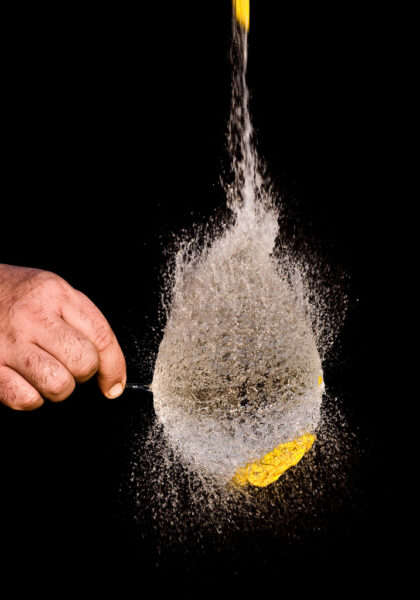
If you’ve ever wondered what a water balloon looks like right at the instant it pops (don’t you lie awake contemplating this?) — here you go. These photographers clearly have vibrant inner children!

{images: CameraShyMom, A.Connah, herbe_nelson}

Joyful art: Gerhard Richter’s painted photos

2 October 2009

richter1

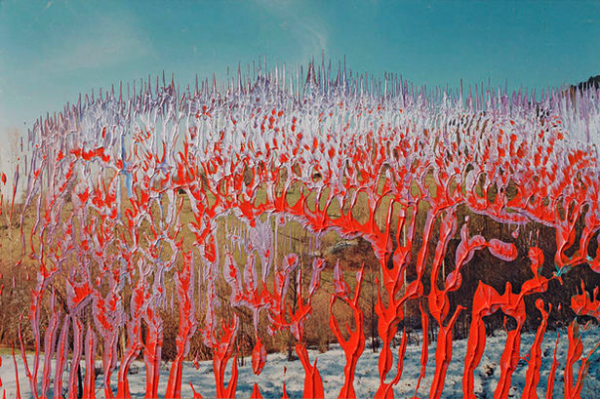
I love the spontaneity and texture of these paintings layered over photographs by Gerhard Richter. I h0pe they brighten your Friday and that you have a lovely, joyful weekend!

Xx Ingrid

richter2

richter4

richter6

richter5

Aesthetic of joy: quiet + serene

18 September 2009

1252626335

Stephanie and Mav of 3191 have this serenely joyful aesthetic that always leaves me inspired. I think it’s because their  lenses reveal the intense pleasure in simple things, with a focus on contrasts and textures. Their photos become like abstract compositions, with ordinary elements balanced like a squares in a Mondrian painting or steel plates in Calder mobile.

It’s a great example of a different kind of aesthetic of joy. Not the high-energy, celebratory kind I often embrace here on the blog, but a quieter version. There is a sense of domestic peace in their images, but the emotion I get is not sedate contentment, it’s a slow rising tide of delight, a buoyant energy simmering just below the surface, like a pot of water just before the crescendo to boil.

I loved this back to school post by Mav. I had exactly the same sentiments when I was going back to school. School supplies were the balm that soothed the nerves and stoked the anticipation. They’re just so beautiful too.

sept11m2

sept11m3

Joyful art: Massimo Vitali

14 September 2009

mvitali2a

Someone turned me on to photographer Massimo Vitali this week, and I can’t stop looking at his fascinating images of Italian beach culture. Viscerally, there’s something immediately appealing about the slightly sun-bleached color palette and the way the images manage to be both peaceful and bustling with activity at the same time. It’s hard to see at this scale, but because Vitali shoots large-format, the images are incredibly detailed, so much so that he considers them to be compositions of portraits. In an interview with LensCulture magazine (audio here), he describes the role of the human element in his decision to press the shutter.

And then it comes a moment. Because in fact all the pictures are taken in a very little amount of time. And obviously, I follow stories and things. I look at the people, people that interest me and that pick up my fantasy, and I say, “Oh, what is she doing? Why is she looking at her?” and so I start to make connections, and when I see a certain number of these connections taking place, then I shoot. Because I want to, I try to have the picture as complicated as I possibly can.

His photos are actually compositions of stories, tons of little narratives distilled into light and color, and there is joy in the abundance of it, the way you can simply get lost in the contemplation of other lives in their leisure. This idea of complexity is fascinating, because we don’t normally associate it with joy. We think of joys as simple pleasures, but when we think about simple pleasures, we often fail to recognize how sensorially complex they are. We simplify a day at the beach to sun, sand, saltwater.

But the sun has a feel that is particular to a latitude, a time of day, even the melanin composition in a particular person’s skin. Sand has texture and color (different everywhere), micro and macroscopic scale, hidden stones and shells that may be jewel-like treasures. Saltwater has smell and taste, temperature, and translucent color so mottled and varied it’s like a world in itself. Before we even get beyond the setting, the beach proves to be a deeply complex pleasure. This complexity is one of the things that makes joy renewable. It explains why the same settings can trigger powerful emotions over and over again. Just like gazing at a Vitali portrait-scape, each time you return to something that gives you joy, there’s always the likelihood you’ll discover something new.

mvitali1a

mvitali3a

mvitali6a

mvitali7a

mvitali9a

Polaroid joy

9 September 2009

polaroidcardsWhere do I begin with describing the joy of Polaroids? There’s the magic of the technology, which unlike many high-tech innovations manages to be enchanting long past the point of newness. There’s the delight of instant gratification coupled with a delicious (almost torturous) anticipation. And then there’s the experience itself, the sheer pleasure of the image emerging, first a ghostly impression, then full color, out of a sort of muddy brown nothingness.

Digital cameras bring joy too, of course. Our first encounters with that technology were certainly magical, though its proliferation has made them less so. You can relive that initial joy and remind yourself how wondrous digital photography is by traveling to the most remote places with a digital camera. In 2006, my then-boyfriend and I were admiring a donkey in rural Kyrgyzstan when its owner came along and invited me to give it whirl. The man joined me in a photo and I’ll never forget how his eyes lit up at seeing the photo displayed on that tiny screen. We rarely have the opportunity to feel that way anymore, but digital photography still has its joys — they just come from other attributes. For example, the scale of digital technology is such that we can carry it with us everywhere, so we never miss a joyful moment. And because we can take zillions of shots for free, without even thinking about it, digital photography lends itself to more spontaneous, unexpected results.

But Polaroid has a few joyful features that the weensy camera in my iPhone can’t hope to match. First, the Polaroid is a real thing, an artifact. The Polaroid spits out a real picture (and does so with that exciting ejector noise). The picture is a real, tangible thing. It has weight and texture, smell and sheen. It interacts with light, reflecting it off its glossy surface. It interacts with the hands, showing fingerprints and odd effects if you touch the surface during the developing process. A digital photo feels ethereal; it’s an image, but not a picture. It engages just our vision, while a Polaroid engages all our senses. (Well, except taste. I hope.)

The Polaroid does the instant gratification of digital one better by incorporating a tiny interval, a delay that allows our anticipation to build. Studies have shown that interruptions or delays preceding a desired event make the event more pleasurable when it occurs. So while that wait for the image to come through tries our patience, it actually makes for a more joyful rush when the image actually appears.

The interval suggests another joyful feature of Polaroid, to me the most important one. Polaroid is not just a product, but a process. This is essential to the notion of joy. People don’t derive joy from products; they derive joy from experiences. A product is static. It can only create joy through its contribution to an experience — the experience of using it (hula hoop), wearing it (pair of shoes), doing something fun with it (golf clubs), interacting with others through it (phone), contemplating it (art), and so on. Objects that suggest or prescribe an experience are more likely to be joyful than others. But objects can also incorporate experience into their very essence, their matter, and this is transcendent. Polaroid is one of those rare products that embodies an experience. Every Polaroid picture is a unique show, a one-act play of light and color whose action unfolds silently in front of the user. That process reflects the experience you just had when you took the photo, when the moment crystallized in front of you as photo-worthy, when the players assumed just the right poses, when you depressed the shutter and made it permanent. The image emerges, a transformed vision of 3-5 minutes ago, as the most beautiful kind of déjà vu.

Which is all to say that I’m very pleased about the renaissance of the Polaroid that seems to be happening these days. Urban Outfitters is now selling Polaroid film, and I just founded these gorgeous Polaroid notecards (above) on the always charming Jars of Cute (available at Fred Flare). To me it’s less a manifestation of retro nostalgia than a craving for tangible, joyful experiences, something I think we all can use a little more of in our lives.