Joy as ideology

9 March 2013

661b9ec1842cd6a15fb371f37ce63151

Do you read Erin Loechner’s wonderful Design for Mankind blog? She has long been finding some of the most beautiful, joyful findings on the web, but lately her blog has gotten even better as she’s adopted a “slow blogging” philosophy and taken time to share more about her approach. I respect the open and vulnerable way she puts her thoughts out there, and the community she has built around values that I share, namely that design (and specifically aesthetics) can change the world.

Back in February, Erin asked me to share some of my perspectives on “Why Design Matters” with her readers, and I realized I never linked back to it to share with you. It was fun to see how she translated my discursive ramblings and related them to her point of view. You can read the post here.

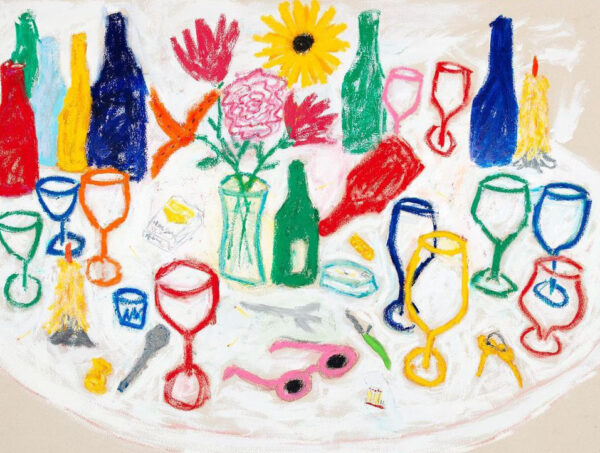
A couple of weeks ago, these beautiful images caught my eye on Design for Mankind, and I was struck by the philosophy of the artist, Evonne Bellefluer. She says, “I don’t think art should be about communicating some ideology. Art, like fashion, is meant to be enjoyed … something I look to to make me happy.”

I smiled to read that because of course that is an ideology, and not just any ideology, but the one I embrace in Aesthetics of Joy. Art can serve many legitimate purposes, among them provocation, representation, union, dissent, exploration, catharsis. Art can incite and art can woo, both credibly. But rarely can art be purely joyful without interrogation of its claim towards seriousness. And yet what higher purpose could art strive for than to improve wellbeing simply through beauty?

Erin quotes Evonne as saying, “I had a conversation with a friend the other day who suggested that my art didn’t belong in a gallery setting because it had nothing to say.” Must everything talk to our conscious minds to be meaningful? This ignores the reality that most of our brain is unconscious mind, which processes the deep, wordless notions of euphoria, yellowness, buoyancy, and belonging in chemical silence. We are much more sensation and emotion than we are ideas.

Bb59afcfaea0c6c75559c91eed982063

Erin’s blog always makes me think. Here’s one more post about slowing down. I hope it sparks something for your too.

Link: “On Intention” on Design for Mankind
Images: via Evonne Bellefleur on Behance

ee

5 March 2013

Have I written before about poetry in the mornings? Sometime last year I realized that all the news and feeds in the mornings was making me anxious. The endlessness of it all, the constantly refreshing twitter streams and feeds made me feel like I was already behind. I would stay in bed reading articles and tweets, unconsciously trying to catch up, when what I really wanted to do was get up and write. I know you can’t catch up with a river. It’s always flowing — all you can do is appreciate the part that happens to be where you are in the present moment.

My other problem was that most of that stuff was garbage: entertaining, attention-grabbing, but fluffy. So starting my day with it was like having sugar pops for breakfast. Lots of nervous energy and no substance. Garbage in, garbage out, they say, and the mind is no different. My solution was poetry. I keep a book on my bedside table and most mornings read a few poems before getting out of bed. Poetry is the anti-Twitter. It is slow, quiet, and deep. If Twitter is a river, poetry is a secluded swimming hole, yours only and exactly when you want it.

Over the past several months, I’ve had the great pleasure of rediscovering ee cummings and his joyous fracturing of language. I’ve been reading the wonderful Richard Kennedy-edited collection. Kennedy, as ee’s biographer, puts the poems in context of his life, which was deeply engaged with people, nature, and the vibrancy of art. As a child, ee grew up going with his family to a place they called Joy Farm (this thrilled me — I want to go!), and he continued to go into adulthood for the spring and summer months. Many of his poems share sensitive observations of natural phenomena and seasons, the love of which was clearly cultivated there.

I’ve been wanting to share this poem for awhile. I love how the colors unfold, pulled across the page in loose syllables like wispy clouds. I love how the breaks in the words force you to slow down to make sense of it, like the sky does. I have been dazzled to my toes by a sky like this; just reading the words, I can be there in my mind. It is nothing too profound — it is not the meaning of life in verse — but when I read it, I take the colors into my day and everything looks different.

Book: Selected Poems, by ee cummings, edited by Richard S. Kennedy

On clotheslines

22 February 2013

D58c7fa0c67911e19c6622000a1e89ba 7

It doesn’t get more prosaic than the clothesline. Once a household staple, now replaced in most of the US with washer/dryer units, they’re a rare sight for many Americans. Yet go abroad and they’re still ubiquitous, used either by necessity or by desire, for a more eco-friendly life or the wonderful feeling of clothes dried in the sunshine.

I’ve always thought that clotheslines are like impromptu garlands. Though they are explicitly functional objects, as are the items that hang on them, they imbue a space with a celebratory feeling. They add color and draw the eye upwards. This is especially true in cities, where clotheslines festoon alleyways, swooping from window to window up several stories.

4fb447fec67a11e19b0622000a1e8a4f 7

2cebd782c67a11e1bf341231380f8a12 7

On clotheslines, the clothes themselves become more than just pants or t-shirts; unified by color and drape, they are more like flags of different shapes. This is a great reminder of how grouping things together changes how we perceive them. And you can see some ideas of curation in the launderer, making choices about color adjacencies, patterns, and scale. In effect, this person, the unseen clothes-washer, is a designer of public space, changing how neighbors and tourists experience the buildings, streets, and passageways between them.

469806aac67b11e1bef722000a1e8bb5 7

D7fe53cac67a11e1b2fe1231380205bf 7

0096d9b6c67a11e19894123138140d8c 7

I spotted these particular clothesline photos in the Instagram feed of my friend Sheena Matheiken; she has a wonderful, joyful eye and I had to share them with you. Clotheslines seem emblematic of the idea that joy is in your prism, in how you choose to see the world. You could see them as intrusions in the landscape, objects of toil or clutter. Or you can relish their quotidian beauty, the way the light shines through them, and the charming absurdity of seeing a stranger’s underwear fluttering in the open breeze. Anaïs Nin famously said, “We don’t see things as they are. We see them as we are.”

I think I see so much joy in the world because I choose to see it that way. Some people think that if you’re looking so much for joy, you’ll have high expectations that are often disappointed. But I don’t believe it works that way. Being joyful by nature, and by intention, I find it jumps out at me. I don’t actually have to look very hard; it finds me.

What are your “clotheslines?” What are your favorite examples of everyday things that become joyful when you really look at them?

Images: Sheena Matheiken

Glasses that give color to the colorblind

18 February 2013

As a color-lover, I’ve often wondered what it would be like to be colorblind. What would I miss, beyond the boundaries of my own visible spectrum? Would I understand the lack intuitively, or only by comparison with others?

The short film above, “Ishihara” by Yoav Brill, offers an emotional peek into the world of someone with severe color blindness. In the film, Brill cleverly co-opts the visual language of the Ishihara test, a series of dotted color plates used to determine whether someone has problems with their color vision. I’ve always found the Ishihara test to be joyful-looking, like clusters of colored bubbles, though bittersweet that something so beautiful could be the confirmation of bad news for someone. And I imagine it must be frustrating to know that there’s information hidden in the pattern, and yet be completely unable to detect it. (If you are color normal, you will see the numbers 6, 12, 2, and 42 in the charts below.)

Ishihara plates

On the other hand, when I listened to this episode of Radiolab, I realized that lots of animals have better color vision than we do. Birds have one extra type of cone cell in their eyes, opening up a world of different colors than we have. And if that sounds amazing, think of butterflies, some types of which have seven cones, or the mantis shrimp, the organism with the world’s most complex eye, which has sixteen cone cells! Those guys must have a technicolor life!

All of which is to say that the colors that exist in the world are far more numerous than we can perceive, whether we are color blind or color normal. Maybe one day scientists will figure out a way to let us see what birds see. But more significantly, just recently scientists have figured out a way to help color blind people see more normally.

Neuroscientist Mark Changizi (whose work I first wrote about here) has written extensively on the evolutionary history of vision, and why everything from our depth perception to our written language evolved the way it did. His work on color vision is particularly interesting. He has put forth an alternative (or perhaps complementary) theory to the idea that human red-green color vision evolved to help us find nourishment, instead proposing that we evolved the ability to see color to understand the health and emotions of the people around us. Based on that work, a few years ago Changizi co-founded a company called 2AI Labs and started development of a set of glasses called O2Amps designed to amplify the visibility of blood oxygenation and other factors that help make these physical and emotional states more apparent.

Hospitals are using the glasses to help with diagnoses — they can make bruising under the skin from trauma and other disorders more obvious — and to help nurses find a patient’s vein. Another potential application is for security officers such as the TSA; the glasses may help officers better identify people in an agitated state. Once the glasses were released, though, Changizi and his collaborators began hearing from color blind people who had put them on and experienced the world in an entirely new way.

Here’s a quote from Dan Bor, a red-green color blind neuroscientist who tested the glasses:

I’ve just received a couple of special specs to attempt to reduce my colour blindness, from Mark Changizi and O2Amp. When I first put one of them on [the Oxy-Iso,], I got a shiver of excitement at how vibrant and red lips, clothes and other objects around me seemed. I’ve just done a quick 8 plate Ishihara colour blindness test. I scored 0/8 without the specs (so obviously colour blind), but 8/8 with them on (normal colour vision)! I’m pretty thrilled and can’t wait to explore more of the world with the specs over the next few days.

The glasses aren’t without some issues — while red-green perception improves, other areas of color vision suffer. Bor observes that while red and blue were far more clear and intense while wearing the glasses (and I love that he says that lips looked red like he’d never seen them before), some shades of yellow seemed to disappear, and Changizi cautions that the glasses shouldn’t be worn while driving, as the yellow light in a traffic signal could become invisible. As magical as it seems to give color to the color blind, it’s not a pure gain, as the enhancement in one part of the spectrum comes by “spreading out” the loss across other regions. Still, Bor notes that it’s amazing to be able to have a sense of what someone who is color normal might see, and even better to have the choice. (He says he’d bring the glasses to an art gallery, but probably wouldn’t wear them every day.)

When I see anything, art or science, that can expand the boundaries of our world and give more vibrancy to it, I feel such a sense of awe. It’s like joy is hiding in front of us, sometimes in plain sight. And then one day someone just comes along and reveals it. A pretty wonderful world we live in, don’t you think?

Sources: Changizi blog and Scientific American
Images: Ishihara plates no. 1, 13, 19, and 23 from Wikipedia

Colorful reflections

9 February 2013

Snow01

Here’s something subtle, yet charming, in honor of today’s snowy day. Artist Toshihiko Shibuya adds color to snow through reflection. By painting metal disks and plates with bright colors, he creates a vibrant palette in the snow. I love the magic of this, letting the elements (in this case, snow) reveal a hidden hue. It’s very Japanese, to work with the landscape, to patiently tease out color from the interactions between forces rather than painting it thick across the top.

Snowpallet toshihiko01

Snowpallet toshihiko02

Snowpallet toshihiko04

42c993e4743f866d555a917eb87337f7

I was enchanted by the same color reflections when doing space analysis in design school. I used to spend untold hours hanging colored planes in boxes made of foam core so that the light would tinge just so. Based on this fascination, I designed one of the pieces for my thesis using the same idea. I don’t often share my work on this site, but this seems relevant. I designed the stools below to almost disappear when looked at head on. Then when stacked, they reveal their hidden color.

The intent of my thesis was to illustrate different essential ideas of Aesthetics of Joy in simple furniture forms. I designed 10 pieces. If you like these, maybe I’ll post more… I miss furniture design. I love creating utilitarian things that brighten up everyday life. One day, when I finish this book, I’ll get back to it. (And hopefully that will be sooner, rather than later!)

Surprise white

Surprise stack

Images: Toshihiko Shibuya’s work courtesy of Designboom; mine are my own

Secret joys: colorful socks

9 December 2012

Gap animal socks

Socks are a secret way to be joyful, even (especially!) in serious situations. No one has to know that inside your shoes are rainbow stripes, or polka dots, or a pair of owls on ice-skates. Your feet are your own territory; you’re free to decorate them as you choose.

I’ve always loved colorful, patterned socks. My philosophy is, “Why not?” No one has to know they’re there, and the act of putting them on in the mornings perks me up. Taking them off at the end of the day, I smile again, remembering that they were under there, my true joyful self under all the emotions that came and went.

Joyful socks don’t have to be expensive. They shouldn’t be! They only need to be bright and comfortable. Yesterday, I fell in love with these charming pairs at the Gap. I couldn’t resist them, and they’re on sale. The fox has a stocking cap. The penguin is bundled up. The owl is headed for Rockefeller Center. Are they too cute? Probably, but that never hurt anyone. It’s a gloomy, drizzly day in Brooklyn, but I’m inside mulling cider and contemplating a winter with warm, happy feet. Wishing you the same!

Upside-down rainbows

24 November 2012

JackJusticePembrokeONT art 7 25314

At the risk of becoming the all-rainbows-all-the-time blog, I had brave monotony to share one more. Though these rare formations have the familiar red-to-violet spectrum, they are technically not rainbows, but “circumzenithal arcs.” They owe their upside-down shape to light refracted by ice crystals high up in the atmosphere. Note also that the colors appear in reverse order, with violet on top and red at the bottom.

Circumzenithal arcs are about as common as rainbows, but they seem rarer; because they appear at such high altitudes, they are harder to spot. A good place to look for them is in cirrus clouds.

One more reason to look up more often: you might see the sky smiling back at you.

MichelTalbotOttawaONT art 7 25315

Via: The Weather Network, with thanks to Michael McQuay for the tip.
Images: Jack Justice and Michel Talbot.

Giveaway: Lux Archive

26 September 2012

9030f7c782e47ca7b7b3c5a14b4ea73e 900 900

Fall is my favorite season. I know, I know — wasn’t I just lamenting the end of summer a few weeks ago? But while I miss summer’s energy and abundance when it goes, there is no salve like the surreal vibrancy of fall, of trees lit up like firecrackers in the crisp, drying air. In fall, I feel most awake, most attuned to the world, and perhaps most inclined to savor, as we slip towards the dark of winter. Though the colors of the trees are actually harbingers of decay, revealed from their normal hideout under a scrim of chlorophyll, they feel like a celebration.

As it gets cooler, things calm down, and I find I get a little more time to spend at home. Especially at this time of year, I think its important to make sure home is a place you want to be, and having beautiful, colorful art on the walls is big part of that. So I’m delighted that Lux Archive, a site that offers affordable, limited edition fine art photographs, has offered a special discount and giveaway for Aesthetics of Joy readers. Lux Archive has a beautiful range, with lots of pieces that bring the joy of the world into clear focus. Back in February I posted an amazing image of a cardinal in flight by Paul Nelson, which is part of a remarkable series called Wild Birds Flying available on the site. The amazing fall color images for this post are by David Reinfeld, and I love how each image seems to replicate a leaf structure at large scale — the branches like veins, the leaves like cells — affirming the lacy, fractal structure of our amazing world. There’s more: the airy, beachy images of Kerry Mansfield, the exploded flowers of Fong Qi Wei, and this deliciously bright and absurd dog on a giant watermelon.

For 20% off on prints at Lux Archive, use code JOY20. And for a $50 coupon for one reader (that covers half the cost of a small print), write your favorite thing about fall in the comments. I’ll choose one that’s particularly joyful and award the coupon next week. Make sure to leave your email in your comment so I can contact you.

I’ve never done giveaways on this site, but I liked this one because I thought it was generous and might bring joy to some of you who are seeking it. Enjoy, and if you buy a piece, let us know which one so we can enjoy it with you!

6f914fadd01f04e6da4d3b9ef467e9c8 900 900

Images: David Reinfeld, courtesy of Lux Archive. For more David Reinfeld, see here.

The importance of rainbows

9 September 2012

7785

Sometimes there’s a theme that just begs you to write about it. You ponder it, you scribble down a few thoughts, you procrastinate — but it just keeps following you. That’s how it’s been these past few weeks with rainbows. They arrive surreptitiously, by night in my inbox. They appear in the scatter of the spray from a drainpipe. They pop up at the ends of random links, cheerily persistent: “Hi, remember me? I’m that rainbow you were going to write about!” These rainbows act like they have important business.

And so they do. The other night I received a note from a reader named Lauren, with a story that both broke my heart and touched it deeply. Lauren wrote:

…I like to look at how others have used rainbows to brighten their world. I painted a rainbow chrysanthemum on the coffin of my baby boy when I buried him in July this year. Somehow, the colours have inspired me to keep going despite the tragedy that has divided our family.

I must say, first, that there can be nothing so horrible for a family as the loss of a child. Just reading Lauren’s few words filled me with empathy and sorrow. But Lauren’s story is not just about pain. It’s also about an act of beauty that is an expression of fierce love, and positivity that looks an awful lot like hope.

A rainbow is no compensation for the losses in our lives. Filmy and weightless, a rainbow replaces nothing, certainly not a beloved child. But strangely, the rainbow’s kind of joy is often the most able to reach us in those dark moments. Wordless, visceral, instantaneous: it has a direct line to our unconscious. We may feel incapable of laughing in a tragic moment, we may be ashamed of our impulses towards play, but we don’t begrudge ourselves a feeling of wonder at the sight of beauty. Rainbows, light, color, music — these are the things that break through to our dark places and lift us up. They make small spaces of lightness in a heavy heart, spaces for hope to take root. And it’s amazing (isn’t it?) that this kind of hope can be ignited just by color, by something so many people dismiss as “just decoration.” The surfaces of things have a deep kind of power.

In the fourteenth century, the German mystic Meister Eckhart wrote that there was a place within the soul that neither time, nor space, nor no created thing can touch. John O’Donohue, writer and philosopher, interpreted this to mean “that there is a place in you where you have never been wounded.” This place, I think, is our childlike heart, our awed and hopeful heart that dares to believe that life is worth living even in the midst of terrible pain. In depths of sadness, this place can seem inaccessible. It can feel as if it doesn’t even exist, that joy has been wrung out of our lives by struggle. In those moments, when we feel we cannot even find ourselves, it is good to remember that the way in, the way back, is beautifully simple.

So the rainbows were right to pursue me — their message is an important one. Beauty matters, especially in times of pain. If you know someone going through a difficult time, perhaps there is something beautiful you can do for them that will provide a spark of hope. And if it’s your difficult time, trust your own impulses towards beauty. Be kind to yourself. Take a walk somewhere open and wild, play music, or look at art. Seek out rainbows, or make your own.

I’m inspired by Lauren’s example, and feel privileged that she reached out to share her story. She continues to look forward, not forgetting her son Elijah (whose middle name is Rainbow) but remembering with a joyful mindset:

Elijah’s unfuneral in the park was a special day with rainbow flares coming up on the lens and rainbow face-painting. Now, two months after his death, I have yet to see a real rainbow. When I do, it will be special. In the meantime, I make my own rainbows and plan to decorate our new housebus with a rainbow of colour.

Image and story shared with openness and generosity by Lauren Fisher. On her site, you can learn more about her story, and the things she does to bring joy into her life and lives of her girls.

Summer’s end

1 September 2012

IMG 0106

Summer is that season of joyful, frenetic energy when our lives seem at their most vibrant. Soaked in the light of long days, we go from scene to scene without the same need for rest we have in other seasons. We are fueled by solar energy, our molecules sped up, expanding in the heat. Work slows down, weekends expand. And every once-empty space brims with abundance: with foods, with sensations, with delight. The pleasures are simple, but all encompassing.

It all goes too fast. But at the end I look back and wonder how it was possible that I did so many things. I seem to have been everywhere at once, on a beach and a farm, a rooftop and a stadium, an island and an opera house. By all measures, it has been a gorgeously full summer.

But it’s not over yet! There’s one more weekend, and I hope you’re making the most of it. My wish for you is that you get to do one wonderful summer thing that you didn’t get to do, perhaps that you put off doing, for the last three months. Maybe you haven’t eaten a fat red tomato, or browsed a yard sale, or put your feet in salty ocean water. Whatever it is, I hope you enjoy every minute!

Joyfully,
Ingrid

IMG 0394

IMG 8944

IMG 0404

IMG 0166

Mrsoftee

IMG 0107

IMG 0299