Aesthetics of Joy for birds

15 July 2011

For about thirty seconds after coming across this piece, “Housing Boom, if You’re a Bird,” in the NYT, I was enchanted. I read:

Along the spine-jarring road that runs through this city on the South China Sea, in between the sparse, waterlogged shacks of corrugated aluminum and wood, colorful buildings have begun to sprout.

They tower over their low-slung surroundings with dollhouse facades, colored in baby blues, sunshine yellows and ruby reds.

Then I realized that the reason these homes were being built was to harvest the edible nests of the avian inhabitants to sell to China, and the piece became less charming. I loved the idea of a colorful spate of birdhouses being built all over Indonesia, for conservation or simply enjoyment. But for commerce – a kind of semi-parasitic home-stealing commerce – the birdhouses suddenly feel less appealing. A kind of Aesthetics of Joy used as deception, like a marketing bait-and-switch.

But regardless of the intention, there’s a joy-related insight here. It intrigues me that the builders of these houses use color to attract the birds, while when left to their own devices the swiftlets typically nest in caves. Is it that we are so inexorably attracted by bright color that we believe other species will be too? Or is there evidence that the birds prefer color, just like we do? Either answer makes a statement on the power of color to engage us and arouse our emotions.

If anything, birds may be even more sensitive to color than we are. Most birds are tetrachromats, meaning that they have four types of cone cells in their retinas, which are the cells that sense color. While humans have cones with red, green, and blue receptors, birds have a fourth cone that lets them see into the ultraviolet range. This means that birds may see colors we don’t even know exist!

Whether this brings them joy, we can only guess. But I guess it can’t hurt, if you’re building a birdhouse, to pull out all the stops (and the colors of the rainbow).

Grazie, Dario, for the link! And thanks to @markchangizi for first pointing out to me tetrachromacy in birds.

The New Humanism

24 March 2011

1109 Essay I x600

I can’t believe I nearly missed this. Eight weeks straight on a plane, and you’d think I’d be spending a bit more time with the New York Times app on my iPhone. But, no, this incredibly well-considered piece of synthesis by David Brooks nearly slid right by me.

It’s not that Brooks is saying anything truly new here. Writers in the diverse fields he mentions – neuroscience, psychology, sociology, etc. – have been building a case for the integral connection between reason and emotion for years, decades even. But his distillation of the key insights of “the new humanism,” as he puts it, is especially sharp and clear:

This growing, dispersed body of research reminds us of a few key insights. First, the unconscious parts of the mind are most of the mind, where many of the most impressive feats of thinking take place. Second, emotion is not opposed to reason; our emotions assign value to things and are the basis of reason. Finally, we are not individuals who form relationships. We are social animals, deeply interpenetrated with one another, who emerge out of relationships.

What Brooks offers is a synthesis that points to synthesis – the reuniting of concepts our culture has told us are dialectical, disconnected, or broken into disparate parts. It occurs to me that the shift in thinking he describes is really the shift from object-oriented thinking to systems thinking. Our brains are not a set of discrete objects, but a unified system; we cannot distinguish the functions of one part from the whole without fallacy. And we ourselves are not discrete units, but rather nodes in social systems. Everything is interconnected. It’s a profound shift in worldview.

1109 Essay F x600

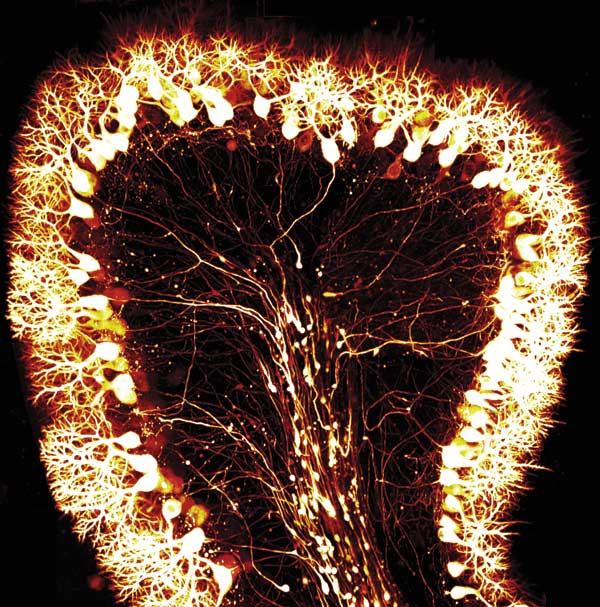
These images, in case you’re wondering, come from a 2009 piece in Technology Review called “Time Travel Through the Brain,” showing a kind of history of brain imaging. The images have no specific link to Brooks’s NYT piece, but looking at the images with their branching fibers and tendrils, I was reminded that all the brain really is is connections. Synthesis, linking things together, drawing multiple inputs into a cohesive picture – this is what the brain does. Any structure as reaching as this one cannot really be a dichotomy in how it behaves.

Tumblr ks7y46KKl81qa6reco1 500

Of the three insights I’ve quoted from Brooks above, the first two are foundational to Aesthetics of Joy, and the third is deeply significant. How quickly we forget the effortless magic of our unconscious mind, a silent engine, a hidden processor that runs in the background, quietly alert. Aesthetics of Joy is about the language that speaks to this unconscious mind, the language of form, movement, surface, and character that communicates with the mute sensemaker that is our emotional brain. Joy is sense, as is sadness or contentment or shame. All of these are a kind of proto-rationality, a set of organizing principles that help us prioritize our interactions and parcel out our precious, limited conscious attention towards the world. To say “our emotions assign value to things” has an ironic accuracy. We have for so long assumed that the rational brain assigns value through measurement, probability, and calculation, and that our emotions misappraise value. Now that we know the limits of our tools, our inbuilt estimator looks better and better. Though relative and mercurial, emotionally-calibrated value offers a truer reflection of a thing’s importance in our sphere.

Tumblr ks7ydmYU5a1qa6reco1 500

For design, I hope this emerging synthetic view will lead to a more synthetic practice. Too often, I think designers swing between extremes of rigor and intuition. Because design can be hard to explain, we justify our decisions based on hyper-rational principles or we fall back on “it just feels right.” What I’m working towards, and what I know others are as well, is an informed intuition – an understanding of why things feel right when they do, and a language for communicating this among ourselves and to others. A new humanism, I hope, will also help to bring about a newly humanistic kind of design.

NYT: “The New Humanism”
Technology Review: “Time Travel Through the Brain”

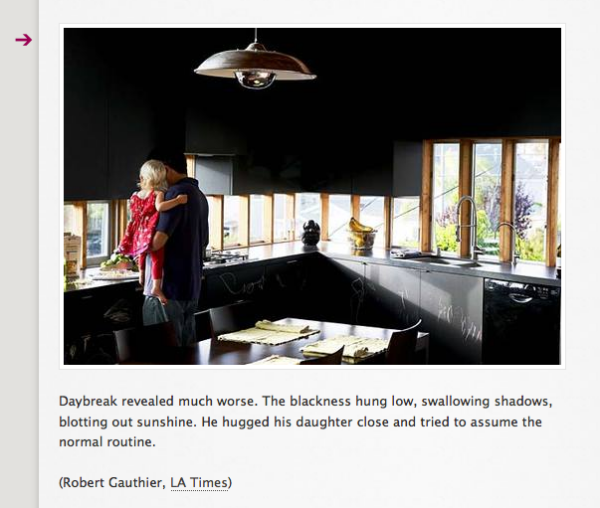
Unhappy hipsters: does modern design make us gloomy?

8 February 2010

My latest post for my Psychology Today blog is generating a lot of great discussion in the comments about architecture and emotion. The post uses the phenomenon of the blog Unhappy Hipsters, which assigns new captions to photos from Dwell and other design magazines, as a springboard for questioning the emotions evoked by modern design aesthetics. I argue that there are ways in which modernism is fundamentally in tension with the aesthetics of joy, particularly when it comes to angular forms, desaturated color palettes, and minimalist or restrained tendencies. Though it sounds as if I’m a modernist-hater from the premise, if you’re a regular reader you know that’s not the case. In fact, I’ve posted on the opposite topic — confluences between modernism and joy — more than once before. The post was inspired by the old adage, “it’s funny because it’s true.” I was curious if the humor in Unhappy Hipsters stemmed from a larger, mainly unconscious issue with modern design. The post was an attempt to provoke some reflection on some of the salient features of the style/ideology of modernism and why they might be at odds with positive affect. I’m heartened to see the level of debate and thought in the discussion, and I’d love to hear your thoughts as well.

Saarinen and the curve

10 November 2009

saarinen_ny600

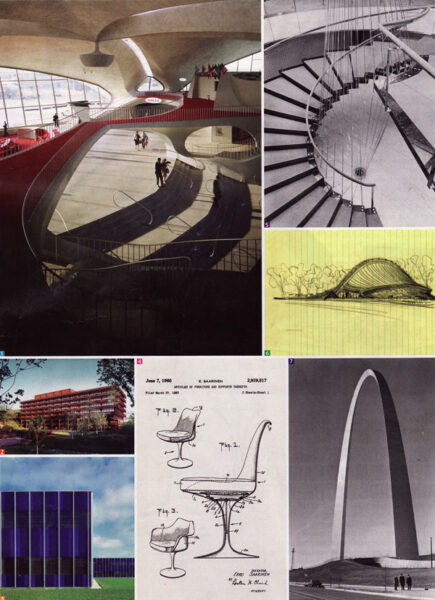
In this week’s New York magazine, Justin Davidson has a review of the new Eero Saarinen show at the Museum of the City of New York (a wonderful place, so if you’ve never had the opportunity to visit, this might be a good chance). The title of Davidson’s review is “Joy Constructed,” so of course this caught my eye and started me thinking that perhaps Saarinen might represent a counterpoint to the hard-edged, rationalist, emotionally-muted modernism represented by the Bauhaus and the International Style — a truly joyful modernist.

Looking at the swooping railings, ceilings, staircases, and arches in the spread above (from New York magazine), I can’t help but feel uplifted. But why? I’ve previously suggested that curves and round forms have a primal appeal because they are connected with safety. As children we are naturally drawn to objects with non-threatening surfaces, and the more broad and neutral the curve, the more safe and approachable an object is. (No one’s going to cut themselves on a beach ball.)

As it turns out, there’s science to support this idea. In a 2007 study published in the journal Neuropsychologia, researchers demonstrated that angular objects and shapes are perceived as significantly more threatening by the emotional brain. Showing curved and angular variants of the same object (a watch, a pitcher, a candle) and abstract patterns to a group of volunteers resulted in markedly different activity in a part of the brain called the amygdala, which is involved in threat and fear reactions and responds far more quickly than the conscious brain. Angular objects create much more activity in this part of the brain than curved objects. This makes sense in the context of survival within a primitive world — sharp angles are rare in nature, and usually do signal danger, or at least something we should be alert to: teeth, claws, cliff edges, and so on.

Human nature is a funny thing. You can build upon it, channel it, develop it to its greatest potential, but you can’t fight it. I look at the rigid rectilinear solids of modernist construction and I think of them as an attempt to put human nature in a box. To suppress these innate responses. But the unconscious elements within us react whether or not we want them to — they are uncontainable. In thinking of Saarinen, along with Zeisel and Aalto and other modernists who embraced the curve, I see a modernism that runs along the contours of our natural inclinations, an aesthetic that is conducive to joy.

Joy isn’t rational, and it seems fitting that Saarinen would say of his water tower design for GM (below) that it “is a departure from the completely rational.” It’s an unexpected admission for a modernist, and yet a fitting one for a designer who, in Davidson’s words, was spurred on by,  “the dogged pursuit of joy.”

gm-water-tower

Cuteness + the joywashing of Windows 7

7 October 2009

With its latest ads, Microsoft is hoping that some tooth-aching cuteness will make you forget all about the nightmare that was Vista. We might quibble with the logic, but the execution is hard to fault. Kylie’s cute, and I can’t help but giggle when that music comes on and the cat with the marshmallows flashes on the screen with the words, “snappy and responsive.”

A few weeks ago, Virginia tweeted me the question: “What is the relationship between cuteness and joy?” It’s a question I’ve been pondering for a while now. My theory on the subject is still evolving, but in short, it’s based on the fact that we have a visceral, positive reaction to children and childlike things, even those that are not related to us. This is adaptive, of course, because raising children requires sacrifices of a society, not just a parental unit, and so a natural affinity and protective instinct towards children protects the species as a whole. (Chowing down on a few of your neighbor’s hatchlings might be ok when you’re a crocodile with 70 eggs, but with us low-yield humans this kind of behavior is evolutionarily unwise, not to mention socially unpopular.) The assertion that we have an innate positive reaction to children is supported to some extent by research by Morton Kringelbach in his book The Pleasure Center, in which non-parent adults show greater activity in a region of the brain associated with emotion and reward when viewing infant faces than when viewing adult faces.

How does this translate to cuteness? Many cute things are defined by abstractions of neotenized (juvenilized) qualities: big eyes, round cheeks, proportionally large head, and prominent forehead. You would think abstractions would be less effective at evoking our emotions, but actually the reverse may be true, due to something psychologists call the peak-shift effect. Evidently the brain recognizes features made more salient through amplification and distortion even better than the real thing. This is why caricatures are so easy to recognize and so compelling. Cute things are like caricatures of children, distorted by the overemphasis of certain childlike proportions and features. Compare the big-headed Bratz dolls with Barbie, and the features of any stuffed animal with the real thing to see how this abstraction plays out. You can also see abstraction of childhood in cute movements, such as the wobbling of Weebles, which mimic an unsteady toddler. And perhaps we will also find the same to be true for sounds, as children’s voices are higher in pitch than adult voices, and have a less regular cadence.

Maybe Microsoft is hoping that by associating Windows 7 with all this cuteness, there will be a halo effect of protection and tenderness towards the operating system. I’m not sure but it could work, at least in the short term until the emotional impact of daily use takes prominence. Emotions are curiously non-directed, and though they are triggered by one object, the feelings are often transferred or ascribed to another. Microsoft is also shrewdly and not-so-subtly tapping into something else here, which is the cute photo and video forwarding meme (epitomized by sites like Cute Overload) which consumes significant bandwidth on most social media platforms. So it’s not just an innate emotional programing this type of ad appeals to, but also a cultural moment.

At the end of the ad, Microsoft promises “more happy” is to come. Very curious to see what that will look like, and whether Windows 7 actually incorporates any aesthetics of joy into the design of the software itself.

Aromatic graffiti

30 September 2009

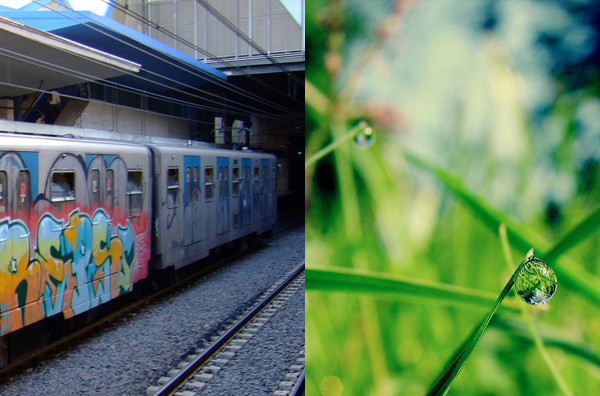
scent_graffiti

I love non-traditional street art. Yarnbombing, seedbombing, mossbombing, LED throwies — anything that brightens and transforms the urban environment really brings me a sense of joy.

So this scent graffiti by Mitchell Heinrich really charms me. Scent is a particularly interesting medium for several reasons. Heinrich says:

Scent is interpreted by the limbic system which is very closely tied to emotion and memory. This leads me to believe that interacting with people using scent can potentially be a much more powerful medium than paint since people experiencing it can’t help but react to it. The goal of this project is to realize the potential of smell as art and to explore different ways of using it to interact with people.

True, but this is only part of the story. Scent requires proximity in a way that vision does not. Visual understanding is nearly immediate once something enters our eyeline. But scent is based on the diffusion of volatile chemicals through the environment, so it reaches us in a more gradual way. It’s like vision is a sudden downpour and scent is a slowly increasing drizzle. So the quality of the surprise achieved is fundamentally different.

Also, in a chat I had a few weeks ago with Dr. Pamela Dalton at the Monell Chemical Senses Center, I learned one of the most important factors in scent processing is context. Many scents occur in multiple contexts. One example is butyric acid, a molecule that in some situations we recognize as aged cheese, and in others we recoil from as the odor of sweaty feet. Without realizing it, we constantly use contextual information to interpret scents and determine how to react emotionally to them. This fact creates some interesting possibilities for scent art. By taking scents strongly identified with a particular context — say cut grass or baking cookies — and pairing them with urban contexts that have a strong associated odor, the effect could be quite dazzling and dislocating. It could also work the other way, creating a powerful negative emotional response. But either way, it likely would cause to reflect on the environment more mundane sensory stimuli as well, and develop a clearer picture of how those make us feel.

Scent graffiti is also fleeting, and that transience is appealing. So often graffiti is not about destruction but about reclamation: the desire to form some kind of personal relationship with the anonymously-designed city that contains and constrains us. To shape this looming environment in some small way. The evanescence of aroma allows for continually shifting scent-images to alter the city, allowing a constant redesign and rediscovery of public space.

Here’s a link to an instructable on how to create your own scent spray cans. Images: attack the darkness and circulating.

{via PSFK}

Joy in the news: happiness may be contagious

15 September 2009

13contagion2-500

Choose your friends wisely: new research says they can make you happy (or fat, or a cancer-stick-sucking addict for that matter). We’ve known since at least Darwin that joy is contagious in a momentary sense — smiling or laughing often causes others to engage in the same behavior and share the pleasure of a particular experience. But this new research suggests a more durable social influence in determining positive emotion.

Interestingly, the article also suggests that positive emotion is more contagious than negative emotion. So while it pays to start hanging out with your friends in the rose-colored glasses, it doesn’t mean you have to drop the Debbie downers entirely.
NYT: Is Happiness Catching?

In another interesting piece of news today, French president Nicolas Sarkozy says France will incorporate happiness measures into their GDP. Though it sounds a little like the touchy-feely Bhutanese accounting method on the surface, the new method is the brainchild of Nobel Prize-winning US economist Joseph Stiglitz. The revised indicators account for the economic benefits of welfare systems, holidays, and environmental measures, correcting what many see as a bias towards productivity at any social and ecological cost in the current figures.
FT: France to Count Happiness in GDP

Another reason why joy is good for you

24 August 2009

240389468_eae91116d1_b

We often think about joy as an end, something we want to achieve. Happiness is a goal, feeling good is desirable for its own sake, not for what it leads to. But one of the hypotheses behind Aesthetics of Joy is that positive emotion can lead to other things, such as heightened creativity, more fruitful collaboration, and social change.

At the end of an essay on enjoyment, neuroscientist Huda Akil suggests another possible benefit of bringing more joy into our lives: intelligence. The science behind it is still in its infancy, but she speculates that we will eventually discover a connection between pleasurable activity and child neurodevelopment. While playing with her granddaughter Sophie in the park, Akil observes:

On that day in the park, I realized that Sophie knows something essential that we adults tend to forget: Having fun is important! It entails unexpected sensations, novel situations, body contact, and physical challenge (as long as these are not extreme or threatening). I imagine that the motor and sensory stimulation and the ensuing exhilaration are doing something special to her young brain, possibly much more important than reading a book. I know with even greater certainty that playing with her–experiencing the simple joy of being silly and making her happy–is wonderful for my brain.

It all comes back to why we have joy in the first place. If I learned one thing from the Galapagos it is that evolution is not wasteful. These features of our bodies and minds have survived nature’s ruthless selection because they enhance our survival. The capacity for joy enhances our survival by inspiring us to seek out new sources of things that might be beneficial to the continuation of the species: food, territory, social connection, mates, etc. The aesthetic and emotional experience of joy rewards the effort.

Now that psychobiology has started to turn its lens on positive emotion, it will be exciting to see what discoveries they bring forward, and how that may influence how seriously we take the need for play, joy, and recreation in our lives.

Article: The Pursuit of Happiness
Image: Shoothead (one of my all-time favoritest Flickr finds)

Words that make you joyful

1 July 2009

391851994_61acf9b5ee_o

I would like to know what words make people feel joyful. I just finished reading Eric Weiner’s The Geography of Bliss, a book that illuminates several truths about joy, and in one very funny passage, he comments on the way the name Moldova has a certain emotional quality:

Even the name sounds melancholy. Moldooova. Try it. Notice how your jaw droops reflexively and your shoulders slouch, Eeyore-like. (Unlike “Jamaica,” which is impossible to say without smiling.)

It’s true about Jamaica. I think this simple pronunciation exercise could be a prescription on a list of things designed to help people nudge up their happiness levels, ever so slightly. If people got out of bed every morning for a month and said “Jamaica” a couple times before they went about their days, I wonder what effects it might have.

It is really just a silly, but enjoyable form of facial feedback, a phenomenon well-documented by psychologists where a person’s facial expressions have been demonstrated to impact their mood. One particularly interesting experiment asked participants to rate a set of cartoons while holding a pencil either between their teeth or their lips. Holding a pencil between your teeth forces your mouth into a smile (you can try this yourself) while holding it between your lips curves your mouth downward into a frown. The subjects who rated the very same set of cartoons with the pencil between their teeth on average found the cartoons funnier than the “lips” group. Other studies have induced certain expressions in people by giving them instructions on which muscles to contract, and subjects have reported feeling anger and other emotions due to the induced expressions.

So maybe pronouncing joyful words, words that make our mouth muscles curve up into a smile, can make us feel more joyful. What words make you joyful? I’d love to know!

Image: edwindejongh

ztpe47xbg2

Nova: Musical Minds with Dr. Oliver Sacks

30 June 2009

home

I’m guilty of not being much of a public television watcher (even as I adore public radio), so I’m awfully glad that the New York Times reviewed tonight’s Nova: Musical Minds in this morning’s paper. I haven’t yet read Musicophilia: Tales of Music and the Brain, the latest of Dr. Sacks’s explorations into atypical neuroscience, but this was a pretty good primer. The show tells the stories of several people with unusual relationships to music: a guy with Tourette’s who discovered drumming keeps his tics in check, a blind and autistic man with a gift for piano, a man who developed a magical musical ability after being struck by lightning, and a woman who gets no pleasure from music at all.

The show also treats us to fMRIs of the brain of Dr. Sacks himself, on music, so to speak. Interested as I am in the way that music relates to joy, it was particularly exciting to see how many parts of the brain are involved in the enjoyment of music. Sacks points out that even some of the oldest parts of the brain, such as the cerebellum, get in on the act when music is processed in the brain, suggesting to me that music is a very deep, very old pleasure for humans.

You can watch the entire episode online tomorrow, here. I highly recommend it!