I had to read the headline twice. “Dopamine dressing is out and Cortisol dressing is in,” it proclaimed.
Cortisol dressing? What fresh hell is this?
I read on to learn that the now trending “Cortisol Closet,” composed of soothing shades like butter yellow and oatmeal, promises to alleviate anxiety from the outside in.
Is the Trend Cycle Just Dopamine vs. Cortisol?
The name is a little weird. After all, dopamine dressing makes sense because dopamine is something people generally seek, whereas cortisol is the thing these clothes are trying to help us avoid.
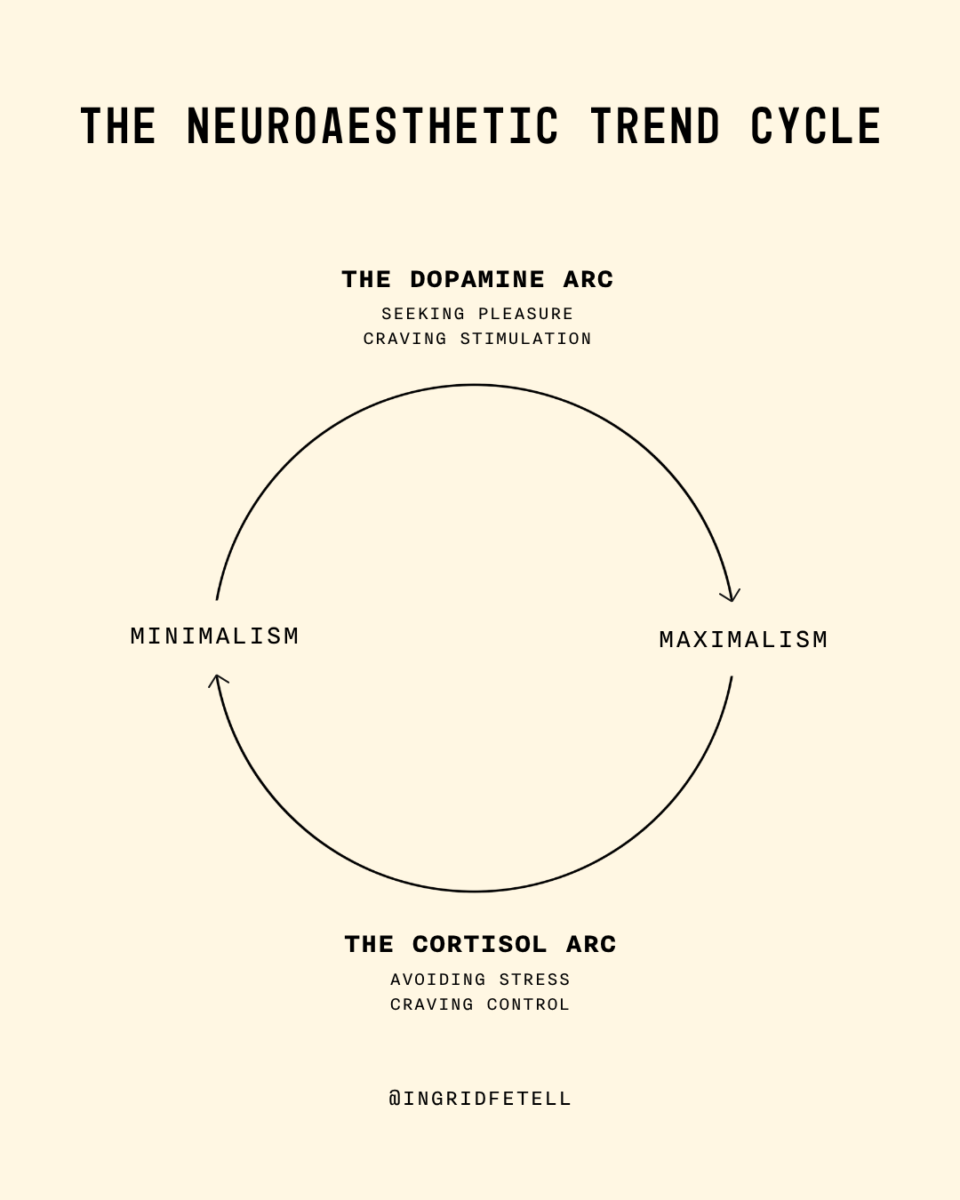
But leaving that aside, it struck me that maybe the post may have identified something profound. Every few years we cycle between minimalism and maximalism, alternately craving color and pattern and then banishing it from our sight. Could the trend cycle be driven on a deeper level by a craving for certain neurotransmitters (or an aversion to others)?
Maximalism would be the dopamine arc of the cycle, where we feel understimulated and crave the pleasure of joyful sensations. We fill our spaces with wallpaper and knickknacks, our closets with vibrant hues. We accessorize and gild the lily. We do not edit. The trends dopamine decor and dopamine dressing exemplify this arc.
Eventually, we find ourselves feeling overstimulated. All that stuff stresses us out. This is the cortisol (or cortisol-avoidance) portion of the cycle. We want to declutter, simplify. The patterns are pleasurable, but it’s a lot of work to get everything to match. We want to reach into the closet in the morning and look put together. We’ll take the hit to our pleasure if it helps us feel more in control, less overwhelmed.
What Neuroscience Actually Says About Dopamine and Cortisol
This is obviously a dramatic oversimplification that no neuroscientist would ever endorse. Our bodies are always awash in an array of neurotransmitters and hormones, and most feelings come from complex interactions between them, not just one. There’s norepinephrine, which drives excitement and alertness, oxytocin which reinforces affiliation and bonding, GABA which promotes relaxation, and many more. Dopamine, which is talked about online as a feel-good chemical, is actually less about pleasure and more about learning and motivation. Cortisol is not a neurotransmitter at all, but a hormone that affects the whole body.
Our relationship to these chemicals is also dose-dependent. A certain amount of cortisol is essential for alertness and for rising to meet the challenges of life. Only when it becomes excessive is it a problem. Likewise, some dopamine feels rewarding and pleasurable. But dopamine is also involved in addictive behavior (including device addiction). Most casual discussion of these two chemicals leaves out these critical nuances.
How Trends Reflect Collective Emotional States
All that said, if instead of taking these terms scientifically, we use them the way popular culture does — as a shorthand for an emotional state — then they become useful. If we take dopamine to signify “bursts of pleasure” rather than the specific molecule in our brains and cortisol to mean “under stress” rather than a chemical secreted by the adrenal glands, then we have the foundation of an interesting reframe. Perhaps the trend cycle is not just a reflection of economic pressures and fickle whims, but cravings for a mind-body state. Perhaps trends reveal an attempt at nervous system regulation, a drive toward homeostasis in a world that swings wildly between over- and under-stimulating.
It’s oddly reassuring that despite our fragmentation, division, and social isolation, we might be tuned into a sort of collective social desire to change the way we feel, and make aesthetic choices to help effect that change.
The ennui and sameness of the Kinfolk 90s, expressed in hundreds of thousands of characterless cafés and rentals, left us hungry for sensation. The pandemic intensified this, and the growing backlash against device addiction and social media has propelled a desire for our physical spaces and wardrobes to compete, sensorially, with the constant dopamine spikes offered by our phones. I think we are still on that maximalist arc, but the “Cortisol Closet” trend might be a bellwether of a shift brewing in the opposite direction. AI anxiety and the frenetic pace of change may turn avoidance of stress into the more dominant drive.
A different Way To Forecast Trends
The takeaway for me is that instead of looking at trends as purely cultural phenomena, we might make more accurate (and more interesting) forecasts if we look at trends in emotional health. Not just good/bad, but what kinds of struggles are people reporting, and what do their aesthetic choices suggest they’re craving? It might also lead to more imaginative solutions than just the swing between maximalism/minimalism. Minimalism isn’t the only way to ease stress, and maximalism isn’t the only path to pleasure.
How does this framework resonate with you? Where do you think we are on this arc?
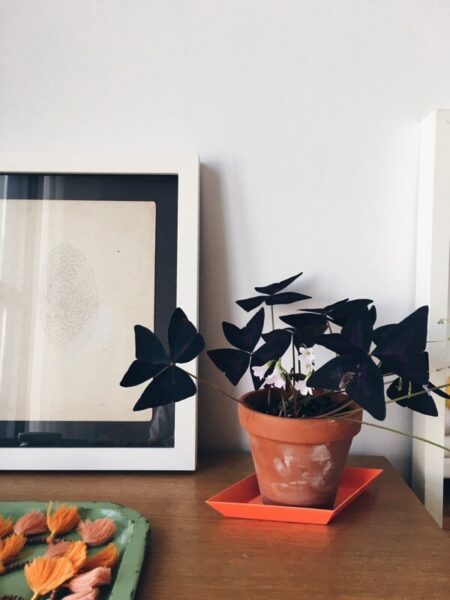
Image: Hannah Morgan via Unsplash


Discussion (2 Comments)
This is really interesting….more going on than just a phase. For the last year I have been slowly transitioning my clothing and interior decor to more neutral colors and solid patterns and it has felt like a relief, like I can fully relax. When I changed the guest bedroom bed linens from a brightly colored striped quilt and patterned sheets to a solid olive quilt and solid linen sheets in a flax color, even my husband (who never notices decor) walked by the room, stopped, and said, ‘That bed looks so comfortable I could fall asleep in it now. Did you change something?” I still appreciate color and patterns so I immerse myself in them in smaller ways like in the jigsaw puzzles I like to do and in an outfit accessory. Color and pattern have become small points/moments of joy I can access any time while surrounded by the calm of solids and neutrals.
I find myself craving different colours at different times. During Covid I was craving red as I needed the strength and energy that this colour provides. At the moment, in the midst of a very busy work schedule, and selling the house to move country, I’m craving the restfulness and calm of green.