Musical cooperation

15 October 2012

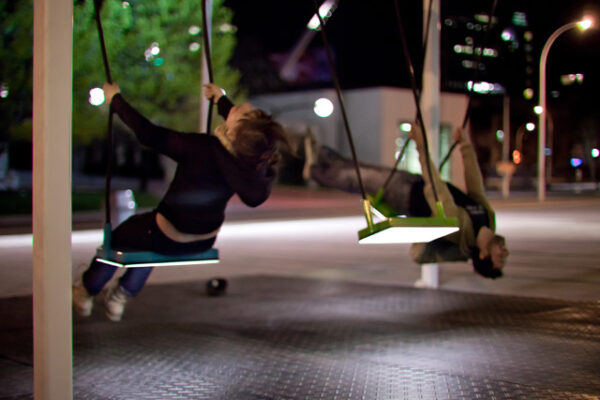
This may have already crossed your transom, but even so I wanted to share it because it is so beautiful. The project, called 21 Balançoires (21 Swings), is an installation in Montreal by the Canadian design collective Daily Tous Les Jours. The swings play sounds when in use, and through cooperation, different harmonies can be produced. One special set of melodies only appears when all twenty-one swings are in use.

Swing 1

Swing 2

Swing 3

There are layers of joy in this piece. It starts with a familiar form, the playground swing. We may think this is joyful simply because of nostalgia for childhood. There is that, but it’s not the whole story. Dig deeper, and ask: How did the swing get so popular in the first place? The answer arises from the movement; the soaring, freeing, swooping arc that gives the sensation of flying and that millisecond of weightlessness before the gentle fall. Layered on top is the music, and the light, and the abundance of it all — the line of swings stretching on and on, an endless playground.

The collaborative aspect adds another dimension. The music echoes that wonderful feeling when you find yourself perfectly in sync with others, when the hidden harmonies of the world are revealed. One of the teenagers in the film puts this nicely when he says: ”I find it adds to the beauty of life, because a single sound isn’t really nice, but together they make a beautiful melody.” And actually, we frequently use these kinds of musical metaphors to describe our feeling of symbiosis with others: we resonate to someone, or sing the same tune, or feel in harmony with each other.

It’s a success for public art in my book, not just to be pleasing or interesting, but to celebrate the interactions between people, promoting cooperation and harmony. Are there installations like this in your cities? If so, please share them!

Swing 4

45 img17362

via Colossal, with thanks to Sera

Vibrating color: Jim Lambie

9 July 2012

Glasgow-based artist Jim Lambie creates installations out of vinyl tape that make spaces come alive with an intense energy. Tracing the contours of a room’s perimeter, his work seems to magnify the lines of the structures, surfacing patterns from static-seeming architecture. It’s almost as if he’s liberating the movement from the space, giving it voice through color.

The kinetic force of Lambie’s work may stem from his origins in music. He has said:

You put a record on and it’s like all the edges disappear. You’re in a psychological space. You don’t sit there thinking about the music, you’re listening to the music. You’re inside that space that the music’s making for you.

This is true about music: it’s something you inhabit rather than something you regard. It’s also true that music has an inherent movement, a temporal thrust, a pace and vibration. Music, with its long oscillations, jostles the air around us, scatters its molecules and sends them pinging against our eardrums. We don’t see it, but music transforms a room into a thoroughly kinetic space. Lambie’s color similarly fills the space with vibrations.

While I object to the comparison with Pollock, I feel sympathy with Jonathan Jones of The Guardian when he writes in 2008:

Like Pollock he pours colour and line in ways that liberate energy and suggest the inner structures of the cosmos. Above all, Lambie is a pure artist – his art is totally self-sufficient in its worth and power. It is distilled energy, concentrated life. Marvellous stuff.

Right now I’m steeped in the study of energy – photons, pulsations, valences, spectrums – and thinking a lot about movement at all scales, from the quiver of electrons to the whirl of the planets. But it all comes back to aesthetics for me: how we feel this energy through our senses, and once felt, how it affects us. Lambie’s work is just poppy and irreverent enough to seem like play, but that hides its power. This is potent stuff: bracing, fervent, and vital.

Via: Bjorn’s Randoms

Bringing color to life

19 October 2010

I love this new ad from Canon Pixma, which is the result of an unexpected combination of paint, sound, and a macro lens. It almost feels like peering into a magical world: The slow speed and tight focus allow us to see transient sculptures that would just be a mess of splatters to the unaided eye. It’s also an intriguingly experimental approach. I feel like there is a rising trend lately towards experimentation in ads, events, and art pieces; people set up systems of conditions and allow unpredictable variation to determine the results. Mother’s ad for IKEA is a recent example, where cats, with all their mercurial whims, were released into the store to see what interactions might occur. As in this case, the “making of” video is as significant as the final result — the process is as joyful as the outcome. The work of design shifts from creating a beautiful thing to orchestrating a beautiful system, from controlling variability to modulating it.

The ad first caught my eye as a possible example of joywashing. I did an interview the other day during which I was asked to talk a bit about the concept, so it’s been top of mind. I said that joywashing itself isn’t harmful — more aesthetics of joy in the world is hardly a bad thing — but that it bothers me to see advertising that puts a chipper veneer on an ordinary product and claims it will make you happy. I’d rather see the design of the product reflect the emotional claim. If the product fails to deliver on the joyful promise, then it’s joywashing. But seeing this ad makes me want to refine that statement a bit.

I have no idea if the Pixma printer is a good one or not, whether it produces dazzling color or only so-so color, whether a print it makes is any more likely to cause delight than a print from any other printer. So on those grounds this ad would be suspect in my book. But I think this marketing effort transcends joywashing because the ad itself is truly joyful. In contrast to most ads, which say their brand is joyful (usually they shout it at you), this ad instead offers a brief experience of joy. Through an artful experiment full of delightful aesthetics, it creates a minute-long immersion into a surreal, uplifting world. I found myself spellbound by the ethereal forms and celebratory movements — it’s a great illustration of just how emotionally evocative abstraction can be.

I hope the product delivers on the tagline: Bring color to life. But even if it doesn’t, the ad doesn’t feel like joywashing because it can be appreciated and enjoyed all on its own. If the product doesn’t live up to the promise, I’ll buy something else, but at least I can appreciate the fact that the company has invested in creativity, and has chosen to put something inspiring out there, instead of insincerity, hoodwinking, and self-congratulation. I’d love to see the creativity and joyful spirit of the ad spark user’s creativity in similarly delightful ways. Even better would be if Canon had an events program up its sleeve, like Levi’s Workshops, for example, that will teach people ways to “bring color to life.” In this case, the ad, events, and products would all be parts of the Pixma experience, and the brand’s delivery against the promise of delight.

Joyful noises

11 May 2010

I’m  still trying to put my finger on what exactly is so joyful about Bzzzpeek, a site where you can play recordings of what children think animals sound like in different parts of the globe. Is it the sweet, earnest quality of the children’s imitations? The general cuteness of the site design? Or just the charm of being able to travel the world via quacks and ribbits? I don’t know, but the moment it appeared in my inbox (thank you, Jon), it brought a smile to my face.

The deeper question here is why we feel the need to imitate animal sounds when we have words to describe the animals. Before we had language, “Moo,” was a good way to alert neighbors to a food source. Now, when we can say, “There’s a herd of cows grazing just over the grassy knoll,” “Moo” seems terribly obsolete. Of course, there are still a few functional reasons to make animal sounds: birders do it to attract different species to look at, pet owners do it out of some empathic desire to connect with their pets. But why do children do it? I wonder if there’s some innate pleasure in imitation, or if there’s some other reason why we simply enjoy making animal sounds. Thoughts?

Languages of happiness

29 October 2009

chalkboard

Whoa whoa whoa!

That was my friend Peter’s reaction to evolutionary biologist Olivia Judson’s NYT blog post this week, which discussed the connection between making certain sounds (such as “eeee”) and positive emotion, via what’s called the facial feedback hypothesis. Judson explains the link and then goes on to wonder: Do certain languages with “smiling sounds” make their speakers feel happier than others? Are some languages, by a curious accident of circumstances, languages of happiness?

Peter’s reaction was mine as well, because we had just had this exact conversation a few weeks ago. I was expressing my frustration in being unable to find a linguist who could illuminate the connection between language and the facial feedback hypothesis. I had done this post on words that make you joyful early on in the blog’s history, and drawing on Eric Weiner’s “Mol-do-va” (dour) vs. “Ja-mai-ca” (euphoric) comparison I was sure there had to be research on the subject. Peter then told me he had formulated this hypothesis 35 years ago, and had long believed in the power of onomatopoeic words like “glee” to boost your mood.

According to Judson, no research has really been done to confirm or refute these suppositions. But, going on what we do know we can deduce a premise that intuitively feels plausible. If induced smiles have been shown to impact mood (as they have in several studies, most notably this one), and certain sounds induce smiles, then it seems likely that these sounds could influence mood, and by extension, so could the languages that make frequent use of them.

If, through research, we discover this is true, then it adds in an exciting way to the pool of sounds that can be considered intrinsic aesthetics of joy. We already accept the emotional content of musical sounds — that a bright, brassy note from a trumpet is joyous while a drawn-out note on a cello is baleful and contemplative. And certain voices affect us similarly — the high pitch of a child’s voice triggering a different emotional response than the husky bass of an old man. With linguistic sounds, the question is slightly different because it is not about the sound itself, but the motions required to produce the sound — the accident of nature that conflated smiling and speaking functions into the same muscles.

This leads to another interesting question: do you have to actually make the “eeee” sound, or is just hearing it or seeing it pronounced enough? For true facial feedback, you’d actually need to perform the gesture. But I wonder if seeing the action might trigger another brain mechanism — mirror neurons — that might augment the effect of a “happiness language” through social interaction. Mirror neurons are a relatively recent (and extremely exciting) discovery in neuroscience. They fire not just when we perform an action, but also when we see or hear the action being performed by another. Supposedly, these neurons help us learn something new through imitation, whether its a language, an instrument, or another skill. If this is true, then perhaps just sitting across the table from a person making “eeee” sounds over brunch could give your mood a boost, and a “happiness language” could have a contagious quality, infecting people with positivity even during mundane interactions.

What does this have to do with design? Perhaps we could design a language for happiness. I’m not talking about the next Esperanto, but what about a new slang that replaces a few of the most frequently used words with eeee-heavy alternatives? We could adopt the Spanish “sí” for yes, but draw out the vowel so it becomes “seee” and choose another eeee word for no. Start pronouncing “the” as “thee,” as in “theeee end.” Push, pull, stop, go, walk, don’t walk — the verbs of urban living might all have smiling correlates.

What else could design do with smiling sounds? Redesign positive affirmations to use smile-inducing words, so that the act of speaking them reinforces the message. Change the yoga chant from “om” to “eeem.” Use smiling sounds in the naming of new products so that saying the name intrinsically creates a positive connection. Create linguistic-based facial exercises for sufferers of depression. Incorporate verbal keywords into the computing experience, all based around smiling sounds, so that instead of feeling frustration at our computers, we feel…a little less frustration. Design verbally activated switches for the home that react to “eeee” sounds — a happier “Clapper.” These are just top-of-mind thoughts, but the possibilities are intriguing. They may sound silly, but that could just be the point. At least, if you pronounce it “silleeee.”

NYT: A Language of Smiles
Image: Ferdinand Reus, CC

People in order

23 October 2009

I dare you not to giggle while watching this short film from the People in Order series by Lenka Clayton and John Price. The film presents people in age order from 1 to 100 years old.

The drum device is pure aesthetics of joy — an exuberant bang that runs like a unifying thread through the ages. It also distinguishes them: the four and five year-olds’ delicious pleasure in generating noise is a powerful contrast with the defiant staccato of the their 96 and 100 year-old elders — pithy reverberations that seem to say, “We’re still here!” Each age has its mind, distilled into gesture and sound.

{via Mental Floss}

Using aesthetics of joy to create behavioral change

14 October 2009

Design is at its most effective when it encourages or transforms human behavior for the better. There’s a lot of talk about how we need adopt healthier or more eco-friendly habits. The onus is on us to make the changes, but design can facilitate the behavior and make it easier or more enjoyable to change. Examples abound: the George Foreman grill, dedicated recycling bins, 100-calorie snack packaging. All of these things make it easier to do the right thing. Easier, yes, but not necessarily any more pleasurable, which is where The Fun Theory comes in.

An initiative of Volkswagen, the Fun Theory is a series of experiments that demonstrate how joyful design can encourage positive changes in behavior. In the video above, a staircase goes from being the less-chosen alternative to the escalator to the preferred path after the addition of some giant piano keys. In another video, litter collection rises after an amusing noise is introduced to a public trash can.

The pre/post measurements are striking and really prove the point that aesthetics of joy — through interaction, play, sound, and surprise — can create real, immediate change in the way we live.

{via PSFK}

For the birds

10 October 2009

3954841866_dc0930a761_o

When I moved from Manhattan to Brooklyn, I discovered something I had missed without realizing it: the sounds of the birds. Now that I live on the top floor of a brownstone with a lush, critter-friendly backyard, I find myself at ear-level with the most amazing array of birds. This morning they were really going nuts, reveling in the warm cloudy day. I captured a few of their calls to share with you.

I’m off the Met to see the Vermeers and the new American wing — I hope you’re having a joyful weekend!

Listen to the birds

Image by the always wonderful John&Fish