Joymaker: Naomi London, visual artist

19 January 2012

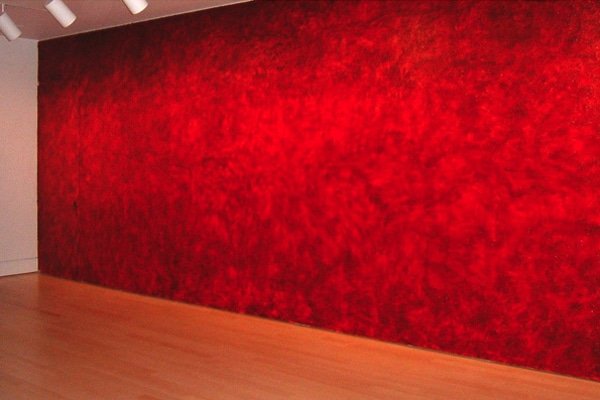
Jamwall001

Joymaker is a new series spotlighting people who seek to create joy in their work.

It takes a kind of joyful madness to hand-apply 100 lbs. of raspberry jam to a gallery wall. And that’s exactly what attracted me to the work of Naomi London, a visual artist based in Montreal, who tries to bring a voice for joy and play to contemporary art. London uses joyful forms, visual metaphors, and textures (such as polka dots) to give her audience a sense of delight.

I’m fascinated by the shiny, sticky surface of this enormous red wall. While a red wall might typically take on a violent or alarming quality, the material makes it totally disarming, even childlike. I wonder if it stayed sticky throughout the installation, and slightly fluid, shifting its mottles in a slow gravitational creep towards the floor. Or whether it stayed firm, drying like a giant fruit roll-up. I didn’t ask Naomi these silly questions, but I did ask her some others:

How do you want people to feel when they engage with your work?

I’m very interested in the notion of play in art. I’m hoping that when people see the Jam Wall they can appreciate the unexpected beauty of the colour, as well as the playful absurdity of using this material.

Can you talk more about this connection between joy and absurdity?

I associate absurdity very much with play, and play is joyful. Other connections include humour in the absurd, e.g. the odd rhymes and tongue twisters of several early Dr. Seuss books. I find that there is pleasure in being in a ‘non-logical place’ in your head, which is how I think of the absurd. It’s about the unexpected, fun, and delight that can be felt when exploring things that deliberately don’t make logical sense, but are full of wonder and joy. There is an importance in the purposelessness of the absurd, which is something that makes is joyful (to me) and thus also linked to play.

Jam wall installing

Jam wall sample

What is the role of joy in your work?

I think that joy, beauty, humour and play have been underrepresented in contemporary art over the last few decades. I’ve been interested in trying to address joy and happiness in my work for past ten years or so. I’m currently working on a sculpture installation project in homage to my mother, (who died just over two years ago). Even though it is a memorial work of sorts, I hope that it still somehow evokes a sense of joy.

I’m making a series of balls which are made exclusively out of fabric inherited from my mom. (She was a talented seamstress and made almost all my clothes during my childhood.)

What one object most symbolizes joy to you?

I think I’m torn between seeing the first tulips in early Spring and my favorite large white mixing bowl that I use when I bake a cake.

What’s inspiring you right now?

Colour, and the unexpected use of saturated colour: chartreuse yellow + green, fire engine red, brilliant orange.

What other designers, artists, or creators should Aesthetics of Joy readers know about?

There is an interesting website run by a researcher/academic in Rotterdam:  The World Database of Happiness. The layout of the site is dry aesthetically but I think that its wonderful that the subject of happiness is being studied in this way.

I like the work of Franz West very much. Another artist whose work I really like is Ana Rewakowicz.

You can see more of Naomi’s work here. (In particular, make sure to check out Polka Dot Wall, a site-specific installation I find very joyful.) Images courtesy of Naomi London.

Artful sweets: Rothko tribute

8 January 2012

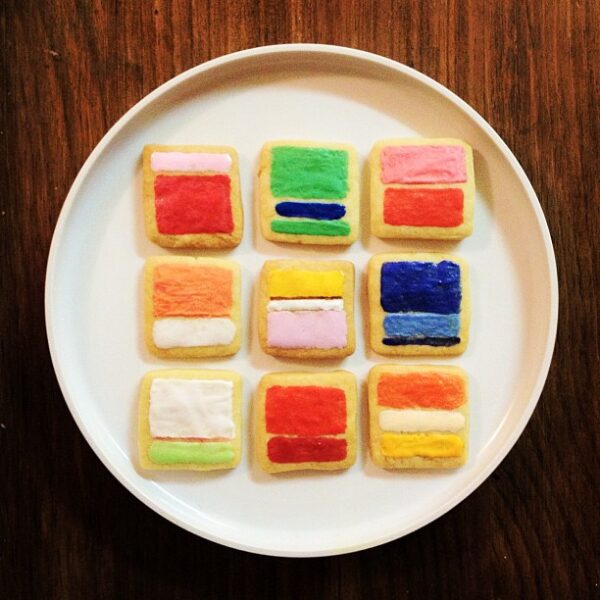
When my brilliant friend Mimi O Chun posted this picture in her Instagram stream with the description “Rothko tribute,” she received a veritable ton of likes and comments, many urging her to turn the concept into a series, or even a full-fledged art bakery. Though Rothko himself was not a terribly joyful sort, these colorful, charming cookies are, and I couldn’t resist sharing the image with you all.

So, let’s hope this becomes the first of many in the Dead Artist Baked Goods series, as Mimi puts it. Though similar in feel to this first installment, I’d like to see some Albers cookies; I also think that Pollock would be pretty fun to make. Whose art would you like to see made into sweets?

Mimi O Chun on Instagram and Twitter

Joy in the news: Small wonders

26 October 2011

26ALTSMALL SPAN articleLarge

Last week I was interviewed for this great piece on the trend towards “tiny sweets” by New York Times writer Julia Moskin. In the article I try to demystify why it is we’re attracted to mini-canolis or Baked by Melissa cupcakes (above) and talk about the “Alice in Wonderland effect,” where big changes in the scale of objects around us, either tiny or huge, make us reconsider our scale in relation to the world in a joyful way.

For more, check out past posts on tiny sweets, giant sweets, and the joy of miniaturization.

NYT: “Small Wonders”
Image: Tony Cenicola/New York Times

Ice cream for Africa

9 October 2011

110426 RW Inzozi 40

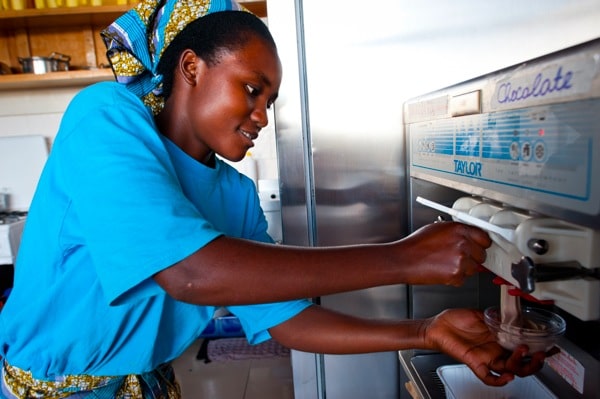
When a country has suffered a devastating genocide and come out the other side to rebuild, the last thing you expect someone to say is, “They could really use some ice cream!” But it’s exactly what Rwandan playwright Kiki Gakire was thinking when she asked Brooklyn ice cream makers Blue Marble to partner with her in opening the first-ever ice cream shop in her recovering country. The shop is profiled in this season’s issue of Edible Brooklyn, and, in addition to filling my eyes with tears, it reminded me that the need for joy is sometimes counterintuitive.

We tend to believe that people who have suffered and are suffering – those who are hungry or destitute or illiterate or injured– must have only rational needs. We see them struggling in the lower tiers of Maslow’s pyramid and we believe that our only way to help them is to address their physical circumstances. With all our best intentions, we build hospitals and schools, wells and roads. And while these are critical applications of our generosity, and we could redouble these efforts many times over and still not meet the need, some very real and valid emotional needs are pushed to the background. As Blue Marble co-founder Alexis Miesen recalls Gakire saying, “There’s no room to dream when survival is the only goal. You can’t just rebuild roads; you have to repair people, and show that life is good.”

Marie rose and jess

After all, survival is not living. And what “superficial” joyful moments (such as those spent catching cold drips off a cone with sprinkles) do for us is give us a model for what living looks and feels like. It restores our will to strive, when we know what we’re striving for. I was first made aware of this in the preface to Virginia Postrel’s The Substance of Style, where she discusses men’s rush to shave, women’s application of nail polish, and the reopening of beauty salons in war-torn Afghanistan after the fall of the Taliban government. She writes, “Liberation is supposed to be about grave matters: elections, education, a free press. But Afghans acted as though superficial things were just as important.”

Reflecting on this, and the Rwandan ice cream shop, I find my hackles raised at the arrogance of judging such desires and efforts frivolous. In a nation whose founding documents enshrine the pursuit of happiness as a right, how can we dismiss this same pursuit in others as wasteful? It’s unreasonable to expect that people wait until basic needs are met to create joy. It’s not how we are built –and with good reason.

These words of Gakire, quoted from the Blue Marble Dreams website leave me ever more convinced that the pursuit of joy in design is vital. These words will stay with me a long time.

Because we struggle most of the time, we find ourselves aggressive against happiness, love, joy, life. When we have children, we teach them that happiness doesn’t exist; that there is no pure love and as legacy, we give them our despair, our debts, our doubts, our tears, our failures… Rwandan women… want to reshape life in its simple and sweetest form. We want to share moments that are not embossed by despair and death… We want to create a space where poverty, disease, illiteracy… are not obstacles to happiness and barriers between human beings… We have to, for the sake of the health of our soul. The ice cream will have the power to reconcile people with life by providing privileged moments when life reminds them that it is also sweet.

You can read more about the shop here, and support Blue Marble Dreams here.

{via Edible Brooklyn}

Lollipop law

18 August 2011

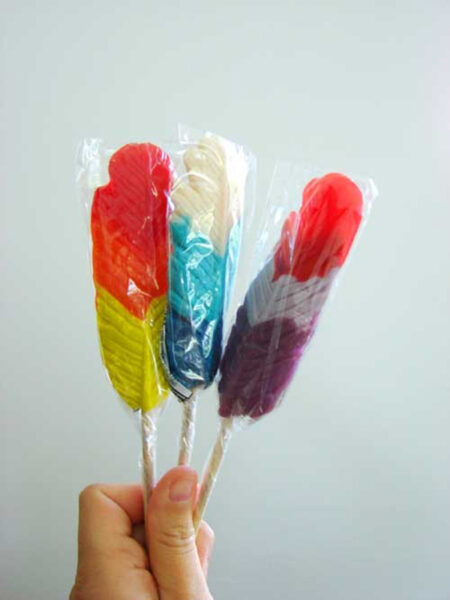
What do lollipops have to do with keeping the peace? Surprisingly, more than a little. A recent initiative by a city council in the city of Victoria in British Columbia offered free lollipops to drunken revelers leaving bars to cut down on noise and violence after a night out. Councillor Charlayne Thornton-Joe explained that the treats make it hard for inebriated partiers to be too loud, and that they minimize dialogue that could lead to brawls. More practically speaking, they also regulate blood sugar and, like pacifiers, have a calming effect.

While there’s no hard evidence that the lollipops worked, councillor Thornton-Joe says that it seemed to be so effective that the city is considering making it a permanent program. It’s a charming idea – that something so childlike and innocent could disarm a rowdy bunch. And it makes for a joyful image, to imagine adults appeased by candies on sticks.

This is aesthetics of joy at their beguiling best. Sugar, color, and a form that evokes nostalgia for childhood – these things have real power. Contrary to so much of what we are taught, they are not just styling or superficial extras. They are phrases in the language with which our stuff speaks to us, quietly shaping our desires and our behavior. It’s a joy to see them applied in a such a novel way, and for such playful problem-solving. I hope to see this idea take off in other places too.

Photo: Beautiful feather lollipops by Abbey Hendrickson of Aesthetic Outburst, via Pinterest
NPR: “Lollipops: Pacifiers for Bar Patrons?” 

The joy of bubbles

12 July 2011

John Nese, proprietor of Galco’s Soda Pop Stop, exudes a childlike exuberance when he talks about his favorite subject: the independent and small batch bottles of pop he sells in his store. In this wonderful video interview by Chowhound, he reveals all kinds of interesting factoids about bubbly beverages, and projects an infectious enthusiasm for the topic.

Soda’s a hard one to claim as joyful, given its contribution to the obesity epidemic and myriad other health problems. But Nese reminds us that soda is a treat, something to be enjoyed occasionally, not guzzled in place of water as so many people do. When asked about diet sodas, he condemns most of them as unsavory, and says, “Drink less. How’s that? Have six ounces rather than twelve, and then you get 60 calories instead of 120 calories. And then you’re satisfied and you’re happy.”

Of course, moderation is hard when you’re facing the trifecta of color, sweetness, and bubbles. Especially the bubbles. Watching the solution fizz and sparkle, seeing the tiny orbs appear from nowhere, feeling them glitter on the palate – carbonation is an oddly magical pleasure. Upon discovering champagne, the monk Dom Perignon was said to exclaim, “Come quickly! I am tasting stars.” Though this story may well be apocryphal, the quote captures our sense of awe and delight at effervescence (alcoholic or otherwise). Something about bubbles seems to elevate us. They carry us upwards with their inexhaustible lightness, buoying our celebrations, our moments of refreshment and play.

We’re evidently not the only species that enjoys bubbles, either. While writing this post I remembered this sweet video of SeaWorld’s dolphins, which have turned bubbles into a novel underwater toy. Enjoy!


Ice cream trucks around the world

29 April 2010

Ice cream trucks from around the world! What is it about trucks that lend themselves so readily to decorating?

via Let’s Color