Technicolor landscapes

25 April 2010

I’ve taken many plane rides before, but never seen a landscape quite like this. I recently stumbled upon this article showing Holland’s tulip fields from above. Can you believe there’s a landscape that actually looks like this? It’s like agricultural earth art. I had to dig up some more images for inspiration. Let’s hope all these April showers will bring us some, well, you know…

Images: livetowander, Daily Mail, powerfocusfotografie, Daily Mail, Samuel_Leo, _Darek, heavenuphere.

Precious potholes

2 March 2010

Artist Pete Dungey says of his Pothole Gardens, “If we planted one of those in every hole, it would be like a forest in the road.” Indeed. And a gorgeous, surprising example of urban renewal and joyful activism.

{via for the love of bikes}

Carnations, pink and joyful

25 January 2010

These variegated poufs of carnations are like a gorgeous brand of cheerleaders’ pom-poms. I love how this arrangement makes a prosaic blossom seem so luxurious. They’re so tactile too — you can just imagine how the cool, feathery petals would feel on your hands.

{flowers by BORNAY}

Toyota’s flowers

10 November 2009

482268781_49dc6032cf_b

Nice mention of AoJ in this post on Brandchannel about Toyota’s creation of two new flower species that absorb nitrogen oxides and take heat out of the atmosphere. The two flowers, variants of the cherry sage and the gardenia, are planted at Toyota’s headquarters in Japan. Designed to highlight green improvements to Toyota’s manufacturing facilities, the flowers are an interesting marketing move and a great example of a joyful gesture. It may be “joywashing meets greenwashing,” but it’s hard to be skeptical when it just makes you want to smile.

{image: crossmage}

Delicious books

5 November 2009

coralie-bickford-smith-book-designs1

Well, I was going to leave you for the next few days* but then I saw these and I couldn’t wait to put them up. For these Penguin Classics, designed by Coralie Bickford-Smith, I might actually think about violating my multivariate color-coding system.

What is it about gorgeous objects that makes me all synesthetic? I literally want to eat these. I guess, in the end, all aesthetics comes back to survival, food being a big part of that. Whatever the reason, I think these are just delicious.

Also, one the more joyful interviews I’ve read in awhile features Bickford-Smith on the Penguin blog. The image-text format really made me smile.

{via Daily Candy, available on amazon}

*Wow, it’s evidence of the long week I’ve had that I spent this whole morning convinced it was Friday. But, no, it’s still a day away. So there will be at least one new post here tomorrow. Apologies if I confused anybody! xx Ingrid

Joy of pattern

15 September 2009

issue_patterns

Patterns give me joy, and this quiz from @Issue magazine suggests that they bring joy to many cultures around the world as well. The quiz asks you to match the patterns above with the nationalities that created them, showing the diversity and distinctiveness of the ways we express ourselves in non-linguistic 2d terms. The differences interest me less than the fact that all cultures seem driven to create in this way; to abstract, in varying degrees, our essential experiences into color, line, shape, and repetition.

Take the full quiz here.
Via Joyful Delight

Simple pleasures: watching flowers open

12 August 2009

I love love love these wonderful videos of flowers growing and blossoming in time-lapse. I get a visceral wave of joy watching each one.

Above, the ornithogalum reminds me of popcorn popping open. Below, the tiny blossoms of the eremurus sparkle like firecrackers, stamens bursting out of their centers all right on cue. And last but not least, the daisies, which remind me of that beautiful Mia Michaels piece danced by Jeanine and Kayla on the So You Think You Can Dance finale (which I watched in its entirety at 1 in the morning the night I got home!). The way that they rise and bend, growing in bursts, the struggle palpable yet  beautiful — it may sound silly but they make me feel inspired.

There are more on munich timelapse‘s page, and each one is captivating in its own unique way.

Ornithogalum blossom one after the other / timelapse, Three flowers dancing / timelapse and Eremurus flower / timelapse from munich timelapse on Vimeo.

Joyful activism, guerrilla style

30 June 2009

bed-stuy-meadow-transforming-a-neighborhood-with-flowers-2

Joyful activism is a theme that keeps popping up these days. Rather than angry protests, a lot of people are realizing that a good way to effect change is to make people feel good.

I love this project, the Bed Stuy Meadow, by 21st Century Plowshare, the goal of which is to cover every vacant patch of land in the somewhat rough-and-ready neighborhood with wildflowers. Joy is at the heart of the activist premise:

The profusion of wildflowers will probably be relentless and visually unifying, and this relentless unity of wildflowers will probably make anyone walking down the street feel really good.

And the designer here recognizes that such positivity can have a contagious effect:

I want people who don’t even live within the five boroughs to visit Bed Stuy for the first time so that they can see the Meadow with their own eyes, and I want people who will never even come to be so inspired by the Bed Stuy Meadow that they make their own amazing neighborhood project and share it on 21st Century Plowshare.

Guerrilla actions such as this one have a much greater likelihood of success when the tone is positive. In a way, the Bed-Stuy meadow is a form of graffiti, the exertion of one person’s artistic will over a communal environment, but who can object to flowers? I think we’ll be seeing a lot more initiatives like this one in the coming years.

via PSFK

Another allium

30 June 2009

img_3014

Here’s another allium, this one from my pics of The High Line. These look a lot like fireworks, another joyful thing, in the way they burst open from a central point. I’ve been thinking a lot about joyful movements lately, and I think this idea of “bursting” is a particularly joyful one.

Think about all the things that burst. Fireworks, of course, burst. Seedpods burst when they’re ready to cover the world with new plant life. Water breaks, or bursts, as a signal that a baby is ready to be born. Jack-in-the-boxes burst from their lidded confines. We say our hearts are “bursting with happiness,” that we have a “burst of energy,” and we burst into laughter or song.

Of course, bursting can also be negative. Bombs burst, and so do bubbles. But designed in the right way, with color cues or other joyful aesthetics, bursting movements can trigger a powerfully joyful response from an object.

Allium and the joy of flowers

30 June 2009

img_3180

I’ve been writing more than a little about the notion of the absurd as a route to joy lately, and as far as absurd flowers go, the allium pretty much takes the cake. Poofy, sparkly orbs, disproportionately large yet still light and airy atop impossibly tall, straight stems — the allium looks like something that would grow on a newly discovered planet. Its family heritage is no less comical: the cheery allium is actually a variant of the onion, presenting a globe above ground while its cousin hides one below.

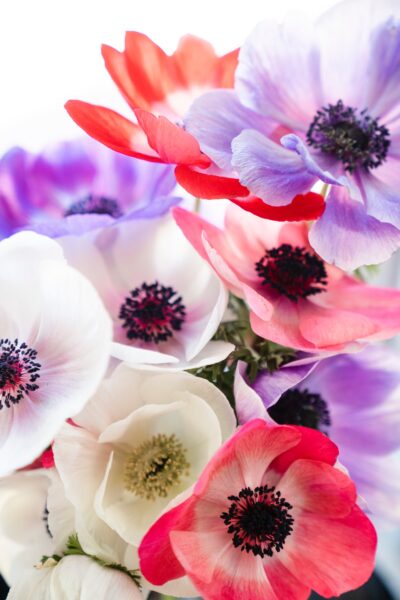
The allium is one flower that never fails to make me smile. But of course there are many joyful flowers. Poppies, with their irrational exuberance — bright, fragile, and abundant. Peonies, which are perhaps more stately, but lavish with their fragrance and the endless layers of petals that unfurl implausibly from those tight, hard buds. Lilacs, which appear in an intoxicating fog of scent, offering a pure glut of sensation for only a few weeks. Tulips, too, with their early spring color and their way of opening themselves so wide as to practically turn inside out, offering all before going bare for another year.

The whole idea of the flower is joyful. It is an alluring spectacle, an unfurling of vibrant energy, both excessive and necessary. Color, pattern, scent, texture, intricacy of design — in the flower, nature spared no aesthetic expense. Surely she could have evolved other (more efficient) ways for plants to reproduce, but how lucky we are that flowers evolved to be the dominant means!