Make your own fun

10 February 2013

Winterfun 3

I came home last Sunday evening to sounds of laughter and the smell of woodsmoke coming up from the backyard. It was one of those frigid nights we’ve been having, the kind of night when a balaclava seems to make sense for something other than a bank robbery. I pressed my nose up to the window to look outside, and it sent a chill right to the root of my spine. But then I saw it: first the flicker of the campfire, illuminating a handful of bundled revelers holding sticks with marshmallows. And then, squinting into the dim light, something even better: a slick of ice, and boys on skates.

This is a Brooklyn backyard we’re talking about here, about as small a patch of real estate as you could imagine. And yet, faced with an endless stretch of freezing temperatures, my neighbors decided to make their own fun. They flooded a patch of the concrete yard with a hose, let it freeze, and had their own ice-skating rink (barely larger than a dining table, mind you), their own winter wonderland.

Winterfun 2

Winterfun

You might ask what this has to do with design. It has everything to do with design. This is people altering their environment, using the tools at hand, to create joy for themselves and others. We often say: design loves constraints. And this is a brilliant design under the constraints of winter in a dense northeastern city, a way to be outside and together when the mood gravitates towards being inside in solitude. It’s a beautifully aesthetic moment too—light, movement, warmth, the sweetness of marshmallows, and the small swooping curves of skaters on their tiny rink—an oasis in what can often be a bleak time.

Make your own fun, this winter or whenever. Make your own joy.

Tickled by Tokyo

18 July 2012

Tokyo7x

In May, I went to Tokyo for work. (If you follow me on Instagram, you may have seen a number of photos with the tag #joyinjapan.) For some, this might mean sitting in a conference center most of the time, getting to eat some sushi between lectures and walk around Shibuya a bit. But lucky me (and I mean that — lucky, lucky me), my job involves being completely out there, talking to people, experiencing the city’s smells, sounds, and colors, drinking a place in until I’m drunk.

Where do I begin with it all? I felt so joyful in Japan I could hardly stand it. Like when someone is tickling you and you’re laughing and you get to a point where feel like you’re going to explode and you beg them to stop — “Please, please, no more!” — and as the feeling subsides and you’re able to breathe again a quiet little voice pipes up inside you, whispering…

“More. Please, just a little more.”

There isn’t one thing to point to, but a thousand small gestures that accumulate to leave you almost woozy with delight. Tokyo is a relentless layering of vibrant color palettes, cute icons, sweet miniatures, subtle textures, and delicate objects arranged just so. (And also some things that are so crazy they make your head spin around in full revolutions.) It’s a testament to a people that has a true material culture, a people that feels kinship with the objects in their lives and understands that beautiful things are valuable not as status symbols but because they suffuse beauty into the spaces around them.

Alain de Botton writes: “What we seek, at the deepest level, is inwardly to resemble, rather than physically to possess, the objects and places that touch us through their beauty.” This is the crux of what I felt in Tokyo. I sensed the beauty that emanated from the perfectly balanced, crafted way of things, and wanted to strive for more of this in myself. A beautifully crafted plate of food or a carefully lettered sign showed care, and it made me want to slow down and appreciate the care my hosts put into these small gestures. My travel companions and I all changed our behavior over the course of the week. We were more polite, we noticed more, we ate more slowly. We let the place change us in a good way.

IMG 7950

Tokyo7x6

IMG 3821

Every day we walked the city until our feet hurt. At night, I would wake up at about 4am from the jet lag, my feet still pulsing, hoping a few more hours of sleep would ease them. We took thousands of photos. There was a surprise around nearly every corner — we were afraid to put our cameras away. My travel companions, fellow IDEOers Anthony and Erika, and I (all above) were lucky to have some amazing hosts. In some of my photos you’ll see Mike, a good friend of mine since my first day at IDEO, who is now in our Tokyo office. He wins the “host of the year” award, making sure we saw his favorite places (such as the tiny coffee shop pictured top right and lower left, below), ordered for us in places with no English menus, and even pointed us towards very specific observations, like that that gorgeous reflection of the copper sink in Higashiyama’s bathrooms (below).

I was also excited to spend some time with Azusa, a friend of mine from Pratt (you may remember her joyful work from this post a few years back). Azusa took us one night to get yuzu ramen (noodles flavored with yuzu, a Japanese citrus fruit) and after, we discovered a tiny little bar with only about ten seats. There, a bartender proceeded to make the most thoughtful screwdriver I’ve ever seen. The screwdriver must be the most thoughtless of cocktails, sloshed together in questionable proportions, often in a Solo cup. But this bartender showed me the screwdriver-as-art-form: squeezing the juice by hand, shaking the drink as if he were in slow motion. I don’t think I will ever see a cocktail performed in that way again, totally simple, yet with honor for its simplicity.

Tokyo7x7

We stayed our last few nights at the Claska, technically the only boutique hotel in Tokyo. The Claska is a wonderful, odd place for many reasons. It is a bit out of the way, but it has a gorgeous sixties modern lobby and the most beautiful gift shop, full of perfect, quirky artifacts. But by far my favorite feature of the Claska is the retro dog grooming salon just off the lobby (pictured above). A long window, positioned at eye level just by the lobby bar, peeks into the space, where you can watch dogs get fluffed to the max by a passel of groomers using humorously space-age dryers. I never saw a dog walk out of there that didn’t look like it couldn’t blow away on a light wind.

Sushi

A highlight was a visit to Midori Sushi in Shibuya, where you order from an iPad and the sushi is delivered to your table by toy trains. Toy! Trains! You might think that with such an emphasis on precision and self-control, the Japanese would not show much evidence of their “inner child.” But in fact, the inner child is alive and well in Japan, breaking through in an unabashed embrace of cuteness and play, even in serious situations. The toy train idea is something that seems to have been thought up by an eight year-old. Here in the states it would be discarded as ridiculous, but fortunately the Japanese don’t censor themselves in this way.

Tokyo7x5

On our very last day in Tokyo, Erika and I were wandering around the area near Gakugei-Daigaku station and spotted these beautiful books. Stripped of their jackets, they were selling for pennies apiece, and we spent the better part of an hour looking for ones with interesting illustrations to bring back with us. Inside one were these very simple, beautiful erotic line drawings. (Japan has a long tradition of exuberant erotic art, mostly woodblock prints known as shunga.) Azusa was embarrassed but obliging in translating the chapter headers for us. (Nothing too exciting, or I promise I would’ve written them down to share.)

IMG 3837

Hidari Pocket in Naka Meguro is the tiniest, cutest café I have ever seen. The garlands, the little drawings on the side of the van, the tiny weathered stools, the drawings of flowers in the foam on the mocha — it was just too much. In moments like this, we often found ourselves overcome, aesthetically, with the experiences we were having. It was almost as if the circuits in our brains couldn’t handle all the beauty, harmony, cuteness, and cleverness. By a few days in, we actually coined a name for this: design convulsions. Suffice it to say, when three out of four designers at a table have their cameras pointed at a very ordinary object, you can be pretty sure it’s a collective design convulsion.

IMG 7039

Tokyo7x4

There is a palimpsestic quality to Tokyo that you start to discover, as you adjust to it and it starts to unfold for you. There are layers that smack you in the face with their daring or their sweetness. But underpinning these are tiers of sensation: patterns, textures, and reflections that are seductive in their simplicity. I came back so filled with inspiration, I was nearly vibrating. I’ll share more in the coming days, about some specific things that just took my breath away. In the meantime, have you been to Tokyo? What joys did you see there?

Images: a mix of mine and Erika Lee’s; most of the better ones are Erika’s!

The enemy of joy

19 March 2012

Tumblr m122vnV38R1qk58nk

The enemy of joy is coolness.

So says Jim Cooper in an excellent post on his blog, Jim and His Camera. The post talks about witnessing the dancing and revelry of Shanghainese people of all ages in Fuxing Park, and ponders why in the West we don’t embrace such joyful behavior. The conclusion Jim comes to is that rather than embracing our impulses toward joy, we worship cool, a tendency that acts like a “joy police” to tamp down uninhibited displays and enforces this restraint with humiliation and ridicule. Jim writes:

Our lowest level of hell is embarrassment from being deemed uncool. When did we begin to worship this false god: the God of Cool?  The God of Cool forbids spontaneity, silliness and innocence. He encourages snickering not belly laughter, he allows crotch grinding, and ass-shaking but not the smooth arm extended glide of romance – romance is patronized, smiles must be condescending and arrogance is encouraged.

What an evil god the God of Cool is.

I think Jim is right on here. The extent to which joy and coolness are opposed is striking, even if not really surprising. Joy is inclusive and embracing; coolness is detached and superior. Joy is energetic and abundant; coolness is muted and scarce. Joy is warm, and coolness is well, chilly. Coolness is a rigid code of self-control that thrives in a climate of judgment, while joy is at its purest before we learn to judge. At its root, coolness is a status-conscious system, while joy is non-hierarchical, oblivious to rank and prestige.

We’re certainly not without our joys here in the West, but this particular kind of quotidian freedom to move and play is something we accord to children, not ourselves. We think too much of the potential judgments of others, and not enough of the pleasure and companionship we might find in the behavior itself. We’ve made it taboo and risky to be silly, playful, and vulnerable. Why do we only dance in the streets at festivals and parades, at places and times where such activity is sanctioned and corralled?

Jimcooper fuxing

There’s an evident tension between the freedoms enjoyed by Westerners and our abstention from many public joys, and the repressive constraints endured by most Chinese, and the way they give themselves to this kind of pleasure. Jim observes:

People in Fuxing Park have had lives harder than we in the West can ever imagine. They’ve survived revolution and cultural change beyond our comprehension. They twirl, jiggle, sing, fling and sometimes waltz with strangers – eyes closed, living in a perfect self-created moment. There’s a beautiful heartbreaking dignity to it: a dignity found in heroic uninhibited innocence.

Where do we find permission to recapture that joy? Because it is a kind of dignity, a much greater dignity than coolness’s hauteur, a dignity born of authenticity rather than condescension. It makes me wonder how design might better support the collective liberation of our playful tendencies. Where are the oases where we let the mask drop, where we risk awkwardness for joy? One place that occurs to me is amusement parks – but are there less extreme environments that break down our need to be seen a certain way, and allow us simply to enjoy ourselves together?

Images: Jim Cooper
Via: Paul Bennett 


Joyfully over-complicated

8 January 2012

This morning I read with delight about Brooklyn-based artist Joseph Herscher, who is reviving the joy of the Rube Goldberg machine, a device “that accomplishes a simple task in the most complicated way possible.” Using objects such as rolling balls, burning fuses, watering cans, ladles, fly swatters, and even a pet guinea pig, Herscher creates sprawling kinetic sculptures that perform mundane actions such as fixing a cocktail or turning the page of a book. The video above shows one of his simpler machines, La Macchina Botanica, performed at the Venice Biennale and constructed with the help of forty local children. The video on the New York Times site has a broader overview of his work, as well as a new piece called Page Turner, and is well worth a look.

Listen to the crowd as La Macchina Botanica unfolds; their responses offer an illustration of the workings of joy. Around :48, as the long mallet moves so slowly it almost seems stuck, there’s an audible swell of anticipation, followed by a cheer of release as the ball eventually starts rolling again. (Is it possible not to smile along with this moment?) The anticipation breaks the rhythm and creates a point of tension, which provides an opportunity to offer relief. When a piece moves unexpectedly, there are similar exclamations of surprise and enchantment. The unpredictability of the device disrupts our expectations in a clever, pleasurable way. And at the end, when the piece achieves its objective, there is collective celebration, with an outpouring of applause and acclaim. It’s a moment of completion, of joyful narrative resolution. After all, what the device is really doing is imposing a storyline onto a thoughtless act. The task becomes relatively unimportant, as we know it can be accomplished by other means. What is important is completing the story, watching the machine glide smoothly over all the hairy, implausible connections with balletic ease, and resolving the tension introduced by the complexity of the stage set.

At its core, the Rube Goldberg machine is playful, and this is the essence of its allure; it is a task that has been turned into a game. This playful tendency sits in tension with the basic premise of a machine, which Herscher comments on in the Times video: ”Usually machines are things you have to make your life easier, to do things more efficiently.” And efficiency is rarely a route to joy. Play has no role in a world governed by efficiency, because by definition play is not an efficient act. An apparently purposeless activity that is enjoyed for its own sake, play is inimical to the virtues of efficiency: it is slow, wasteful, and distracting. So a playful machine is an inherent absurdity, but as playful creatures living in an increasingly mechanistic world, we finding it intensely compelling. For this reason, the more mundane the task and the more extravagantly silly the process of achieving it, the better the machine. It seems that Herscher’s work is evolving in that direction; it will be interesting to see what he does next.

NYT: Who Says Machines Must Be Useful?

The Phantom Tollbooth turns 50

11 December 2011

And yet the fifty-year birthday of a good children’s book marks a real passage, since it means that the book hasn’t been passed just from parent to child but from parent to child and on to child again. A book that has crossed that three-generation barrier has a good chance at permanence. So to note the fiftieth birthday of the closest thing that American literature has to an “Alice in Wonderland” of its own, Norton Juster’s “The Phantom Tollbooth”—with illustrations, by Jules Feiffer, that are as perfectly matched to Juster’s text as Tenniel’s were to Carroll’s—is to mark an anniversary that matters.

The Phantom Tollbooth turned 50 a couple of months ago. I have a deep affection for this book. I will never fail to be moved by the image of the conductor who orchestrates the sunset, colors coming in at the flourish of a baton – it was my first understanding of synesthesia, and continues to be my reference point. It was the moment that art transcended medium for me – that I understood that to write was to compose was to paint – all equivalent creative processes, despite the differences in syntax.

The excerpt at the beginning of this post is from an excellent Adam Gopnik piece in the New Yorker about the impact of the book. There’s also a sweet documentary project that was just funded on Kickstarter. Read the book if you haven’t, or reread it if you have. It’s a treasure.

Stick bombs (what the?)

6 October 2011

Stick bombs. Did you know such a thing existed? This is totally something I would’ve been building as a kid (along with those extremely satisfying domino chains) had I known it were possible. I put a lot of stock in this kind of play: mundane objects elevated by creativity. It’s through these kinds of hands-on explorations that we learn the forces that govern the world, both their limits and their potential.

The best part is the kid’s tutorial about how to make a stick bomb. I especially love the distinction between a “baby cobra weave” and “the other kind of weave.” Send it along to all the kids in your life with a pack of jumbo* popsicle sticks, and get cracking!

*Don’t forget to get the jumbo kind, otherwise it will be really really really really really really hard!

The joy of swimming pools

1 September 2010

It’s been a hot summer (today was no exception) and since the first taste of this ebbing-and-flowing heat wave, I’ve been thinking about swimming pools. There is no greater luxury or greater joy in a midsummer city than a swimming pool, a cool watery oasis in a desert of hot reeking concrete. Last summer there was the frenzy of the Gowanus dumpster pools, now converted into a public attraction by the Bloomberg administration for Summer Streets. Before that, the most talked-about New York pool was the floating pool lady, a barge converted to a pool by the city that debuted in 2007 in Brooklyn, and that docks in a different borough each summer. I haven’t managed to swim in either, but this summer I’ve been the benefactor of the generosity of a friend with a private pool, a backyard gem in the East Village that is all the more tantalizing for its secrecy.

After a couple of years living in Sydney, it’s hard to be without a pool. There, private pools are rare, but the public ones are ubiquitous and stunning. There’s the Andrew Boy Charleton pool, a 50m beauty that makes you feel like you’re literally swimming in the harbor. There’s also the North Sydney pool, right in the shadow of the Harbor Bridge. And there are the ocean pools, so beloved by Australians that they have their own culture, a culture robust enough to be the subject of a documentary: Sea Pool: A Life in the Ocean, teased in the video above. Bondi Icebergs, shown in the teaser, is particularly amazing; fed by crashing waves, it is briny and bracing all year round. Membership requires that you swim every weekend, regardless of the weather. Do that for five years, and you’re a member for life. It is the ultimate pool-lover’s pool club.

A frigid pool on a hot day is a delight; on a cold day, it is a trial. This may be an illustration of the difference between joy and happiness. Joy is immediate, momentary. It reacts to stimuli that accompanied the satisfaction of needs over the many generations of our evolution. A hot body in a cold pool is one step closer to homeostasis, and the aesthetics of the swimming pool (cool, shimmering blueness) are all designed to advertise that temperature-regulating function. Hot and cold in tension, moving towards balance: there is a certain kind of harmony there. A cold body in a cold pool, on the other hand, stands in defiance of emotional logic. The winter swimmer must see something beyond the immediate, because the proximate experience is discomfort, possibly even pain. Past the trial must be something: the satisfaction of completing a goal, the strength of physicality inured, the delight of an invitation to a company of like minds. It’s the pre-frontal cortex that envisions and plans this, that looks past disharmony towards a greater future pleasure. Joy, arising unconsciously from the limbic brain, revels in a more immediate gratification.

Along with the harmony of the pool, there is also freedom. Buoyant, liberated from gravity, we float in effortless space. We glide on the edge of another world, one in which the usual rules of movement are relaxed and transformed. I’m reminded of a moment in the John Cheever story The Swimmer:

To be embraced and sustained by the light green water was less a pleasure, it seemed, than the resumption of a natural condition, and he would have liked to swim without trunks, but this was not possible, considering his project.*

The waterborne lightness of swimming does feel natural, even in the truly unnatural setting of the swimming pool. And it feels freeing, even though the pool is a fixed, bounded area. The pool becomes an oasis, a space where the rules, both natural and cultural, are different. Not only are we free to move differently, but we are free to act differently: We do spontaneous headstands, splash around in silly patterns, lounge indolently. We are a bit more childlike, and perhaps more like our real selves. Childlike pleasure is often a breadcrumb on the route to joy, and the child’s love of the swimming pool is a clue to a delight buried within most of us.

Do we grow out of the joy of the pool? Ellen Meloy writes in her ode to the pool, a chapter called “Swimming the Mojave” from her memoir, The Anthropology of Turquoise:

The human body needs the embrace of water. The fifties boom in California swimming pools, and the attachment of pools to the culture of a mobilized America, announced affluence, comfort, and good climate, and it made the embrace available in controlled circumstances: big recreational bathtubs gone outdoors, with no worry about what might lurk in their depths. For everyone but children, for whom it is a baptism of sheer joy, a pool holds more chlorine than wonder.

It’s true that a pool can be fake, and chemical, and wasteful. In a backyard, it can be mundane. In a desert, absurd. But I still think there’s always a glimmer of joy in the swimming pool, regardless of your age. It’s in the faces and movements of those in the video above—a visceral pleasure, a reawakening of body, a liberation of spirit. A pool may be an artificial experience, but the joy is all real.

*The Swimmer tells the story of a man who decides to swim home from a party, dipping into all the pools along the way.

Sea Pool: A Life in the Ocean, by Jason Wingrove
More teasers here and here

{Thanks, Sarah, for the link to the video above, and the swims!}

The transformative power of snow

26 February 2010

I am a big fan of snow. I know it’s inconvenient. I know it piles up in big drifts that make it hard to get around. I know you have to shovel it within 4 hours in Brooklyn or you’ll get a ticket. I know it looks pristine for about 30 seconds in the city and then it turns poo-brown and ugly. I know all this but there’s really nothing you could say that would make me love snow any less.

My first reaction to snow is always a visceral call to memories of childhood joy: “Snowday!” Just the barest snippet of a winter weather forecast or a “storm warning” brings a rush of delight. As a child, a forecast of snow meant I immediately put down the books and pencils and stopped doing my homework, and started dreaming of sledding and hot chocolate and the general indolence of a holiday in the middle of the week. Occasionally the snow failed to materialize, and I was on my way to school with a pack full of unlearned knowledge and bad excuses. But usually the comforting voice of the local radio announcer would announce my school closed along with my best friend’s, and we would grab our matching orange plastic sleds and head for the hills. As an adult, I see snow, and I turn right back into this little girl (in the red, on the left):

There’s a personal joy for me in those memories — in having them and sharing them. But I think there’s a deeper, more profound joy to be found here, one that is more universal because it derives from the aesthetic experience of snow. There’s something magical about snow, the way it drops from the sky with the lightness of cotton, and yet rests so heavy on the earth. There’s a sense of awe created too, by the extent of its scale, both macro and micro: snow covers everything, quickly and indiscriminately, and yet miraculously, because the scale of each flake is so diminutive.

These are common joyful elements that I have written about before, but looking at the commonalities illuminates the many facets of snow’s delight. With its lightness, snow is like bubbles, feathers, dandelion seeds, marshmallows, and meringue — transcendent things that are made of and at home in the air. With its scale, snow can be like the ocean, the redwoods, or the Grand Canyon — awe-inspiring in its vastness. And yet, as tiny things, snowflakes are like jewels, like haikus, and like hobbyist’s miniatures — joyful things made precious by the intricacy they possess in such small scale. Snow’s magic is the magic of invisible sources, of something from nothing. A snowfall is a slow-unfolding abracadabra moment of a rabbit being pulled from a hat, an extended display of the tangible emerging from the intangible as it blows and accumulates into drifts.

Underlying all of this, for me, is a kind of joy of transformation. Snow is itself a shapeshifter, first light, then heavy; small, then large. It is moldable, a substrate for transient sculpture, be it snowman or snowangel, or merely a snowweapon in the form of an icicle or a ball. But more significant is what snow does to what’s around it. In this sense, snow is an intrusion, a new element that transforms its context by its presence. Snow’s intrusion into a city is all-encompassing. Snow’s color and texture redefine the setting. Its volume and density redefine the action. It blankets, it bleaches, and it slows. Snow changes our behavior; it gives us permission to be more playful. And snow changes the feeling of even indoor spaces, making them more intimate and cozy.

The pleasure of this transformation is heightened because we know it won’t last. Days, sometimes weeks, after the first magic act of its appearance, snow performs a second one, disappearing into what seems like nothing. We revel in it because we know it’s an evanescent joy. And we’re not sorry to see it go because we know that like all true delights, it will come again.

{Thanks to Rachel for inspiring this post!}

Joyspotting: 33rd and Lex

15 February 2010

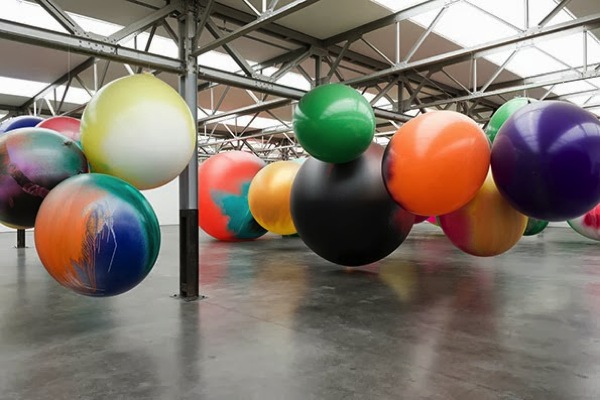
Spotted this installation near the corner of 33rd and Lex a few weeks ago. Despite the bitter cold, people kept stopping to play. Does anyone know whose work this is?

Ball is the universal toy!

18 November 2009
The Daily Show With Jon Stewart Mon – Thurs 11p / 10c
Windowless News Van for Kids – The Ball
www.thedailyshow.com
Daily Show
Full Episodes
Political Humor Health Care Crisis

Monday night on the Daily Show, Jon Stewart took the National Toy Hall of Fame to task for waiting so long to induct the ball into its hallowed ranks. In this segment, he rails against the institution for selecting “stick” and “cardboard box” years before the ancient and essential “ball.”

I like that the National Toy Hall of Fame is celebrating simple playthings, not just the latest craze coming out of Mattel and Hasbro’s factories. The truth is that the most stimulating toys are the most open-ended, a point I raised a few months ago in a post on aesthetics of play, and the ball is the most infinitely malleable toy out there. Having a ball means having a game, whether you’re bouncing it against a wall or playing with dozens of others on teams. Surely everyone has a childhood memory of a game they played with a ball where the rules were some imaginative variation on an existing game. My best friend Annie and I invented “pancake-turner ball,” which was a cross between keep-up and tennis played with two spatulas and an over-sized tennis ball.

Like Stewart, it strikes me as ridiculous that it could take so long (11 years!) to get ball into the Toy Hall of Fame. So, congrats Ball, on your long-overdue honor!